Grant (automobile)
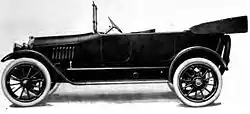
The Grant Motor Co was an American automobile manufacturing company from 1913 to 1922, based in Findlay, Ohio.[1][2] The company produced several thousand four- and six-cylinder automobiles, and exported cars to England as Whiting-Grant.[1] In 1916, a five-passenger touring car produced by the company sold for US$795.[2]
History
Grant Bros. Auto Co.
The history of the Grant automobile can be traced back to at least 1907 with the Grant Bros. Auto Co. in Detroit. Where the brothers George D. Grant and Charles A. Grant were running an automobile dealership in Detroit selling Thomas Flyers, Thomas Detroit, and Buick cars. Their locations were at 1000 Woodward Avenue and 742 Woodward Avenue.[3]
One of the Grant Brothers on May 2 1908 would participate on a three day 400 mile reliability run in the Detroit area. Grant would be driving a 40 horsepower Thomas Detroit. Another employee would drive a Thomas Forty. The roads were rough and unpaved and many cars had breakdowns and a few did not finish. Both cars driven by the Grant Bros. Co. would earn perfect scores.[4]
By 1910 Grant Bros. was selling Chalmers cars exclusively.[5] this would later change to Everitt and then to Lozier.

Grant Bros. would have an unusual arrangement where their dealership would occupy half of the building, the other half being occupied by the Winton Motor Carriage Company. The 97x20 foot building would be split in half with the left side being used by Grant and the right side being used by Winton. [6]
1914 would be the last year that Grant Bros. would be mentioned by trade journals or advertisements. By 1914 the purpose of Grant Bros. was to distribute Grant built cars for Michigan. Presumably in 1914 Grant Bros. would either crease to exist or would be absorbed by the successor firm.[7]
Grant Motor Company
On May 24th 1913 the Grant Motor Co. would be incorporated in Detroit with a capitalization of $100,000 to manufacture cyclecars. The Grant brothers would lead the firm with George acting as president and Charles as vice president and sales manager. David Shaw would be the company's secretary and treasurer along with G.F. Salzman and J.M. Howe who would work as manager and engineer respectively.[8] Citing overwhelming demand for their cars and a need to produce enough vehicles capitalization would be increased from $100,000 to $165,000 and then later to $200,000 to fund the expansion of the company.[9]
In late 1913 production would shift from Detroit to Findlay Ohio after less than a year of manufacturing in Detroit. The reason for the move to Findlay was that there was a vacant factory that was previously occupied by the Findlay Motor Company. Findlay Motor Company had been placed into the hands of a receiver two years prior. Grant publicly apologized for leaving Detroit, but with enough supplies to make over 5000 cars, and probably a factory not large enough to build such a quantity quickly enough, a larger factory was necessary for success. Shortly after purchasing the plant the supplies were moved from Detroit to Findlay.[10]
Models
Model M
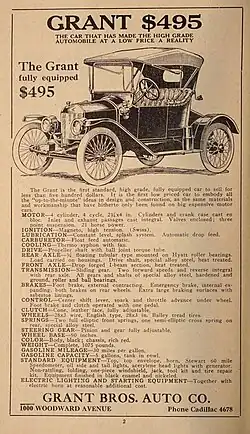
The first car offered by Grant would be the Model M. A small cyclecar with seating for two that would go on sale in early 1913. The car would be offered in one body style only with left hand drive and center controls. The Model M would be powered by a 16 horsepower four cylinder L head engine that was made in-house. A Mayer carburetor and Bosch magneto were standard. Cooling was by thermo-syphon with no water pump. There were two forward gears and a reverse. Advertising indicated that the car could achieve 30 to 35 miles per gallon.[11] The initial price was $495, but would be reduced to $425 for mid 1914. Gas lighting would be standard, but for $80 a buyer could get electric lights and an electric starter. The weight was 1,075 pounds.[12]
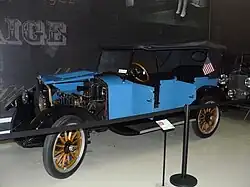
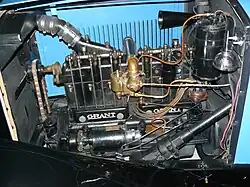

Overview of production figures
| Year | Production | Model | Serial number |
|---|---|---|---|
| 1913 | ~200 | M | 0 to ~199 |
| 1914 | ~ 2834 | M [13] | ~199 to 3033 |
| 1915 | 2054 | T | 5000 to 7053 |
| 1916 | 4003 | V | 10000 to 14002 |
| 1917 | 12001 | K | 15000 to 27000 |
| 1918 | ~ 5000 | G | 30001 to ~35000 |
| 1919 | ~ 5000 | GX | ~ 35000 to 40001 |
| 1920 | 6000 | H [14] | 50001 to 56000 |
| ↑ | HX | ↑ | |
| 1921 | ~ 5000 | HY | 60001 to .. |
| ↑ | HZ | ↑ | |
| 1922 | ~ 2000 | HZ | 65000 to .. |
| Sum | ≥ 50.000[15][16] |
See also
References
- ^ a b Wise, David Burgress (2000). The New Illustrated Encyclopedia of Automobiles. Chartwell Books. ISBN 0-7858-1106-0.
- ^ a b Automobile Year Book. Automobile department of McClure's magazine, The McClure Publications, inc. 1916.
- ^ Automobile Topics. 1907. p. 176.
- ^ Motor Age. Vol. XIII No. 19. May 7, 1908. p. 5.
- ^ The Automobile. June 16, 1910. p. 1113.
- ^ Cycle and Automobile Trade Journal. 1910. p. 135.
- ^ Motor World. April 22, 1914. p. 35.
- ^ The Automobile. May 29, 1913. p. 1106.
- ^ The Hub. October 1913. p. 253.
- ^ Automobile Topics. December 6, 1913. p. 264.
- ^ The Automobile. June 26, 1913. p. 1320.
- ^ Motor World. August 12, 1914. p. 23.
- ^ "Grant M". Carette. America's first carette and cyclecar V. 1(1913-1914). 1914-09-01. Retrieved 2025-08-30.
- ^ "Grant Model H". Cleveland Public Library. Fine Arts and Special Collections Department. 1921-01-01. Retrieved 2025-09-02.
- ^ "Grant Production". Branham automobile reference book, showing in illustrated form the location of motor and serial numbers on all passenger cars and trucks 1923. 1923-01-01. Retrieved 2025-08-30.
- ^ "Grant Production till 1921 p. 3". Cleveland Public Library. Fine Arts and Special Collections Department. 1921-01-01. Retrieved 2025-09-02.
External links
- Grant Six Model H (1921)