The Darlington constituency is located in County Durham and covers most of the Borough of Darlington. It contains the large town of Darlington and some villages and rural areas to its north and west, including Heighington. Historically a small market town,[3] Darlington grew in population during the late 19th century as a centre for railway manufacturing.[4] The town has high levels of deprivation, with much of it falling within the 10% most-deprived areas in England, although the south-western suburbs of Hummersknott and Blackwell are affluent.[5]
On average, residents of Darlington have lower levels of income, education and professional employment compared to nationwide figures, and house prices are low. At the 2021 census, White people made up 94% of the population.[6] At the local borough council, most of the town is represented by Labour Party councillors, whilst Conservatives and Greens were elected in the rural areas and the wealthy south-west of the town. An estimated 57% of voters in Darlington favoured leaving the European Union in the 2016 referendum, above the nationwide figure of 52%.[6]
Boundaries
1868–1885
Under the Reform Act 1867, the proposed contents of the new parliamentary borough were defined as the townships of Darlington, Haughton-le-Skerne, and Cockerton.[2] However, this was amended under the Boundary Act 1868, with the boundary defined as being coterminous with the Municipal Borough of Darlington.[7]
The boundaries were adjusted in 1918, 1950 and 1973 to reflect changes to the boundaries of the county borough.
1983–2010
The Borough of Darlington wards of Bank Top, Central, Cockerton East, Cockerton West, college, Eastbourne North, Eastbourne South, Harrowgate Hill, Haughton East, Haughton West, Hummersknott, Lascelles, Lingfield, Mowden, Northgate North, Northgate South, North Road, Park East, Park West, and Pierremont.[11][12]
No change to boundaries.
2010–2024
The Borough of Darlington wards of Bank Top, Central, Cockerton East, Cockerton West, College, Eastbourne, Faverdale, Harrowgate Hill, Haughton East, Haughton North, Haughton West, Hummersknott, Lascelles, Lingfield, Mowden, Northgate, North Road, Park East, Park West, and Pierremont.[13]
The Borough of Darlington wards of: Bank Top & Lascelles; Brinkburn & Faverdale; Cockerton; College; Eastbourne; Harrowgate Hill; Haughton & Springfield; Heighington & Coniscliffe; Hummersknott; Mowden; North Road; Northgate; Park East; Park West; Pierremont; Red Hall & Lingfield; Stephenson; Whinfield.[14]
The constituency was expanded slightly to bring the electorate within the permitted range, by adding the rural ward of Heighington & Coniscliffe from the abolished constituency of Sedgefield.
Political history
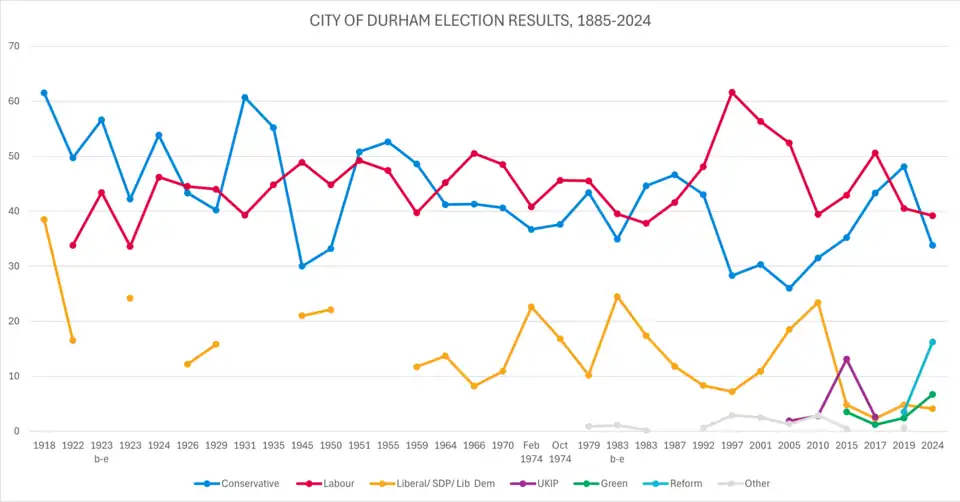
The seat has been held by all three major parties in its long existence, but has been a marginal constituency between the Labour and Conservative parties in the years since the Second World War. Labour held the seat for 27 years from 1992 with their candidate Jenny Chapman winning the seat in 2010 with a 3,388 majority down from 10,404 in the previous election. In 2015, her majority over the Conservatives fell to 3,158. In the 2019 general election Conservative Peter Gibson defeated Chapman with a 3,294 majority before being defeated himself in 2024 by Lola McEvoy of Labour by a margin of 2,298
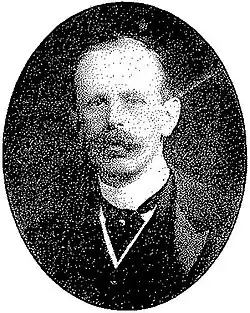
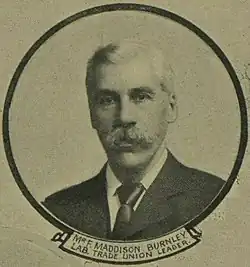
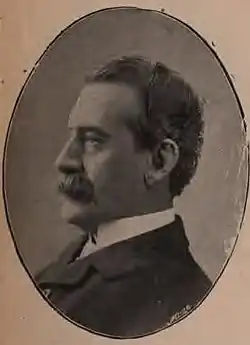
Another General Election was required to take place before the end of 1915. The political parties had been making preparations for an election to take place and by July 1914, the following candidates had been selected;
^As with all constituencies, the constituency elects one Member of Parliament (MP) by the first past the post system of election at least every five years.
^Craig, Fred W. S. (1972). Boundaries of parliamentary constituencies 1885–1972;. Chichester: Political Reference Publications. pp. 11, 59, 129. ISBN 0-900178-09-4. OCLC539011.
^"Archived copy"(PDF). Archived(PDF) from the original on 15 November 2019. Retrieved 15 November 2019.{{cite web}}: CS1 maint: archived copy as title (link)
^ abcCraig, F. W. S., ed. (1977). British Parliamentary Election Results 1832–1885 (e-book) (1st ed.). London: Macmillan Press. ISBN 978-1-349-02349-3.
^"H K Spark's Candidature". Durham Chronicle. 17 July 1868. p. 7. Retrieved 6 February 2018 – via British Newspaper Archive.

_001.jpg)