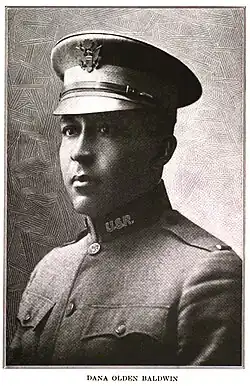
Dana Olden Baldwin
Dana Olden Baldwin | |
|---|---|
 | |
| Born | March 20th, 1881 |
| Died | November 9, 1972 (aged 91) |
| Resting place | Baldwin Family Cemetery, Apex Wake County, North Carolina, US |
| Education | Leonard Medical School (1910) |
| Occupation | physician |
| Title |  First Lieutenant First Lieutenant |
| Spouse | Vina A. Flood |
| Children | Mattie Ruth; Mae and Rosa (adopted) three boys (foster) |
Dana Olden Baldwin, M.D. (March 20, 1881– November 9, 1972) was a prominent African American physician in Martinsville, Virginia. He served in World War I as a medical officer until he was honorably discharged in 1918. In addition to his medical practice, Baldwin was a successful African American businessman, with ventures including the Baldwin Business Center, St. Mary's Hospital, and Sandy Beach Resort. His businesses operated under racial segregation of Jim Crow laws, which prevented Black customers from entry to white establishments. Baldwin Memorial Park was named in his honor.
Early life
Baldwin was born on March 20, 1881, in Belvoir, North Carolina, and was the oldest child of Reverend James Hayes and Mary Crutchfield Baldwin. His father was a Methodist priest. Baldwin's paternal grandfather, Jerry Baldwin, and maternal grandmother, Margaret Crutchfield, were both slaves.[1] Baldwin worked as a farm worker from a very young age and displayed his intelligence by graduating from the Apex Normal and Industrial Institute at the age of 16 in 1897. Following graduation, Baldwin attended Shaw University, a historically Black college in Raleigh, North Carolina.
The years before the war, Baldwin found it difficult to maintain his practice but found that it grew more each year by the growing African American population. Baldwin married a woman named Vina in 1911. They were situated on Fayette Street, the heart of Martinsville's African American business district.[2] At the start of World War I, Baldwin was 36 years old and immediately he volunteered.[3]
Military service
Upon entry into the military, Baldwin was commissioned to the Medical Reserve Corps and sent for basic training at Fort Des Moines Provisional Army Officer Training School. Military service was racially segregated during WWI. Following a huge influx of African American volunteers and ongoing advocacy by the NAACP and administrators and students at Historically Black colleges and universities (HBCUs), the first officer candidate class for African Americans was held at Fort Des Moines in 1917. He was awarded the rank of First Lieutenant. However, there was still some discontent at the facility as many soldiers found that he had been unfairly assessed for merely being Black.[4] This or friction with his superior might have been a factor in Baldwin submitting his resignation from the 368th Ambulance Company of the 92nd Division, 317 Sanitary Train post he had been assigned.[5]
Once he arrived in France, Baldwin had the main responsibility of handling sanitation concerns, surgery duties and hospital illnesses. Much of the 92nd Infantry Division was involved with trench warfare and were aiding the French in pushing back the German forces, who sent a large number of gas attacks into the field.[6] However, Baldwin found himself mostly concerned with the breakout of influenza which came in September 1918. A large portion of the Baldwin's patients mostly consisted of illness. The war came to a close in 1919, and Baldwin was honorably discharged on April 2.[3]
Career
Baldwin returned to Martinsville, and resumed working in his practice. It was after his military service that Baldwin really began to put an active effort in improving the conditions of the African American community. In the Virginia edition of The History of the American Negro, Dr. Baldwin stated that in order for the African American community to prosper, people should start "by advocating and working for better schools, better churches... by seeing to it that children are instructed in civic duty in the schools and taught the importance and power of the ballot.[7]
Many of the white hospitals in the area had barred entrance or denied care for African Americans. In 1929, Dr. Baldwin opened a 27-bed facility meant to treat the poor African American population unable to afford or enter other hospitals. It was named St. Mary's, for his mother who had encouraged him to study medicine. He coordinated with a younger brother who'd owned his own pharmacy. The area was designated "Baldwin Block". Baldwin opened a number of other businesses in the 1920s and 1930s, including the Sandy Beach Resort, Baldwin Miniature Golf Course, Baldwin's Gymntorium and Baldwin Business Center. All these facilities were opened to the African American community as the many white institutions were barred because of the Jim Crow laws.
Dr. Baldwin was also a heavy contributor for a number of churches and societies, including AMR Church, the Masons, Odd Fellows, Magic City Medical Society and The National Medical Association. Dr. Baldwin was given media attention after treating an African American man for a broken leg and forced the police department to pay his bill regarding the injury. Baldwin continued his practice for 60 years and never retired.
Death and legacy
Dr. Baldwin died of a stroke on November 9, 1972. He was buried in Wake County, North Carolina, in the Baldwin Burial site, where a number of his family are also buried.
Dr. Baldwin was well remembered in the Martinsville community as being selfless and working with all his might to provide a brighter future for his brethren. Virginia Humanities dedicated the Dr. Dana O. Baldwin Memorial Park, situated in Baldwin Block.[8] There are also a number of streets in the area named after him. St. Mary's stayed open until 1952 and was memorialized in an exhibit made by Virginia Humanities.[8] Baldwin was honored as one of the Strong Men & Women in Virginia History by the Library of Virginia in 2018.[9]
Personal life
On December 24, 1911, Baldwin married Vina S. Flood, daughter of L. F. and Elizabeth Flood. Vina had been educated in Hartshorn Memorial College and was a teacher in a number of local public schools. The couple could not have children of their own. Later in their marriage they adopted two girls: Mae and Rosa Baldwin.
Prior to adopting, Dr. Baldwin had a daughter named Mattie Redd in 1926. Mattie's mother, Lucy Redd, was from Martinsville, VA. As a teenager, Mattie worked on the Baldwin Block in her father's store, pharmacy, and hospital as did his foster children. Mattie spent several years in Dr. Baldwin's and Mrs. Vinny's life. Mattie married Alfred Williams II and they lived in Columbus, Ohio, but frequently visited Dr. Baldwin. In 1972, Mattie returned to Martinsville when Dr. Baldwin's health began to fail. She cared for him prior to his death from a stroke that same year. Mattie's relationship to Dana Olden Baldwin, as well as her children's relationship to Dana Olden Baldwin (and his siblings) has been verified through ancestry.com.
References
- ^ Caldwell, Arthur Bunyan (1917). History of the American Negro and his institutions; (Volume 5). Atlanta, Georgia: A. B. Caldwell Publishing Co. pp. 289–290. ISBN 978-1149335567.
{{cite book}}: ISBN / Date incompatibility (help) - ^ "Baldwin Block (including the Dr. Dana O. Baldwin Memorial Park)". Virginia Foundation for the Humanities. 14 June 2023 – via African American Historical Sites Database.
- ^ a b Buckley, Joann H.; Fisher, W. Douglas (2016). African American Doctors of World War I: The Lives of 104 Volunteers. Jefferson: McFarland & Company, Inc. pp. 22–23. ISBN 9781476663159.
- ^ Barbeau, Arthur E.; Henri, Florettte (1996). The Unknown Soldiers: African American Troops in World War I. New York: Da Capo Press. pp. 60–61. ISBN 0-306-80694-0.
- ^ Reports, Documents, and Journals of the U.S. Senate and House of Representatives. (1918). Congressional Serial Set : Noncombatant Commissioned Officers of the Army. Washington D.C.: U.S. Government Printing Office. p. 114.
{{cite book}}: CS1 maint: multiple names: authors list (link) - ^ Buckley, Joann H.; Fisher, W. Douglas (2016). African American Doctors of World War I: The Lives of 104 Volunteers. Jefferson: McFarland & Company, Inc. pp. 20–21. ISBN 9781476663159.
- ^ Caldwell, Arthur Bunyan (1917). History of the American Negro and his institutions; (Volume 5). Atlanta, Georgia: A. B. Caldwell Publishing Co. pp. 289. ISBN 978-1149335567.
{{cite book}}: ISBN / Date incompatibility (help) - ^ a b "Baldwin Block (including the Dr. Dana O. Baldwin Memorial Park) - African American Historic Sites Database". 14 June 2023.
- ^ "Strong Men & Women in Virginia History 2018 · Virginia Changemakers". www.lva.virginia.gov. Retrieved 2026-01-29.