Chashme Buddoor (1981 film)
| Chashme Buddoor | |
|---|---|
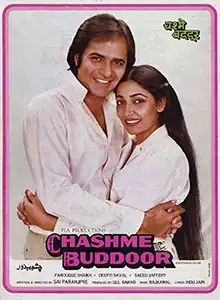 Poster | |
| Directed by | Sai Paranjpye |
| Written by | Sai Paranjpye |
| Produced by | Gul Anand Jayshree Anand-Makhija (uncredited) |
| Starring | Farooq Sheikh Deepti Naval Saeed Jaffrey Rakesh Bedi Leela Mishra Ravi Baswani |
| Cinematography | Virendra Saini |
| Edited by | Om Prakash Makkar |
| Music by | Raj Kamal |
| Distributed by | P.L.A. Productions |
Release date |
|
Running time | 145 minutes |
| Country | India |
| Language | Hindi |
Chashme Buddoor (transl. Far be the evil eye) is a 1981 Indian Hindi-language romantic comedy film written and directed by Sai Paranjpye. The film stars Farooq Sheikh, Deepti Naval, Saeed Jaffrey, Rakesh Bedi, Leela Mishra and Ravi Baswani. The story revolves around three close friends, two of whom (Bedi and Baswani) fall in love at first sight with a girl (Naval), but fail to woo her. After discovering that the third friend (Sheikh) is dating the girl, they plot to end their relationship.
After watching Sparsh at a film festival, producer Gul Anand, asked its writer/director Paranjpye for an escapist film, who then came up with an idea which after some input from Anand would form the screenplay. Principal photography took place in Delhi. The music was composed by Raj Kamal. Themes include Delhi itself, bachelorhood, romance and parody of Hindi film clichés.
Chashme Buddoor had its release on 8 May 1981. The film was a box-office hit, and is considered a classic now. It has since gained a cult following. Two remakes, Malayalam-language Odaruthammava Aalariyam directed by Priyadarshan and Hindi-language Chashme Baddoor directed by David Dhawan were released in 1984 and 2013, respectively.
Plot
Siddharth Parashar, Omi Sharma and Jomo Lakhanpal are close friends and roommates who are enrolled in Delhi University. While Siddharth loves to spend most of his time studying, and has an M.A. in Economics and is preparing for Ph.D, Omi and Jomo are mostly busy chasing girls. The only thing common among the three of them is smoking. They buy cigarettes from a local paan shop owned by Lallan Miyan.
One day, Omi and Jomo spot a girl named Neha Rajan from their balcony and try to impress her one by one by their antics. However, both of them gives up after going through shameful experiences.
After a few days, Neha visits their flat as the salesgirl of Chamko washing powder. Omi and Jomo quickly hide, as soon as they spot her from the peep hole. Siddharth meets Neha, and after a conversation, sparks fly, and they soon begin to date and love blossoms between them. They begin to consider marriage. Meanwhile, he also gets a job in a company, whose manager happens to be Neha's father, a fact that Siddharth is not aware of. He gets impressed by Siddharth, and sees a prospective son-in-law in him, unaware in his turn that his daughter is already dating him. However, one day, Omi and Jomo accidentally discover Siddharth and Neha together. In a fit of jealousy, they plot to end their relationship, which would also help them avenge the embarrassment inflicted upon them by Neha. They successfully character assassinate Neha, and Siddharth soon breaks up with her. Depressed and melancholic, he begins to lose interest in his work.
After accidentally discovering poison, Omi and Jomo, mistakenly thinking Siddharth is considering suicide, confess everything. Siddharth visits Neha, who is not responsive towards the abrupt change in his behaviour. Neha's grandmother, seeing Neha's predicament decides to take matters in her own hands and visit Siddharth, who happens to be outside. Omi and Jomo, who has never seen her, finds out who she is, and together they form a trio and decide to reunite the couple. As a spate of kidnapping, especially of young girls, is taking place in Delhi, they plan a fake kidnapping attempt of Neha, which is to take place outside a temple where her grandmother will take her. Siddharth gets cryptic and vague instruction by Omi and Jomo to be there too, so that he can witness the kidnapping, 'save' her and reconcile their relationship. However, she is kidnapped by the real gang and the trio is left in the lurch. Siddharth, rightly assuming the kidnapping as real, fights them and hands them over to police who arrives at the scene with Lallan Miyan, Omi and Jomo. Siddharth and Neha profess their love to each other and gets married.
Cast
- Farooq Sheikh as Siddharth Parashar
- Deepti Naval as Neha Rajan
- Saeed Jaffrey as Lallan Miyan, the local paan shopkeeper
- Rakesh Bedi as Omi Sharma, Siddharth's roommate and friend
- Leela Mishra as Dadi Amma, Neha's grandmother
- Ravi Baswani as Jomo Lakhanpal, Siddharth's roommate and friend
- Vinod Doshi as Neha's father
- Ranjan Grewal as Neha's brother
- Amitabh Bachchan as himself
- Rekha as herself
- Kimti Anand as the waiter (uncredited)[1]
- Sai Paranjpye as a customer to Lallan Miyan (uncredited)[2]
- Vinod Nagpal as music teacher (uncredited)[3]
Production
Development
After watching Sai Paranjpye's debut Sparsh at the Tashkent Film Festival, producer Gul Anand asked her for a "pure fun, feel-good film with no social message." She wrote a teleplay for Doordarshan, Dhuan Dhuan, about three friends, who one by one, try to befriend a girl, whom they saw from their terrace, and all of whose efforts go up in smoke (dhuan). Anand liked it, but wanted one of the three to be a "hero material: sensible, studious, helpful, hard-working," whose love story should "blossom, not go up in smoke." Paranjpye acknowledged that many key features of the story such as the character of Sheikh, his romance, the elderly personae, were all additions made at the behest of Anand.[4][5] Some elements were also borrowed from 1981 Tamil-language film Indru Poi Naalai Vaa.[6] The film was originally titled Dhuan Dhuan, but it was to change, much to Paranjpye's initial chagrin, until she came across the expression chashme buddoor (may the evil eye be kept away).[5][7]

Paranjpye acknowledged the influence of American sophisticated comedies and the works of Charlie Chaplin. Even though expressing admiration for Hrishikesh Mukherjee, she admitted that neither him nor her contemporaries influenced the production of the film.[8] "In Chashme Buddoor the best work was of Paranjpye. She wrote such a good script and (also) successfully extracted that out of us on screen as well. The film was 80 percent Paranjpye's efforts," Farooq Sheikh stated.[9] The kidnapping idea could have been inspired by actual kidnapping-murder of two young siblings that took place in the late 1970s Delhi.[10]
The film was produced uncredited by Jayshree Anand-Makhija.[2] It has been called a romantic comedy.[a]
Casting
Poonam Dhillon was originally considered for the role of Neha.[7] Paranjpye wanted Deepti Naval, "an actor who did not look larger than life, rather someone who the youth of the country would relate to," who was then eventually cast.[14] The washing powder Chamko, used in the film, which Naval's character sells, was actually a brand available in the market at that time.[15] Naval got the moniker of Miss Chamko after the film.[16] Sheikh and Naval went on to make Saath Saath, Katha, Kissi Se Na Kehna, Rang Birangi, Faasle and Listen... Amaya together.[7]
Saeed Jaffrey spent an inordinate amount of time with 50-odd paan-kiosk owners of Old Delhi in honing his character, Lallan Miyan, "to observe the body language, mannerisms, language and its nuances," Paranjpye wrote. He was actually taken for a real paanwala (paan vendor), as someone tried buying paan from him.[5]
Sheikh's fellow IPTA (Indian People's Theatre Association)-mate Rakesh Bedi was simultaneously shooting for the film Apna Bana Lo, where his character was clean shaven, and Chashme Buddoor, where his character Omi sported a thin-line moustache. To circumvent this, he'd go to the washroom and draw a line with pencil a few inches above his lips before each shoot. One day, while he was wiping his face, half of the line got erased; he only found out when Sheikh couldn't control his laughter. Paranjpye was furious at this.[5]
Naseeruddin Shah, who had known Ravi Baswani from the latter's theatre days in Delhi, was visiting Delhi when Baswani happened to read Paranjpye's script for Sparsh. Impressed, Baswani begged Shah to recruit him as his spot boy, who was then eventually hired for props. Baswani liked to joke that it's entirely possible that Paranjpye offered him Chashme Buddoor as a "bonus" for his backstage work in Sparsh.[17] Jayant Kripalani was originally considered for the role of Jomo.[18]
Vinod Doshi was the chairman of Premier Automobiles Limited.[11] Kimti Anand and Vinod Nagpal had a background in theatre and Doordarshan serials.[3]
Filming
Principal photography took place in Delhi.[19] About the flat where Siddharth, Omi and Jomo lived, Paranjpye said that, "we found an ideal flat in Defence Colony. A roomy hall with a terrace running around it. An additional staircase for quick getaways made it perfect for some of our scenes."[10] "The unit lived in that house," Aditya Arya, still photographer of the film, recalled.[5] Found in Vasant Vihar, South Delhi; Neha's home was described by Paranjpye as a "neat little doll’s house, complete with a garden."[10]
The open garden restaurant scenes were shot in Talkatora Garden.[20] Siddharth, Omi and Jomo meet outside Central Cottage Industries Emporium, Janpath, Connaught Place (since relocated); the three of them were flying balloons in the garden surrounding India Gate (since restricted); the three of them could be seen passing Purana Qila on their bike.[5] Jomo leaving the clinic after getting beaten was shot in Khan Market; Siddharth picks Neha in Mandi House; Lutyens' Delhi could be seen during the motorcycle rides of Siddharth and Neha;[11] the paan stall was located in Nizamuddin, Mathura Road, South Delhi;[10] Omi's dream sequence was filmed on Badkhal Lake, Faridabad; and the climax was filmed on the slopes of Tughlaqabad Fort.[5]
Paranjpye said that Sheikh was "disciplined to a fault. Never touched cigarettes or liquor." To show a "chain-smoking hero" she'd "cut the shots as soon as he raised the cigarette to his lips.[5]
Meena Kumari in Sahib Bibi Aur Ghulam, Zeenat Aman in Qurbani, Sadhana in Rajkumar and Nutan in Paying Guest were parodied during Omi's fantasy scene where Neha auditions for him[12]
Post production
The film originally featured a different ending which was discarded because the producer thought that it was not commercially viable.[19] It was Paranjpye's second film to be completed, but the first to be released, because Basu Bhattacharya, producer of her debut film Sparsh, didn't choose to release it until later.[4]
Soundtrack
All the songs were composed by Raj Kamal and penned by Indu Jain.[21]
| # | Title | Singer(s) | Duration |
|---|---|---|---|
| 1 | "Kahan Se Aaye Badra" | K. J. Yesudas, Haimanti Sukla | 07:38 |
| 2 | "Is Nadi Ko Mera" | Shailendra Singh, Haimanti Shukla | 05:50 |
| 3 | "Kaali Ghodi Dwar Khadi" | K. J. Yesudas, Haimanti Sukla | 05:36 |
| 4 | "Karna Tha Inkar" (parody song) | 03:37 | |
| 5 | "Ansoon Ki Aarti" | Haimanti Sukla | 03:26 |
| 6 | "Kaise Ho Pagal" | Raj Kamal, Haimanti Sukla | 05:00 |
| 7 | "Pyaar, Lagawat, Pranay, Mohabbat" | Anand Kumar C., Shailendra Singh, Hariharan | 04:38 |
In addition, Mehdi Hassan's "Ye Dhuaan Sa Kahan Se Uttha Hai" opens the film, and "Hum Tum Ek Kamre Mein Band Ho" (Bobby) plays on the radio when Siddharth and Neha first meet.[11][16]
Furthermore, "Pyar Kiya To Darna Kya" (Mughal-e-Azam), "Aap Jaisa Koi" (Qurbani), "Tumne Pukara Aur Hum Chale Aaye" (Rajkumar) and "Chhod Do Aanchal, Zamana Kya Kahega" (Paying Guest) were parodied.[22]
Themes
Describing her film as a heartfelt tribute to Delhi, Sai Paranjpye wrote that the "film would explore the length and breadth of the beautiful city and lay bare its soul."[8][10] Rakesh Bedi, who hails from Delhi, said, "Delhi is a character in Chashme Buddoor. I’ve not seen Delhi so participative in a film. Films may have been shot there, but without naming the places or going overboard in showing the locations; the beautifully picturised city became an integral part of the narrative." Aditya Arya, still photographer for the film, said, "Delhi was like a village before that." Chashme Buddoor, shot right before, "will remain a visual-history lesson of what Delhi used to look like."[5] Namrata Joshi said "it makes you long for Delhi of the '80s, quiet and laidback."[3] Aseem Chhabra has called Chashme Buddoor "an ode to Delhi long gone." Elaborating, he said that Defence Colony, where the three friends shared a barsaati, "is now home to expats – journalists working for foreign publications, diplomats, and Indians with strong business ties. Students cannot imagine living in Defence Colony now;" the garden surrounding India Gate, where the three friends were flying balloons, "is now a restricted area as the government has dug up most of green space for the planned Central Vista Redevelopment Project;" Mathura Road, where the paan stall was erected used to be "practically empty." Though, counterpointing, he argued that through the kidnappings, "Paranjpye was definitely hinting at the fact that all was not well in the serene Delhi she presented to the audience."[10] Similarly, The Hindu wrote, "those were times stalking did not exist. When Jai exclaims girl, there is no malice in his intent." Bedi remarked, "terms like voyeurism were unknown then."[11] Deccan Herald commented, "protagonists' cheesy pick-up lines were never offensive."[23]
Dinesh Raheja remarked, "Paranjpye seems to be a fan of Hindi cinema, laughing at and simultaneously drawing on regular Hindi film staple," pointing out songs in a park, appearances by Bachchan and Rekha and parody of songs from films ranging from Mughal-e-Azam to Teesri Manzil.[18] Filmfare also noted, "scenes where Baswani and Bedi take turns in explaining their fake romantic overtures with Naval are classic examples of parody."[2] Similarly, Arushi Jain pointed out the scene where "Siddharth and Neha make fun of Bollywood’s classic trope of lovers breaking into a song randomly in a park."[16] Referring to the same scene, Sudhish Kamath wrote how they were "laughed at by the regulars at the park" when they attempted an impromptu duet.[24] Bollywood Hungama points out the scene where the waiter was told to come back later, who then in turn said that he would be back after interval "right at the stroke of actual interval of the film."[22] Deccan Herald commented, "lovers avoid being filmy, but don't mind if they woo one another with songs and poetry."[23] Joshi pointed out the titles where a woman's hands replaced the man's in the director credit.[3]
Nivedita Mishra wrote, "Sheikh and Naval was what middle-class romantic couples looked like, even the college going ones. There was warmth, friendship and an innate civility about their onscreen romance."[6] Deccan Herald wrote that the film "harks back to that era of innocence when college students chased girls all across town hoping to get them to agree to a coffee or a movie. Sex, if at all, was never discussed," commenting further that Siddharth and Neha "decide to forge a relationship probably because they haven't met too many potential soul-mates to choose from."[23] Joshi called the film about "the times when jaunty young men could fall for girls in two-plait hairstyle."[3] Raheja said, "in keeping with Sai's signature, her heroine refuses to kowtow or pander to politically correct feminist sentiments," pointing out Siddharth suggesting Neha to quit her job after marriage, which she assents to after finishing her Tutti frutti ice-cream.[18] Joshi called "the theme of friendship, jealousies and misunderstandings coming in the way of love" timeless.[3]
"Paranjpye captures the essence of bachelor life so beautifully," The Hindu wrote, "the room-sharing experience a lovely throwback to days when it was a necessity in student life."[11] Filmfare wrote, "it was funny and equally insightful about young men at the time."[2] Jain jokingly referred to the scene where Siddharth offers Neha a homemade laddu in a cup, "of course, how can you expect a bachelor pad to have proper utensils."[16] Joshi pointed out coconut shell ashtrays.[3] Deccan Herald called the film a "heartwarming window into the soul of the middle-class," and thought that the trio smoking all through the film were "a sign of those relatively innocent times when youngsters smoked because they thought they looked cool doing so."[23] Farooq Sheikh said, "Paranjpye had a great eye for detail, for picking up the commonness of life and celebrating that."[25]
In comparing the film's "nothing"-ness to Seinfeld, Mahmood Farooqui wrote, "how little it was about anything, justifying the epithet 'breezy' that has come to be forever associated with Sai."[4] Deccan Herald pointed out how "the characters, who inhabit the middle-income group are untouched by suffering," and how the film is "strewn with a warm bonhomie that suggests a sense of equilibrium in the universe even when human intentions are far from legitimate or sensible."[23]
Pointing out the scene when Siddharth and Neha first meet, Jain wrote, "this entire scenario might be hard to comprehend for a generation that can’t look up from their phones for a second – let alone invite someone in for five minutes."[16]
Release

Chashme Buddoor had its release on 8 May 1981.[13] A digitally restored version of the film was released in 40 screens domestically, alongside its remake on 5 April 2013, a first for India, when the original and the remake were released simultaneously.[19][24]
Reception
Chashme Buddoor was a box-office hit.[b]
In 1981, Chander Uday Singh of India Today wrote that the film was "cleverly handled, it sticks to a formula plot and goes through with the song-and-fight routines, spoofing contemporary films and film stars without being substantially different from the subjects of the spoof yet it manages to be both fresh and funny."[12] In 2003, Dinesh Raheja of Rediff wrote, "Chashme Buddoor is that rare comic Hindi film which is funny without being puerile. It carries a sting in many of its punchlines, which add a knockout little coda after the completion of the main scene, and fluidly strings together funny set pieces."[18] In 2013, Deccan Herald commended Paranjpye for "ably straddling the two worlds of a superior intellectual projection of cinematic conventions and mass entertainment."[23] In 2014, The Hindu wrote, "the magic that Paranjpye created. It is worth watching for its simplicity."[11] In 2023, Arushi Jain of The Indian Express called the film watchable, but did not strongly recommend it because of "the voyeuristic overtures" of its cast, pointing out the scenes where Omi and Jomo chase and check out women, and refer to them as preys, in addition to Siddharth pushing Neha to quit her job.[16] In 2024, Namrata Joshi of Outlook praised the acting, pacing, writing, climax, score and an uncanny eye for detailing "right down to the banal chore of the grandmother: filling achar from a huge martbaan into a small bottle."[3]
Sheikh's performance was praised by Raheja, who stated, "in comic subtlety, he has few rivals."[18] Singh, who said that he looked "just right,"[12] Jain,[16] and The Hindu.[11] Naval's performance was praised by Raheja, who stated that she "looks every inch the girl-next-door and is at her lustrous best in the Chamko scene,"[18] Jain,[16] and The Hindu.[11] In contrast, Singh said that she "carries off the part a little too well."[12] Jaffrey's performance was praised by Singh, who stated that he was "superb, and his acting lifts the movie out of any mundane slots it might have dropped into,"[12] Jain,[16] and The Hindu.[11] Bedi's performance was praised by Singh,[12] Jain,[16] and The Hindu.[11] Baswani's performance was praised by Shaikh Ayaz, who called him a "comic genius who brings a touch of zaniness and Bollywood struggler vibe to the role,"[17] Tanushree Ghosh, who labeled him the "funny bone" of the film,[5] Raheja, who stated that he "displays tremendous comic brio for a first-timer,"[18] Singh,[12] Jain,[16] and The Hindu.[11]
The film is considered a classic now.[c]
It has since gained a cult following.[d]
Accolades
At the 29th Filmfare Awards, the film received five nominations[13]:
Nominated
- Best Film – Gul Anand
- Best Director – Sai Paranjpye
- Best Supporting Actor – Saeed Jaffrey
- Best Comedian – Rakesh Bedi
- Best Comedian – Ravi Baswani
Remakes
A Malayalam-language remake, Odaruthammava Aalariyam, directed by Priyadarshan was released in 1984.[11]
Sai Paranjpye was reportedly appalled and disapproving that a Hindi-language remake, Chashme Baddoor, was to be helmed by David Dhawan. The film had its release on 5 May 2013.[24][31]
See also
- Nayee Padosan (2003), which shares a similar plot
- List of cult films
- List of Hindi films of 1981
Notes
Further reading
- Paranjpye, Sai (2020). A Patchwork Quilt: A Collage of My Creative Life (First published in India ed.). Noida, Uttar Pradesh, India: HarperCollins Publishers India. ISBN 978-93-90327-48-5.
References
- ^ a b Sultan, Parvez (20 February 2017). "Romancing at Talkatora: Delhi's Chashme Baddoor garden will be lovable again". Hindustan Times. Archived from the original on 24 January 2026. Retrieved 24 January 2026.
- ^ a b c d "100 Filmfare Days: Day 54- Chashme Buddoor". Filmfare. 17 June 2014. Archived from the original on 24 January 2026. Retrieved 24 January 2026.
- ^ a b c d e f g h Joshi, Namrata (7 February 2024). "Chashme Buddoor (1981)". Outlook. Archived from the original on 15 February 2026. Retrieved 15 February 2026.
- ^ a b c d Farooqui, Mahmood (10 February 2022). "On Sai Paranjpye, a key figure in India's cultural life". Hindustan Times. Archived from the original on 24 January 2026. Retrieved 24 January 2026.
- ^ a b c d e f g h i j Ghosh, Tanushree (7 June 2021). "How Chashme Buddoor was Sai Paranjpye's love letter to Delhi". The Indian Express. Archived from the original on 8 January 2023. Retrieved 25 January 2026.
- ^ a b Mishra, Nivedita (25 March 2018). "Farooque Shaikh birth anniversary: An unheroic actor who could make us laugh, feel deep remorse". Hindustan Times. Archived from the original on 23 January 2024. Retrieved 23 January 2024.
- ^ a b c Saini, Narendra (6 July 2023). "तीन लड़के, तीनों कड़के, फिर फंसे इस लड़की के फेर में, याद आया इस फिल्म का नाम जो कॉलेज के दिनों की यादें कर देती है ताजा". NDTV. Archived from the original on 24 January 2026. Retrieved 24 January 2026.
- ^ a b c "Exclusive: Sai Paranjpye on Chashme Buddoor, Comedy, and Crafting Cinematic Joy". Filmfare. 20 May 2025. Archived from the original on 24 January 2026. Retrieved 24 January 2026.
- ^ a b "Good script will help David Dhawan remake Chashme Buddoor". NDTV. 17 January 2013. Archived from the original on 24 January 2026. Retrieved 24 January 2026.
- ^ a b c d e f g Chhabra, Aseem (26 July 2021). "In Sai Paranjpye's Chashme Baddoor, a love letter to the Delhi of my memories". Firstpost. Archived from the original on 24 January 2026. Retrieved 24 January 2026.
- ^ a b c d e f g h i j k l m n "Chashme Baddor (1981)". The Hindu. 2 January 2014. Archived from the original on 24 January 2026. Retrieved 25 January 2026.
- ^ a b c d e f g h Singh, Chander Uday (15 June 1981). "Sai Paranjpye's Chashme Baddoor is both fresh and funny". India Today. Archived from the original on 24 January 2026. Retrieved 25 January 2026.
- ^ a b c Gupta, Shubhangi (8 May 2021). "40 Years of Chashme Buddoor: एक ही लड़की के प्यार में पड़े तीन दोस्तों की कहानी, आज भी करती है दिलों पर राज". Amar Ujala. Archived from the original on 24 January 2026. Retrieved 24 January 2026.
- ^ Pereira, Priyanka (13 March 2013). "Meet Miss Chamko". The Indian Express. Archived from the original on 24 January 2026. Retrieved 25 January 2026.
- ^ "Gol Maal, Chashme Buddoor, Choti Si Baat: Revisiting Bollywood's middle class era". Mid Day. 4 April 2013. Archived from the original on 24 January 2026. Retrieved 24 January 2026.
- ^ a b c d e f g h i j k l Jain, Arushi (25 March 2023). "A millennial watches Chashme Buddoor: Farooq Sheikh's rom-com reminds you of simpler times, but hasn't aged well". The Indian Express. Archived from the original on 24 January 2026. Retrieved 24 January 2026.
- ^ a b Ayaz, Shaikh (29 September 2016). "Ravi Baswani: The man who was Jaane Bhi Do Yaaro". The Indian Express. Archived from the original on 24 January 2026. Retrieved 24 January 2026.
- ^ a b c d e f g Raheja, Dinesh (24 February 2003). "A chuckle of a film". Rediff. Archived from the original on 25 January 2026. Retrieved 25 January 2026.
- ^ a b c d e "Flashback: Cult classic 'Chashme Baddoor', the original stills". News18. 28 February 2015. Archived from the original on 24 January 2026. Retrieved 24 January 2026.
- ^ a b "We recreate some of the most romantic scenes in film history that were filmed at iconic Delhi spots". India Today. 22 February 2016. Archived from the original on 24 January 2026. Retrieved 24 January 2026.
- ^ "Chashme Baddoor (1981)". HindiGeetMala. Archived from the original on 24 January 2026. Retrieved 24 January 2026.
- ^ a b c d "Revisiting Classics: Chashme Buddoor". Bollywood Hungama. 4 June 2009. Archived from the original on 29 January 2026. Retrieved 29 January 2026.
- ^ a b c d e f "Classic 'Chashme Buddoor' takes viewers back to era of innocence". Deccan Herald. 7 April 2013. Archived from the original on 15 February 2026. Retrieved 15 February 2026.
- ^ a b c d Kamath, Sudhish (12 June 2016). "Original versus the remake". The Hindu. Archived from the original on 24 January 2026. Retrieved 24 January 2026.
- ^ "Five Farooq Shaikh films you might want to watch again". Business Standard. 3 January 2014. Archived from the original on 24 January 2026. Retrieved 24 January 2026.
- ^ "Chashme Buddoor remake to hit theatres on April 5". NDTV. 24 January 2013. Archived from the original on 24 January 2026. Retrieved 24 January 2026.
- ^ "Farooq Sheikh and Deepti Naval at Chashme Buddoor special screening". Filmfare. 4 April 2013. Archived from the original on 24 January 2026. Retrieved 24 January 2026.
- ^ "Farooque Sheikh: Old classics are national heritage, should be restored". NDTV. 1 April 2013. Archived from the original on 24 January 2026. Retrieved 24 January 2026.
- ^ Kaushal, Sweta (25 March 2014). "Top 10 performances of Farooq Sheikh on his birthday". Hindustan Times. Archived from the original on 24 January 2026. Retrieved 24 January 2026.
- ^ Roychoudhury, Amborish (2018). In a Cult of Their Own: Bollywood Beyond Box Office. Rupa. ISBN 978-8129151353.
- ^ "Chashme Buddoor: Cherish the old world romance". News18. 4 April 2013. Archived from the original on 15 February 2026. Retrieved 15 February 2026.