Trial and Conviction of Charles Flores
The conviction of Charles Don Flores resulted from the January 29, 1998 murder of Elizabeth "Betty" Black, a 64-year-old woman, in Farmers Branch, Texas. Flores was accused during the trial of being the shooter—absent any evidence even placing him at the scene. Long suppressed records show that the lead prosecutor knew that another man, Richard Childs, had shot Black. His conviction relied on testimony from Black's neighbor, Jill Barganier, when she changed her account during the trial after undergoing forensic hypnosis, the use of which has since been outlawed in Texas. Barganier had been unable to identify Flores in a photo lineup before her hypnosis.[1]
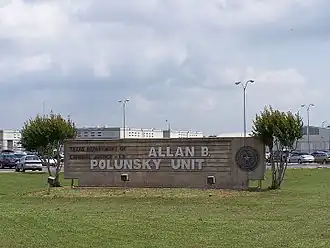
In 2000, Richard Lynn Childs confessed to murdering Black and was sentenced to 35 years in prison; he was released on parole in 2016. No physical or DNA evidence has tied Flores to the murder, and he has maintained his innocence since his arrest. He currently awaits the death penalty at the Polunsky Unit in Livingston, Texas.
Flores maintains his innocence; numerous experts and advocacy groups agree with him and are — as of February 2026 — still advocating for a new trial for him.
Murder
On January 29, 1998, William Black returned home to find his home torn apart and his wife, Elizabeth "Betty" Black, murdered.[2] The murder took place in the early morning when Mr. Black was known to be routinely away from the home and Mrs. Black was known to be asleep. Two men entered the garage, seemingly with the aid of a garage door opener supplied by the estranged common-law wife of the Blacks’ son, a drug dealer. He was then in prison, serving time for drug dealing. His estranged wife, Jackie, had reportedly told numerous people, including Richard Childs, with whom she was having an affair and dealing drugs, that a significant amount of drug money was hidden in the Blacks’ house, probably behind the bathroom walls. Jackie and Richard Childs, both of whom were known to local narcotics investigators, were immediately suspected.[1]
Investigation
Soon after the murder, multiple neighbors stated to police that they saw two men get out of a Volkswagen Beetle with a psychedelic paint scheme and go into the Black's home.[3][2] Within a day, the Blacks’ next-door neighbor easily identified Richard Childs as the car’s driver. And narcotics investigators, who knew Childs, knew of his involvement within hours of the murder. However, he was allowed to remain at large, destroying evidence and meeting with Jackie and others, before he was eventually taken into custody following an attempt to flee in someone else’s car and clothes.[4][5][6][7]
At first, none of the witnesses were able to identify the passenger who went into Black's home along with Childs. Five days after the murder, one of the witnesses — Jill Barganier — was brought to the police station in hopes of creating a composite sketch of the passenger. Barganier had already positively identified Childs as the driver. She repeatedly described the passenger as another white male with long hair who looked like Childs. Therefore, she failed to pick Flores—a large Hispanic male with short, shaved hair—out of a photo lineup.[1][8][9][2]
Meanwhile, she was hypnotized by a police officer who was trained in forensic hypnosis, but had never performed hypnosis before, in hopes of helping her make an identification.[4]Under hypnosis, she stated that the passenger was a white male, medium build, with "very long" hair.[10] Before the end of the hypnosis session, the officer told her that she would “be able to recall more of the events as time goes on”.[3] The recording of the hypnosis session revealed that not all rules were followed; for example, when the technique was still allowed, Texas law forbid an officer involved in the investigation being present. Here the hypnotist had been involved in collecting evidence and the second lead detective sat in the room, off camera.[4][11][12]
Flores has always maintained that he was asleep in a trailer in another part of town with his girlfriend and then got up and made breakfast for her and her daughters, facts confirmed by the girlfriend at the time.[1][13]
Trial
Barganier only identified Flores as the passenger of the VW Beetle over a year later in the courtroom during Flores's trial.[14][15] Flores' counsel has pointed out that his mug shot was shown frequently on television and in the newspaper, and Barganier acknowledged seeing his photograph before identifying Flores in the courtroom.[8][16][17]
Barganier's identification of Flores in court also did not match her original description of the passenger as a tall white man with long hair; Flores is Hispanic, 5'10", stocky with then shaved hair.[18][19] Flores' defense team requested a Zani hearing — a judicial review of the hypnosis session to ensure it followed 10 state guidelines — and while the judge found more than three of ten guidelines had not been followed, the judge nonetheless allowed Barganier to testify trial.[3]
Flores was never accused of murdering Black, only of being a party to the crime. No fingerprints, DNA, or other physical evidence were presented at trial that tied Flores to the crime or to the scene of the crime.[3][17]
Flores' defense team called only one witness during his trial, "a gun expert who testified that a gun belonging to Flores that the police found was not the murder weapon." He was found guilty on March 30, 1999; during his sentencing, his parents were prevented from testifying.[16]
Richard Childs
After confessing to her murder, Richard Childs signed a guilty plea for the murder of Elizabeth Black on April 5, 2000.[16] When he was arrested, Childs had "a box of cartridges that were the same caliber as the bullets from the crime scene."[2] Childs was also known to own a Volkswagen Beetle with a psychedelic paint scheme that matched witness accounts from the morning of Black's murder.[17]
Childs was sentenced to 35 years in prison; he was released on parole in 2016 after serving 17 years of his sentence.[2]
Reactions
Supporters of Flores have long been calling his conviction and incarceration an injustice for a litany of reasons, including the use of forensic hypnosis, which the Texas Rangers stopped using voluntarily in 2021 and was outlawed in the state in 2023.[8] His supporters further point out what they call another injustice: that his case is what sparked legislative reform that eventually led to the 2023 banning of the practice of forensic hypnosis in Texas, but that the law is not retroactive so it did not apply to his case.[20]
As of February 2026, numerous organizations and experts continue to work on Flores's behalf to overturn his conviction and death sentence. Additionally, The Innocence Project has long sounded an alarm about forensic hypnosis calling it "deeply unreliable."[3]
Experts point to research demonstrating that "hypnotized subjects remembered less than those who were not hypnotized and omitted more details", and that "hypnosis increases subjects’ confidence in their memories, regardless of whether those memories are accurate or not."[3]
One expert on forensic hypnosis, Dr. Steven Lynn — who had, early in his career, been a "true believer" in the use of forensic hypnosis — "testified that the hypnosis in the Flores case had relied on this faulty concept of memory", and described Bargainer's identification of Flores as "astounding" 13 months after the crime.[3]
A memory expert at University of California, San Diego, John Wixted, said "the latest memory science suggests Flores is innocent."[17][21][22]
Appeals
Flores has appealed his conviction and sentence at least four times. One appeal, filed in 2016, was denied in 2020 without any discussion of the changed scientific understanding of hypnosis and memory or the testimony of expert Steven Lynn.[4][23][24]
In 2025, the Texas Court of Criminal Appeals (CCA) denied Flores' fourth appeal without explanation.[25] That dismissal is currently being appealed to the U.S. Supreme Court. [26]
In popular culture
Flores' case was featured in two episodes of Pablo Torre Finds Out, one of which was nominated for a Peabody Award.[27][28]
Flores's case was also featured in a TEDx Talk The new science of eyewitness memory, given by psychologist and memory researcher John Wixted.[29]
External links
- Free Charles Flores
- Texas Coalition to Abolish the Death Penalty fact sheet
- Witness to Innocence
- Innocence Project Amicus Curiae Brief
References
- ^ a b c d "Second Subsequent Habeas Application PT 1 - file-stamped.pdf". Google Docs. Retrieved 2026-02-13.
- ^ a b c d e Tsiaperas, Tasha (2017-10-19). "Hypnotized witness helped put dog's killer on death row — but grandma's killer goes free". Dallas News. Retrieved 2026-02-06.
- ^ a b c d e f g Ramchandani, Ariel (2019-10-04). "False witness: why is the US still using hypnosis to convict criminals?". The Guardian. ISSN 0261-3077. Retrieved 2026-02-06.
- ^ a b c d "Second Subsequent Habeas Application PT 2 file-stamped.pdf". Google Docs. Retrieved 2026-02-13.
- ^ Davies, David Martin (2021-12-12). "Forensic hypnosis in Texas prompts questions about death row case". TPR. Retrieved 2026-02-06.
- ^ Osibamowo, Toluwani (2024-04-24). "Recent research on eyewitness memory may be Texas death row inmate's last hope". KERA News. Retrieved 2026-02-06.
- ^ Semple, Kirk; Westbrook, Adam (2024-08-12). "Opinion | The Science That Put This Man on Death Row Has Been Debunked. He's Going to Be Executed Anyway". The New York Times. ISSN 0362-4331. Retrieved 2026-02-06.
- ^ a b c "Texas Matters: The 'Magic Movie Theater,' Hypnosis and Death Row". TPR. Retrieved 2026-02-06.
- ^ Davies, David Martin (2021-12-14). "Forensic hypnosis is big in Texas. Here's how it got its start". TPR. Retrieved 2026-02-06.
- ^ Davies, David Martin (2021-12-12). "Forensic hypnosis in Texas prompts questions about death row case". TPR. Retrieved 2026-02-06.
- ^ Press, Associated (2018-05-15). "Texas Death Row Inmates Push To Ban Forensic Hypnosis". Houston Public Media. Retrieved 2026-02-06.
- ^ McGaughy, Lauren (2018-05-14). "Texas uses hypnosis to investigate crimes. Dallas death row inmates say it's time to stop". Dallas News. Retrieved 2026-02-06.
- ^ Hoffberger, Chase (2016-06-02). "Death Watch: The Merits of Hypnosis-Induced Testimony". The Austin Chronicle. Retrieved 2026-02-06.
- ^ Bradshaw, Robin (May 14, 2025). "Texas death row conviction challenged over use of 'hypnotized' testimony".
- ^ McCullough, Jolie (2023-05-23). "Lawmakers seek to bar hypnosis-induced evidence from Texas criminal trials". The Texas Tribune. Retrieved 2026-02-06.
- ^ a b c Staff, Fusion (May 10, 2016). "Meth, Hypnosis, and Murder: An Incredible True Story of Race and Punishment on Texas' Death Row". Jezebel with Splinter.
- ^ a b c d "Scientists are fixing flawed forensics that can lead to wrongful convictions". 2024-06-06. Retrieved 2026-02-06.
- ^ "Death Row Information". www.tdcj.texas.gov. Archived from the original on 2025-06-29. Retrieved 2026-02-13.
- ^ Bradshaw, Robin (2025-05-14). "New evidence, new laws spark review of Texas death row inmate's case". The Edwardsville Intelligencer. Retrieved 2026-02-06.
- ^ Greenwald, David (2025-05-14). "Texas Death Row Inmate's Innocence Claim Prompts Execution Date Request Halt - Davis Vanguard". Retrieved 2026-02-06.
- ^ "Psychologists Urge Testing Eyewitness Memory Only Once". Forensic Magazine. 2021-11-08. Retrieved 2026-02-06.
- ^ "One and Done: Researchers Urge Testing Eyewitness Memory Only Once". today.ucsd.edu. Retrieved 2026-02-06.
- ^ Boucher, Dave; McGaughy, Lauren (2020-05-06). "Texas court denies death row inmate's hypnosis appeal". Dallas News. Retrieved 2026-02-06.
- ^ Wixted, John; Riley, Patricia A. (2020-09-19). "The Flores case shows how our criminal justice system mishandles eyewitness testimony". Dallas News. Retrieved 2026-02-06.
- ^ Osibamowo, Toluwani (2025-10-10). "Texas death row inmate's appeal of hypnosis conviction for 1998 murder denied a fourth time". KERA News. Retrieved 2026-02-06.
- ^ "Search - Supreme Court of the United States". www.supremecourt.gov. Retrieved 2026-02-13.
- ^ "Pablo Torre Finds Out: Watching the Dallas Cowboys on Death Row". The Peabody Awards. Retrieved 2026-02-06.
- ^ Staff, The Athletic (2025-09-02). "Silly meets smart: What 'Pablo Torre Finds Out' is all about". The New York Times. ISSN 0362-4331. Retrieved 2026-02-06.
- ^ Wixted, John (2026-02-03). The new science of eyewitness memory. Retrieved 2026-02-06 – via www.ted.com.