Canaanite and Aramaic seal inscriptions
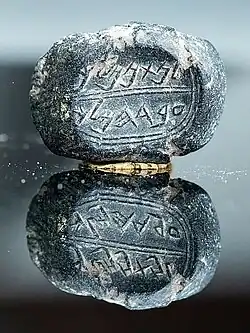
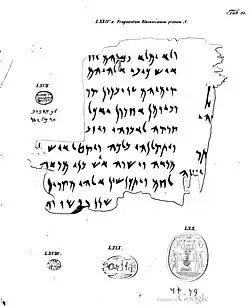
| Part of a series on |
| Canaanite and Aramaic inscriptions |
|---|
 |
Canaanite and Aramaic seal inscriptions are short texts engraved on personal seals and bullae used in the ancient Near East during the first millennium BCE. Written primarily in Phoenician, Hebrew and Aramaic, the inscriptions typically record personal names, patronymics, titles, or brief formulas. They are an important source for the study of wider Canaanite and Aramaic inscriptions, palaeography and onomastics.
Function and characteristics
Seals in the region were initially associated with protective or symbolic functions, and later became administrative tools used to authenticate documents and property. Most are stamp seals, often of scaraboid form, and many are decorated with figural or symbolic motifs in addition to inscriptions.
Most such stamp seals date approximately from the 9th to the 5th centuries BCE.[1]
The inscriptions are usually brief, most commonly giving the name and patronymic of the seal owner. In some cases, titles, the name of a superior, or a blessing formula are included.
Some of the seals show theophoric names, including divine elements such as -yahu and -baʿal.[1]
History of research
The scholarly study of Semitic seal inscriptions began in the late nineteenth century, with pioneering publications by scholars such as Charles Clermont-Ganneau, Eugène-Melchior de Vogüé, and Moritz Abraham Levy. Early corpora relied heavily on museum collections and the antiquities market, often without secure archaeological provenance.[1]
Corpus
Authenticity and forgeries
Forgery is a significant concern in assessing the corpus, as there has been significant demand among collectors, and the items are small and forgery is difficult to detect. Questions of authenticity have played a significant role in the study of seal inscriptions.[2] From the nineteenth century onward, scholars debated whether certain seals represented genuine ancient objects or modern forgeries, especially when seals combined iconographic elements from different cultural traditions.[3]
The numbers of known seals allocated by "nationality" is significantly different from the wider corpus of known Canaanite and Aramaic inscriptions; Hebrew forms a large majority of the seals and bullae, whereas for wider inscriptions, Hebrew is a small minority and Phoenician and Aramaic are the majority.[4]
Writing in 2014, Philippe Bordreuil suggested that we can be certain only of the 164 seal inscriptions which were known prior to the publication of notable monumental descriptions that could be easily copied, as well as those found subsequently in controlled archaeological excavations:[5]
- 44 Hebrew
- 6 Phoenician
- 57 Aramaic
- 34 Ammonite
- 17 Moabite
- 6 Edomite
Earliest published
The table below lists all the inscribed seals published before 1850, ordered by the date they were found.[6]
| Language | Image | Inscription | WSS No. | Century BCE | Material | Known Since | Published |
|---|---|---|---|---|---|---|---|
| Phoenician (disputed) | lʾbybʿl | 1122 | 8th | Sardonyx scaraboid | 1726 | Gori, 1726[7] | |
| Phoenician | lʾḥtmlk ʾšt yšʿ | 1102 | 8th | Agate scaraboid | 1791 | ||
| Phoenician | bnʾw/r | 728 | 6th | White stone scaraboid (unknown location) | 1791 | Tassie and Raspe 1791[8] | |
| Aramaic | lhwdw sprʾ | 754 | 7th | Green jasper scarab | 1791 | Tassie and Raspe 1791[9] CIS II 84 | |
| Hebrew |  |
lbnyhw bn šḥr | 108 | 7th (?) | Onyx scaraboid | 1812 | Clarke 1813[10] |
| Moabite | lkmšṣdq | 1036 | 8th | Porphyry scarab | 1826 | ||
| Aramaic |  |
lmrʾ hd | 809 | 7th | Carnelian scarab | 1828 | Hamaker, 1828 |
| Hebrew | lnʾhbt bt dmlyhw | 39 | 7th | Burnt carnelian scaraboid | 1837 | ||
| Aramaic | lsrgd | – | Late 9th | Quartz cylinder seal | 1837 | Gesenius 1837[11] | |
| Aramaic | lnbrb | 817 | Mid 7th | Agate scaraboid | 1837 | ||
| Aramaic | lʿzy | 1116 | Late 8th / early 7th | Agate scaraboid (missing) | 1837 | Lajard 1837,[12] CIS II 90 | |
| Phoenician | lbʿlytn ʾšʾl mʾš lmlqrt bṣr | 719 | 5th–4th | Chalcedony scaraboid | 1843 | ||
| Hebrew | lʿbdyhw bn yšb | 290 | Late 8th / early 7th | Jasper scaraboid | 1846 | ||
| Aramaic | lpltḥdn | – | 8th | Carnelian cylinder seal | 1847 | Lajard 1847[13] | |
| Aramaic | lmmh | – | 8th | Unknown scaraboid (missing) | 1847–49 | Lajard 1847–49[14] | |
| Aramaic | ḥnky | 795 | Early 6th | Chalcedony octagonal conoid | 1849 | Lajard 1847–49[15] | |
| Hebrew | lntnyhw bn ʿbdyhw | 279 | Early 7th | Chalcedony conoid | 1849 | ||
| Ammonite | ltmkʾl bdmlkm | 853 | 6th | Octagonal conoid | 1849 |
Wider corpus, including unprovenanced
The Corpus of West Semitic Stamp Seals (WSS) states that, at the time of its publication in 1997, approximately 1,591 West Semitic inscribed seals, sealings, and related stamped objects were known when cylinder seals are included, or about 1,511 when they are excluded. Within this larger body, the WSS defines a principal working corpus of 1,189 stamp seals used for detailed study. Of these, 180 are recorded as having secure archaeological provenance, or 85-88 securely provenanced seals excluding a small number of unrepresentative large hoards.[16]
The WSS explains that “nationality” is the primary principle used to classify seals, determined by a combination of script, language, names, and iconography, though palaeography "outweigh[ed] all others". Some have been revised and reclassified, or remain uncertain. The authors emphasise that the classification remains provisional: "we are still far from achieving a definitive classification".[17] According to Avigad and Sass: "There is a great similarity among the scripts and the onomasticon of the various West Semitic peoples, making it difficult to distinguish between the different groups of seals."[1]
The core WSS corpus is as follows:
| Unprovenanced | Provenanced | |||||||
|---|---|---|---|---|---|---|---|---|
| Category | Seals | Bullae | Handles | Total | Seals | Bullae | Handles | Total |
| Hebrew | 399 | 262 | 50 | 711 | 29 | 57 | 46 | 132 |
| Phoenician | 36 | 2 | 38 | 3 | 1 | 4 | ||
| Aramaic | 97 | 8 | 2 | 107 | 6 | 7 | 1 | 14 |
| Ammonite | 148 | 1 | 149 | 10 | 1 | 11 | ||
| Moabite | 41 | 1 | 42 | 3 | 3 | |||
| Edomite | 7 | 2 | 1 | 10 | 3 | 2 | 1 | 6 |
| Philistine? | 4 | 1 | 5 | 3 | 1 | 4 | ||
| Hebrew-Phoenician | 1 | 1 | ||||||
| Hebrew-Aramaic | 5 | 5 | ||||||
| Hebrew-Ammonite | 1 | 1 | ||||||
| Hebrew or Moabite | 4 | 4 | 1 | 1 | ||||
| Moabite or Edomite | 7 | 7 | ||||||
| Phoenician or Aramaic | 21 | 21 | 1 | 1 | ||||
| Aramaic or Ammonite | 18 | 18 | 1 | 1 | ||||
| Undefined | 70 | 70 | 3 | 3 | ||||
| Pseudo-script | 5 | |||||||
| Doubtful and forged | 21 | |||||||
| West Semitic? | 2 | |||||||
| Total | 859 | 277 | 53 | 1217 | 63 | 69 | 48 | 180 |
Provenanced
The 88 core provenanced seals and bullae (excluding handles), excluding LMLK seals, the Avigad hoard and the City of David hoard is:
| Region | Site | Hebrew | Phoenician | Aramaic | Ammonite | Moabite | Edomite | Philist.? | Misc. |
|---|---|---|---|---|---|---|---|---|---|
| Palestine (51) | Acre (2) | 716, 732 | |||||||
| Aroer (1) | 1055 | ||||||||
| Arad (5) | 70, 71, 72, 111, 132 | ||||||||
| Ashdod (1) | 1065 | ||||||||
| Atlit (1) | 777 | ||||||||
| Beersheba (1) | 661 | ||||||||
| Beit Shemesh (2) | 52, 293 | ||||||||
| Beth Zur (1) | 412 | ||||||||
| Dan (3) | 669, 692 | 1165 (Undef.) | |||||||
| En Gedi (2) | 94, 172 | ||||||||
| Tell el-Far'ah (South) (1) | 1069 | ||||||||
| Gibeon (2) | 220 | 757 | |||||||
| Tell el-Hesi (1) | 568 | ||||||||
| Tell Jemmeh (1) | 1068 | ||||||||
| Jerusalem (6) | 35, 147, 150, 210, 261, 326 | ||||||||
| Tell Judeideh (2) | 536, 639 | ||||||||
| Kiriath-Jearim (1) | 212 | ||||||||
| Lachish (6) | 59, 350, 360, 385, 405, 498 | ||||||||
| Tel Megiddo (4) | 2, 85, 160 | 1124 (Undef.) | |||||||
| Tel Michal (1) | 162 | ||||||||
| Tell en-Nasbeh (2) | 8 | 800 | |||||||
| Revadim (1) | 1067 | ||||||||
| Samaria (3) | 419 (W. Daliyeh), 711 | 1078 (He-Mo) | |||||||
| Shechem (1) | 224 | ||||||||
| Transjordan (15) | Amman (5) | 859, 916, 944, 973 | 1011 | ||||||
| Busaira (1) | 1050 | ||||||||
| Deir Alla (1) | 988 | ||||||||
| Tell el-Kheleifeh (2) | 1051, 1054 | ||||||||
| Tell el-Mazar (2) | 872 | 1109 (Ar-Am) | |||||||
| Umm el-Biyara (1) | 1049 | ||||||||
| Tall al-Umayri (3) | 860, 886, 977 | ||||||||
| Phoenicia & the West (4) | Byblos (1) | 990 | |||||||
| Carthage (1) | 185 | ||||||||
| Cádiz (1) | 267 | ||||||||
| Tharros (1) | 745 | ||||||||
| Syria (5) | Carchemish (1) | 774 | |||||||
| Hama (2) | 760, 768 | ||||||||
| Til Barsib (1) | 1100 (Ph-Ar) | ||||||||
| Zincirli (1) | 750 | ||||||||
| Mesopotamia (12) | Babylon (1) | 1048 | |||||||
| Khorsabad (3) | 743 | 755, 843 | |||||||
| Nimrud (1) | 1154 (Undef.) | ||||||||
| Nineveh (2) | 796, 837 | ||||||||
| Nippur (1) | 815 (rig. Susa) | ||||||||
| Susa (1) | 759 | 1020 | |||||||
| Ur (2) | 975 | 1034 | |||||||
| Egypt (1) | Elephantine (1) | 788 | |||||||
| TOTAL (88) | 40 | 4 | 14 | 11 | 3 | 6 | 4 | 6 | |
Examples
- KI 2: two possible Moabite[18][19]
- KI 4k: Shema seal, Tel Megiddo, 1904
- Eliakim, son of Hilkiah bulla, unprovenanced, 1974
- Gedaliah, son of Pashhur bullae, Jerusalem, 2005-08
- Governor of Jerusalem Seal docket, Jerusalem, 2019
- Hilkiah seal
- Jaazaniah seal, Tell en-Nasbeh, 1926-35
- Yehukal son of Shelemyahu seal (found 2005)
- King Ahaz's seal, unprovenanced
- King Hezekiah bulla, Jerusalem, 2009-10
- Kosher Bread Stamp, Horbat 'Uza, 2012
- Shelomit seal, Jerusalem, 2008
- Yeho'ezer ben Hosh'ayahu seal, Jerusalem, 2024
- LMLK seal
- Adadnadinakhe bricks
See also
References
- ^ a b c d Avigad & Sass 1997, p. 21-22.
- ^ Fox, Nili S. (1999). "Nahman Avigad. Corpus of West Semitic Stamp Seals. Revised and completed by Benjamin Sass. Jerusalem: Israel Academy of Sciences and Humanities/Israel Exploration Society/Institute of Archaeology, Hebrew University of Jerusalem, 1997. 640 pp". AJS Review. 24 (2): 362–365. doi:10.1017/S0364009400011326. ISSN 0364-0094. Retrieved 2026-02-07.
Sass is well aware of the possible presence of forgeries in the collection, and consequently he exercises caution by drawing few statistical conclusions. Several of his remarks speak to the issue (e.g., pp. 15, 465, 552). Notably, his final comment on this serious matter appears directly above his name at the end of the volume. It clearly mirrors his deep concern: "The possibility that our mostly unprovenanced material contains forgeries should always be borne in mind, for the impact of such items on works like the present one is inestimable" (p. 552). Given Sass's legitimate concern over authenticity, it is surprising that he did not divide the main catalogue by separating objects derived from controlled archaeological excavations from those acquired by other means.
- ^ Bordreuil 2014, p. 127-140.
- ^ Bordreuil 2014, p. 127-128: "There can be no doubt that the number of Hebrew seals has seen a truly astonishing increase, with most items coming essentially from the antiquities market... The disproportion of Hebrew seals is rather worrying, as the following statistics (based on WSS p. 549) show. Phoenician: 36 well-identified seals and 22 items less certainly identified, for a total of about 58; Aramaic: 97 well-identified seals, with 18 less-certain items, a total of about 115; Ammonite: 148 well-identified seals and 18 less-certain items, a total of about 166; Moabite: 41 well-identified seals and 4 less-certain items, a total of about 45; Edomite: 7 well-identified seals and 7 less-certain items, a total of about 14. How can such a large number of Hebrew documents compared with the relatively small number of Phoenician, Aramaic, and Transjordanian seals be explained? Present data indicate that Old Hebrew writing was commonly in use for only about two centuries, a brief period compared with the centuries-long persistence of Aramaic writing. Moreover, the use of Old Hebrew writing was limited to a rather small territory, which cannot be compared with the extended area of Aramaic writing before and after the 5th century b.c.e. Finally, in spite of the wealth of the cities on the Phoenician coast, Phoenician seals do not exceed a few dozen, a surprisingly small number."
- ^ Bordreuil 2014, p. 127, 138: "The number of West-Semitic inscribed seals has increased greatly since the beginning of the 1970s. The number of these documents was then at approximately 600, whereas today the number of bullae, seal impressions, and seals exceeds 1,600 (WSS p. 552). This is owing to the increasing number of uncontrolled excavations occurring in the Middle East by “amateurs” whose activities, which have been going on for well over a century now, are both a cause and a consequence of increasing demand by collectors. While collectors of the past worked for the most part from their studies, where they received their suppliers, they now must compete, in the field as it were, with travelers seeking ancient artifacts—especially inscriptions. Tiny items such as inscribed seals are relatively easy to smuggle across borders. One consequence of this strong demand has been the development of the forger’s art, and fake seals are becoming more and more sophisticated and difficult to detect... Today, with the criterion of discovery during official archaeological excavations or the publication and/or acquisition of a seal at a date in time before that of a notable monumental inscription, we can be certain of the genuineness of at least 44 Hebrew seals, 6 Phoenician seals, 57 Aramaic seals, 34 Ammonite seals, 17 Moabite seals, and 6 Edomite seals, for a total of 164, or about 10% of the total of approximately 1,600.
- ^ Bordreuil 2014, p. 128-137.
- ^ Gori, A. F. 1726 Inscriptiones antiquae in Etruriae urbibus existantes: 70, pl. 11
- ^ Tassie and Raspe 1791, Descriptive Catalogue of a General Collection of Ancient and Modern Gems: 4, no. 34, pl. 7:34
- ^ Tassie and Raspe 1791: pl. 11:654
- ^ Clarke 1813, Travels in Various Countries of Europe, Asia, and Africa, vol. 2: Greece, Egypt, and the Holy Land: 180
- ^ Gesenius 1837: 221–22, pl. 28:67
- ^ Lajard 1837 Recherches sur le culte, les symboles, les attributs et les monuments figurés de Vénus en Orient et en Occident.: pl. 14G:13
- ^ Lajard 1847 Observations sur l’origine et la signification du symbole appelé la croix ansée. Mémoires de l’Institut royal de France 17: 352, pl. 3:4
- ^ Lajard 1847–49, Introduction à l’étude du culte public et des mystères de Mithra en Orient et en Occident: pl 36:1
- ^ Lajard 1847–49: pl. 44:17
- ^ Avigad & Sass 1997, p. 547-552.
- ^ Avigad & Sass 1997, p. 17.
- ^ Ledrain, E. (1882). "NOTE SUR DEUX SCEAUX PORTANT LE MÊME NOM HÉBREU". Revue Archéologique. 43. Presses Universitaires de France: 285–287. ISSN 0035-0737. JSTOR 41732402. Retrieved 2026-02-07.
- ^ Sachau, Eduard (1882). "Aramäische Inschriften". Sitzungsberichte der Königlich Preussischen Akademie der Wissenschaften zu Berlin. Deutsche Akademie der Wissenschaften zu Berlin: 1064.
Bibliography
- Avigad, Nahman; Sass, Benjamin (1997). Corpus of West Semitic Stamp Seals. Jerusalem: Israel Academy of Sciences and Humanities / Israel Exploration Society.
- Hackett, Jo Ann; Aufrecht, Walter E. (2014-06-06). An Eye for Form": Epigraphic Essays in Honor of Frank Moore Cross. Penn State Press. ISBN 978-1-57506-887-9.
- Levy, Moritz Abraham (1869). Siegel und Gemmen mit aramäischen, phönizischen, althebräischen, himjarischen, nabathäischen und altsyrischen Inschriften (in German). Schletter.
- Vogüé, Melchior de (1868). "Intailles à légendes sémitiques". Mélanges d'archéologie orientale (in French). Impr. impériale. p. 105-140. Retrieved 2026-02-07.
- Clermont-Ganneau, Charles Simon (1883). "Sceaux et cachets israélites, phéniciens et syriens". Journal Asiatique. 8 (in French). 1: 123–159, 304–310.
- Diringer, David (1934). Le iscrizioni antico-ebraiche palestinesi (in Italian). Florence: F. Le Monnier.
- Bordreuil, Pierre (2014). "On the Authenticity of Iron Age Northwest Semitic Inscribed Seals". In Hackett, Jo Ann; Aufrecht, Walter E. (eds.). An Eye for Form: Epigraphic Essays in Honor of Frank Moore Cross. Winona Lake, Indiana: Eisenbrauns. pp. 127–140.
- Schmitz, Philip C. (2014). "Phoenician Seal Script". In Hackett, Jo Ann; Aufrecht, Walter E. (eds.). An Eye for Form: Epigraphic Essays in Honor of Frank Moore Cross. Winona Lake, Indiana: Eisenbrauns. pp. 141–174.
- Herr, Larry G. (2014). "Aramaic and Ammonite Seal Scripts". In Hackett, Jo Ann; Aufrecht, Walter E. (eds.). An Eye for Form: Epigraphic Essays in Honor of Frank Moore Cross. Winona Lake, Indiana: Eisenbrauns. pp. 175–186.
- Herr, Larry G. (2014). "Hebrew, Moabite, and Edomite Seal Scripts". In Hackett, Jo Ann; Aufrecht, Walter E. (eds.). An Eye for Form: Epigraphic Essays in Honor of Frank Moore Cross. Winona Lake, Indiana: Eisenbrauns. pp. 187–201.
- Lidzbarski, Mark (1902). "Über einige Siegel mit semitischen Inschriften". Ephemeris für semitische Epigraphik. Vol. 1. De Gruyter. p. 136-142. doi:10.1515/9783111588438-019. ISBN 978-3-11-158843-8.
{{cite book}}: ISBN / Date incompatibility (help) - Lidzbarski, Mark (1902). "Semitische Legenden auf Siegeln und Gewichten". Ephemeris für semitische Epigraphik. Vol. 1. De Gruyter. p. 271-280. doi:10.1515/9783111588438-019. ISBN 978-3-11-158843-8.
{{cite book}}: ISBN / Date incompatibility (help) - Lidzbarski, Mark (1907). "Hebräische Inschrifte". Ephemeris für semitische Epigraphik. Vol. 2. De Gruyter. p. 70-72. doi:10.1515/9783111588438-019. ISBN 978-3-11-158843-8.
{{cite book}}: ISBN / Date incompatibility (help) - Lidzbarski, Mark (1907). "Über einige Siegel und Gewichte mit semitischen Legenden". Ephemeris für semitische Epigraphik. Vol. 2. De Gruyter. p. 142-149. doi:10.1515/9783111588438-019. ISBN 978-3-11-158843-8.
{{cite book}}: ISBN / Date incompatibility (help)