COVID-19 season
| Coronavirus disease 2019 (COVID-19) | |
|---|---|
| Other names | COVID, (the) coronavirus |
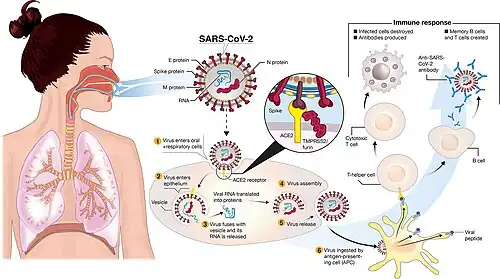 | |
Transmission and life-cycle of SARS-CoV-2, which causes COVID-19 | |
| Pronunciation |
|
| Specialty | Infectious disease |
| Symptoms | Fever, cough, fatigue, shortness of breath, vomiting, loss of taste or smell; some cases asymptomatic[2][3] |
| Complications | Pneumonia, sepsis, ARDS, kidney failure, respiratory failure, pulmonary fibrosis, CKS, MIS-C, long COVID, brain damage |
| Usual onset | 2–14 days (typically 5) after infection |
| Duration | 5 days to chronic |
| Causes | SARS-CoV-2 |
| Diagnostic method | RT‑PCR testing, CT scan, rapid antigen test |
| Prevention | Vaccination, face coverings, quarantine, social distancing, ventilation, hand washing |
| Treatment | Symptomatic and supportive |
| Frequency | 778,999,210[4] confirmed cases (true case count is expected to be much higher[5]) |
| Deaths | |
COVID-19 season refers to the patterns of increased or decreased transmission of SARS-CoV-2, the virus that causes COVID-19, during different times of the year. Unlike many respiratory viruses that exhibit predictable winter peaks, COVID-19 has demonstrated a more complex and less consistent seasonal behavior. This variability is influenced by environmental factors, human behavior, viral evolution, and waning immunity.[7]
Since its emergence in late 2019, COVID-19 has shown periodic surges in transmission.[8] While winter peaks have been common, significant outbreaks have also occurred during summer months. For example, winter surges are often associated with colder temperatures, increased indoor activity, and reduced ventilation. Summer surges have been linked to travel, large gatherings, and the emergence of new variants.[9]
The emergence of new variants of SARS-CoV-2 has significantly impacted seasonal dynamics. Variants with increased transmissibility or immune escape capabilities can trigger outbreaks outside typical respiratory virus seasons. Notable examples include the delta variant surge in summer 2021 and the omicron subvariants driving waves in both winter and summer months
Understanding COVID-19 seasonality is crucial for:
- Vaccine timing: Updated vaccines are typically released ahead of expected seasonal surges
- Healthcare preparedness: Anticipating surges helps allocate resources and implement targeted interventions
- Public messaging: Seasonal awareness can guide personal and community-level precautions.
References
- ^ "Covid-19". Oxford English Dictionary (Online ed.). Oxford University Press. April 2020. Retrieved 15 April 2020. (Subscription or participating institution membership required.)
- ^ "Symptoms of Coronavirus". U.S. Centers for Disease Control and Prevention (CDC). 13 May 2020. Archived from the original on 17 June 2020. Retrieved 18 June 2020.
- ^ "Q&A on coronaviruses (COVID-19)". World Health Organization (WHO). 17 April 2020. Archived from the original on 14 May 2020. Retrieved 14 May 2020.
- ^ a b Mathieu E, Ritchie H, Rodés-Guirao L, Appel C, Giattino C, Hasell J, et al. (2020–2024). "Coronavirus Pandemic (COVID-19)". Our World in Data. Retrieved 6 February 2026.
- ^ Mathieu E, Ritchie H, Rodés-Guirao L, Appel C, Giattino C, Hasell J, et al. (5 March 2020). "Coronavirus Pandemic (COVID-19)". Our World in Data. Archived from the original on 24 February 2024. Retrieved 24 February 2024.
- ^ "The pandemic's true death toll". The Economist. 28 August 2023 [2 November 2021]. Retrieved 28 August 2023.
- ^ CDC (10 January 2025). "COVID-19 can surge throughout the year". National Center for Immunization and Respiratory Diseases. Retrieved 4 February 2026.
- ^ Zabidi NZ, Liew HL, Farouk IA, Puniyamurti A, Yip AJ, Wijesinghe VN, et al. (4 February 2026). "Evolution of SARS-CoV-2 Variants: Implications on Immune Escape, Vaccination, Therapeutic and Diagnostic Strategies". Viruses. 15 (4): 944. doi:10.3390/v15040944. ISSN 1999-4915. PMC 10145020. PMID 37112923.
- ^ "Why COVID Cases Rise Every Summer". Bloomberg School of Public Health, Johns Hopkins. 7 August 2024. Retrieved 4 February 2026.