C.S.A.: The Confederate States of America
| C.S.A.: The Confederate States of America | |
|---|---|
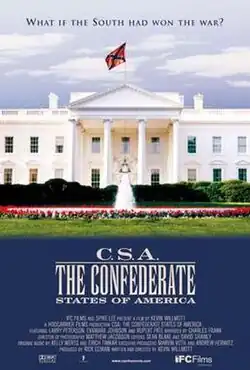 Theatrical release poster | |
| Directed by | Kevin Willmott |
| Written by | Kevin Willmott |
| Produced by | Rick Cowan Ollie Hall Sean Blake Victoria Goetz Benjamin Meade Andrew Herwitz Marvin Voth |
| Starring | Rupert Pate Evamarii Johnson Larry Peterson LaMont Collins, Jr. |
| Narrated by | Charles Frank |
| Cinematography | Matt Jacobson |
| Edited by | Sean Blake David Gramly |
| Music by | Erich L. Timkar Kelly Werts |
Production company | |
| Distributed by | IFC Films |
Release dates |
|
Running time | 89 minutes |
| Country | United States |
| Language | English |
| Box office | $744,165[1] |
C.S.A.: The Confederate States of America is a 2004 American mockumentary film written and directed by Kevin Willmott.
It is an account of an alternate history, in which the Confederacy wins the American Civil War and establishes a new Confederate States of America that incorporates the majority of the Western Hemisphere, including the former contiguous United States, the "Golden Circle", the Caribbean, and South America. Primarily detailing significant political and cultural events of Confederate history from its founding until the early 2000s, this viewpoint is used to satirize real issues and events, and to shed light on the continuing existence of racism against Black Americans.
The film premiered at the 2004 Sundance Film Festival, and was released in the United States on February 15, 2006, by IFC Films. It received positive reviews.
Overview
C.S.A.: The Confederate States of America is set in an alternate history where Abraham Lincoln's Emancipation Proclamation failed. Confederate President Jefferson Davis takes the opportunity to secure British and French aid for the Confederacy, allowing Confederate forces to win the Battle of Gettysburg, besiege Washington, D.C., and capture the White House a few months later. As a result, the Confederacy takes over all of the United States and slavery there survives into the present day and other historical events are affected accordingly.
The film is presented as if it were a British Broadcasting Services (BBS) (a parody of the British Broadcasting Corporation) documentary being broadcast on a CSA television channel in San Francisco, California. It opens with a fictional disclaimer suggesting that censorship came close to preventing the broadcast, that its point of view might not coincide with that of the network, and that it might not be suitable for viewing by children and "servants". It purports to disagree with an orthodox Confederate interpretation of American history.
The film portrays two historians: Sherman Hoyle, a conservative Southerner (a parody of Shelby Foote); and Patricia Johnson, a black Canadian, as talking heads, providing commentary.
The documentary hosts also follow Confederate politician and Democratic presidential hopeful John Ambrose Fauntroy V (the great-grandson of one of the founders of the C.S.A.) during his primary campaign as he faces challenges over alleged black ancestry. Narration explains fake historical newsreel footage, which is either reenacted or compiled of genuine archival footage dubbed with fictional narration.
Racialist advertisements appear as commercial breaks, including consumer products, television programs, and films, all aimed at white slave-owning families. Text during the film's epilogue note that parts of the alternate timeline are based on real history and that some of the racist products depicted such as Uncle Ben's and Aunt Jemima actually existed at the time of the film's production (both products were rebranded in 2020 following the George Floyd protests[2][3]).
Plot
During the Civil War, Confederate State Secretary Judah P. Benjamin successfully convinced France and Britain into recognizing the South as a country, resulting in their aid and winning Gettysburg, officially defeating the Union. Abraham Lincoln attempts to flee the country with the help of Harriet Tubman with the use of blackface but are subsequently caught. Lincoln is exiled to Canada while Harriet Tubman is executed for treason.
Army General Robert E. Lee becomes remorseful when seeing the atrocities committed in the North and advocates for emancipation, however Virginian Congressman and wealthy slave owner John Ambrose Fountroy successfully campaigns the continuation of slavery within the Confederate States. Jefferson Davis, at advice of his slave Popsy, enacts The Davis Plan, which they employed Chattel Slavery against free Northern Non-Whites as well as mixed raced individuals, even ones who also own slaves, with Unionists being forcibly taxed unless they purchased slaves themselves.
Thousands of White Americans and Abolitionists left for the south, such as Harriet Beecher Stowe, Walt Whitman, William Lloyd Garrison, Mark Twain, and Wendell Phillips. Suffrage Leader Susan B. Anthony also leaves for Canada and holds a rally, getting women the right to vote in the country. After a slave murders two white children and ran away, doctor Samuel A. Cartwright coined the term drapetomania, influencing medical torture for slaves suspecting of wanting to run away. John Ambrose Fauntroy, who oversaw The Davis Plan and reshape Northerners view of slavery, has the nomination for presidency, however suffers a stroke and passes away, with his descendants becoming famous and continuing his legacy in reshaping slave owning politics.
After a large amount of black men were executed in what was dubbed the "Black Holocaust" Garrison and Frederick Douglass formed NAACP (National Association for the Advancement for Chattel People) and successfully smuggled hundreds of enslaved people into Canada, an act that the Confederate States still demand reparations for losing their property. Native Americans fought back against the United States and were subsequently crushed while immigrant were enslaved by the government once they came to the west for work. The Confederate government outlawed any non-Christian Denominated religion, while Jewish Americans were delegated to a reservation on Staten Island. Meanwhile, relationships between Union and Confederate relations have been romanticized from novelists in Reconstruction to rebuild unity, all while removing slavery as the reasons for the Civil War happening.
As the 20th century rolled, the CSA managed to successfully expand into South America, but still faced brutal pushback from natives in order to remain free. This emboldened their Manifest Destiny, but the Wall Street Crash crippled their economy, until Senator John Ambrose Fauntroy II began expanding into slave trading through other countries, with warlords from Africa helping sell slaves to the country. The CSA also supported Adolf Hitler and his plan for Aryan supremacy, though Secretary of State Fauntroy III attempted to convince Hitler into enslaving the Jewish citizens for labor instead of exterminating them. The CSA fought against Japan during the Pacific Theatre, with enslaved men promised freedom if they participated in the war, but even once they won were returned to their owners.
In the 1950s during a prosperous time for the CSA, radical Canadian Abolitionist splinter group of the NAACP known as the JBU (John Brown Underground) waged "a war against slavery" attacking major cities against the CSA, spurring paranoia against abolitionism, and installs a wall against the border. Fauntroy IV was assassinated during an JBU attack, resulting in America air striking Canada, and the Summit Nations employed a World Embargo on the CSA, apart from South Africa, sending the CSA into extreme isolationism and CSA citizens beginning to doubt the worth of slavery.
In 1960, John F. Kennedy wins the election and promises a "New Frontier" for the CSA with promise of Emancipation, while suffrage and progressiveness sweeped the nation, and black-inspired art such as Elvis Presley and James Baldwin went to Canada, with American banning on those works lead to creative sterilization within their culture beyond propaganda, while Canada prospered after beating Americans in the Olympic Games. However, JFK's assassination effectively demoralized progress, and resulted in two major slave rebellions in Los Angeles and Newark, New Jersey.
The newest head of the Fauntroy family and Fauntroy I's Great-Grandson, Fauntroy V, employed religious and latest technological advancement to make slavery popular amongst the country in the 1980s and 1990s as newer generations became interested in owning slaves. In the 2000s, Fauntroy V runs for bid as the democratic nominee for Presidency and invites BBS interviewers to boost his public image. However, the reporters are secretly given instructions to a rendezvous organized by JBU leader "Big Sam".
There, the reporters are met by the Fauntroy family slave Horace, whose family been enslaved by the Fauntroy by generations and reveals that Fauntroy I had an affair with Horace's Great-Great Grandmother, and that Fauntroy V was the descendant of the affair, making him mixed. Fauntroy V attempts to defend himself and deny the accusations, but denies to submit to a DNA test, however, the allegations costed him the election and later on, commits suicide. A mandatory DNA was ordered and released days after. The results proved negative.
Cast
- Rupert Pate as Sherman Hoyle, a Confederate American historian who speaks highly of the Confederate American values.
- Evamarii Johnson as Patricia Johnson, an African-Canadian historian whose viewpoints focus on the slaves and minorities oppressed by the Confederate regime.
- Larry Peterson as Senator John Ambrose Fauntroy V, a descendant of Confederate senator John Ambrose Fauntroy I and Democratic candidate for the presidency in 2002.
- Charles Frank as the documentary's narrator.
- Steve Jasen as the voice of Abraham Lincoln
- Arlo Kasper as Old Abraham Lincoln
- Kevin McKinney as Blackface Abraham Lincoln
- Joyce Jefferson as the voice of Harriet Tubman
- Will Averill as Blackface Harriet Tubman
- Brian Paulette as Jefferson Davis
- Lauralei Linzay as Varina Davis
- Sean Blake as Adolf Hitler
- Glenn Q. Pierce as the voice of Robert E. Lee
- Marvin Voth as the voice of Walt Whitman
- John Staniunas as the voice of William Lloyd Garrison
- Greg Funk as the voice of Wendell Phillips
- Kevin Willmott as the voice of Frederick Douglass
Production
Kevin Wilmott began production on the film with a funding from the National Black Programming Consortium (NBPC) and wrote its first draft in 1997.[4]
Willmott, who had earlier written a screenplay about abolitionist John Brown, told interviewers he was inspired to write the story after seeing an episode of Ken Burns' 1990 television documentary miniseries The Civil War.[5] It was produced by Hodcarrier Films.
The film was filmed in Humboldt, Newton and Lawrence cities in Kansas, with a cast and crew coming from the U.S. states of Kansas, Missouri and Iowa as well as Colombia.[6]
Release
An earlier version of the film premiered on February 21, 2003, at Liberty Hall in Lawrence, Kansas,[7] while the film premiered for the second time, at the Sundance Film Festival on January 17, 2004.
In January 2004, after the film's premiere at the Sundance Film Festival, IFC Films acquired the distribution rights to the film in the United States.[8]
The film received a limited theatrical release in some Southern cities on October 7, 2005, and later received a wide theatrical release on February 15, 2006.[9]
Home media
The film was released on DVD by IFC Films (distributed by Genius Products) on August 8, 2006.
Reception
The film grossed $744,165 worldwide in limited release.[1]
On Rotten Tomatoes the film has an approval rating of 80% based on reviews from 66 critics.[10] On Metacritic the film has a score of 62 out of 100 based on reviews from 22 critics, indicating "generally favorable" reviews.[11] Most critics were intrigued by the film's premise, but some found the execution to be lacking primarily due to a low budget.[12][13][14] In 2018 James Berardinelli wrote: "The movie is ultimately more interesting in satire than the presentation of a legitimate alternate timeline. This doesn't invalidate C.S.A.'s approach but it limits its effectiveness as a sort of Twilight Zone look at the last 150 years."[15]
See also
- American Civil War alternate histories
- List of films featuring slavery
- The Domination
- Death of a President
References
- ^ a b "CSA: The Confederate States of America (2005)". Box Office Mojo.
- ^ Vigdor, Neil (February 10, 2021). "Aunt Jemima Has a New Name After 131 Years: The Pearl Milling Company". The New York Times.
- ^ "Uncle Ben's rice changes name to more 'equitable' brand". BBC News. September 23, 2020.
- ^ "What if the South had won?". Lawrence Journal-World. February 21, 2003. Retrieved April 25, 2021.
- ^ "The Second Civil War", Village Voice, February 7, 2006, archived from the original on May 24, 2011.
- ^ "Kansas, Missouri provide cast, crew, locations for new Confederacy film". University of Kansas. February 11, 2003. Archived from the original on April 25, 2021. Retrieved April 25, 2021.
- ^ "Kansas in the Movies". Washburn University. Retrieved April 25, 2021.
- ^ "IFC Films Annexes CSA: The Confederate States Of America in Sundance Acquisition". IFC Films (Press release). January 20, 2004. Retrieved April 25, 2021 – via AMC Networks.
- ^ "Controversial 'CSA' film snags theatrical release". Lawrence Journal-World. October 7, 2005. Retrieved April 25, 2021.
- ^ "CSA: The Confederate States of America (2005)". Rotten Tomatoes.
- ^ "C.S.A.: The Confederate States of America". Metacritic.
- ^ LaSalle, Mick (24 February 2006). "What if the South had won the Civil War?". SFGate.
- ^ McCarthy, Todd (9 March 2004). "C.S.A.: The Confederate States of America". Variety.
- ^ Murray, Noel (21 February 2006). "CSA: The Confederate States Of America". The A.V. Club. Archived from the original on 25 September 2019. Retrieved 25 September 2019.
- ^ Berardinelli, James (January 31, 2018). "C.S.A.: The Confederate States of America". Reelviews Movie Reviews. Retrieved 2018-03-24.