Byzantium in the Crusading movement
| Crusading movement |
|---|
 |
| Origins |
| Just war theory • Penance • Christian pilgrimage • Gregorian Reform |
| Varieties |
| Crusades • Popular Crusades • Iberian Crusades • Northern Crusades• Crusades against Christians |
| Theory and Practice |
| Indulgence • Crusade bull • Preaching • Vow • Warfare • Military orders • Finance • Criticism |
| States |
| Crusader states • Cyprus • Frankish Greece • State of the Teutonic Order • Rhodes • Malta |
| Enemies and Contacts |
| Byzantines • Armenians • Jacobites • Jews |
The Byzantines were active participants in the crusading movement from its inception in the late 11th century until the collapse of the Byzantine Empire in the mid-15th century, acting variously as initiators, allies, and often adversaries. As heirs to the Roman Empire, they associated their state with the civilised world, ruled by a divinely appointed emperor whom they regarded as superior even to the highest-ranking Christian clerics, including the popes. The empire was administered by an educated bureaucratic elite that sought to avert conflict through diplomacy, gifts, and honorary titles. During the early Muslim conquests, the Byzantines lost extensive territories, though from the 960s they recovered some of these lands, including the city of Antioch. Relations between Western Christendom and the Byzantine Church deteriorated owing to theological and liturgical differences, as well as papal claims to supremacy, culminating in the Schism of 1054. Nevertheless, diplomatic contacts endured, leading to Byzantine appeals for western assistance as the empire's frontiers came under sustained pressure from new enemies, particularly the Muslim Turkomans. Following an appeal by Emperor Alexios I Komnenos in March 1095, Pope Urban II proclaimed the First Crusade to support eastern Christians, offering spiritual rewards to its participants. The call generated unexpected enthusiasm, and more than 30,000 armed men set out on crusade, accompanied by tens of thousands of unarmed people.
Cooperation between the crusaders and the Byzantines proved difficult, although the crusaders initially contributed to the reconquest of substantial territories in Anatolia in accordance with their agreements with Alexios. As the Emperor prioritised the defence of Byzantine lands over further expansion, the crusaders came to regard his actions as a breach of their agreements and established three new states in the Middle East: Edessa, Antioch, and Jerusalem by 1100. Because of its strategic importance, the Byzantines sought to recover Antioch, but ultimately failed, despite the defeat of an anti-Byzantine campaign led by Bohemond I of Antioch in 1108.
Background
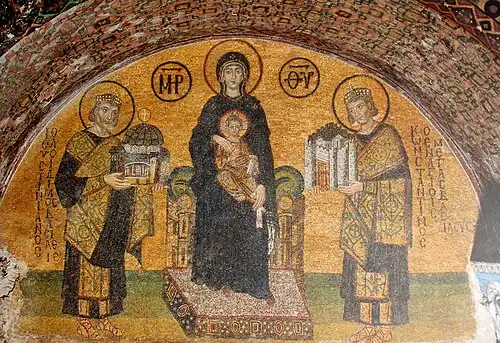
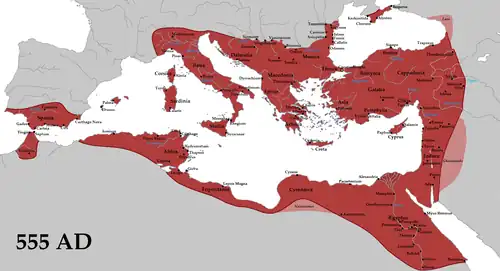
The Byzantine Empire was, as the historian Peter Lock observes, "in every sense the heir and embodiment of the Roman Empire".[1] The formal division of the empire into eastern and western halves occurred in 395. The eastern emperors ruled from Constantinople, refounded in 330 by the first Christian emperor Constantine the Great on the site of ancient Byzantium.[2] After the fall of the western empire in 476, the Byzantine rulers maintained their claim to universal imperial authority.[3] This claim was expressed through the concept of translatio imperii and through the imperial title "Emperor and Autocrat of the Romans". The Byzantines called themselves Romaioi ("Romans") and associated their empire with the Oikoumene, or civilised world.[4]
The emperors were widely regarded as God's representatives on earth. The Christian Church was organised around five major episcopal sees, each headed by a patriarch. Among them, the bishops of Rome, styled popes, enjoyed honorary primacy primarily due to the association of their see with the apostles Peter and Paul, but in imperial thinking were expected to act as loyal officials in support of Christian unity.[5] The Byzantine state was administered by an educated bureaucratic elite who recorded their experiences for future generations. Many courtiers were eunuchs, considered especially reliable.[6] In foreign policy, Byzantium generally favoured diplomacy over warfare, relying on gifts, titles, and elaborate ceremonial to manage rivals and display imperial authority.[7]
Byzantine power rapidly waned under pressure from enemies such as the Sasanian Persians, Avars, and Bulgars. From the 630s, the empire was unable to resist the expansion of the emerging Islamic Caliphate and lost the Middle East, Egypt, and North Africa. Islam emerged under Muhammad, whose revelations formed the Quran, regarded by Muslims as God's final and complete message.[8] Quranic promises of afterlife reward for participation in jihad, or "holy war", helped fuel early Muslim expansion.[9] As a result of these conquests, the patriarchates of Antioch, Alexandria, and Jerusalem came under Muslim rule, leaving only Rome and Constantinople under Christian control.[5][10] Christians living under Islam were classified as dhimmis, protected but legally subordinate.[11]
In western Europe, former Roman territories fragmented into smaller kingdoms ruled largely by Germanic elites. The Franks unified much of Gaul, and under the Carolingians reunited several regions of the former Western Roman Empire.[12] Byzantine iconoclasm weakened ties with Rome and encouraged cooperation between the papacy and the Carolingians. In 800, the Frankish king Charlemagne was crowned emperor by Pope Leo III, though the Byzantines refused to recognise him as Emperor of the Romans. Although iconoclasm was eventually abandoned, the western adoption of the filioque clause about the procession of the Holy Spirit within the Trinity deepened theological divisions with Eastern Christianity.[13] By the mid-9th century, the Carolingian Empire had fragmented into smaller states, including France and Germany.[14] A renewed imperial project arose under the German king Otto I, who was crowned emperor by Pope John XII in 962, but the Holy Roman Empire remained politically fragmented.[15] This diffusion of authority contributed to the rise of a new mounted warrior elite, bound by shared values and later known as knights.[16][17]
Prelude to the First Crusade

After 963, the Byzantine Empire entered a renewed phase of expansion. The weakening of the Abbasid Caliphate enabled the recovery of the islands of Crete (961) and Cyprus (965), as well as the capture of the cities of Antioch (969) and Edessa (1031). Two warrior emperors, Nikephoros II Phokas and John I Tzimiskes, framed their campaigns against Muslim powers as holy wars, a concept that nevertheless remained alien to Byzantine theology.[18][19] In 975, Tzimiskes declared his intention to liberate the Church of the Holy Sepulchre in Jerusalem but made no attempt on the city. From 1027, treaties with the Fatimid Caliphate—the Abbasids' rivals—recognised the Byzantine emperors as protectors of Christians and confirmed their right to appoint the patriarchs of Jerusalem. These agreements improved security on the route to Jerusalem, encouraging western pilgrimage, and facilitating diplomatic contacts with western rulers.[20]
Military success fostered economic growth, with centres such as Corinth, Athens, and Thessalonica flourishing in the empire's interior. Constantinople, home to more than 350,000 inhabitants, ranked among the world's largest cities and prospered from its position on major trade routes.[21] At the death of Emperor Basil II in 1025—the period's third great conqueror—Byzantium dominated south-eastern Europe and the Middle East, yet within 50 years faced severe threats on all its frontiers. Scholars disagree over the causes of this decline, pointing to weakened central authority, institutional shortcomings, or intellectual stagnation.[22] In the late 1020s, cold spells across the Eurasian steppes displaced several Turkic nomadic groups from their homelands: the Pechenegs crossed the Danube in the west, while Turkomans under loose Seljuk leadership took control of the Abbasid Caliphate and raided Anatolia.[23]
From the 1040s, Norman warlords attacked Byzantine territory in southern Italy and threatened the Papal States. This prompted Pope Leo IX to seek an alliance with the Byzantine emperor Constantine IX Monomachos, despite growing tensions between the sees of Rome and Constantinople. By the time papal legates, including Humbert of Silva Candida, reached Constantinople, Leo had died, and negotiations over liturgical differences—especially the western use of unleavened bread in the Eucharist—collapsed into open conflict. On 16 July 1054, the legates excommunicated Patriarch Michael Cerularius, who responded in kind.[24] Humbert was a leading figure in the Gregorian Reform,[24] which sought to free the Church from lay control and strengthen papal authority. The reform movement brought the papacy into conflict with secular rulers during the Investiture Controversy and contributed to western Christian ideas of just war, including the belief that those who died in a just war could be regarded as martyrs.[25][26]
After the Schism of 1054, Constantine IX and the newly elected Pope Stephen IX sought to restore relations, but Stephen's successor, Nicholas II, instead allied with the Normans in 1059.[27][28] In 1062, Constantine exploited the disputed papal succession to send an embassy to Rome proposing an anti-Norman alliance to Antipope Honorius II, who was soon expelled by his pro-Norman rival, Pope Alexander II. According to Bishop Benzo of Alba, Constantine's letter also mentioned the possibility of an expedition to Jerusalem; if reliable, this represents the earliest recorded reference to a plan about a western military campaign for the city.[29]
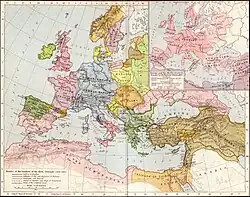
Turkoman pressure intensified along the eastern frontier, which Emperor Romanos IV Diogenes failed to contain, suffering a decisive defeat by the Seljuk sultan Alp Arslan at the Battle of Manzikert in 1071. This defeat, followed by civil war, enabled large-scale Turkoman settlement in Anatolia.[30][31] Turkoman advances encouraged renewed rapprochement between Byzantium and western powers, symbolised by the betrothal of Helen, daughter of the Norman ruler Robert Guiscard, to Constantine, heir of Emperor Michael VII Doukas.[32] In 1074, Pope Gregory VII planned an expedition to support eastern Christians, but it collapsed amid the Investiture Controversy.[33]
In 1077, the general Nikephoros Botaneiates deposed Michael, prompting Gregory to excommunicate him and endorse Guiscard's planned invasion of Byzantium.[34] Botaneiates's ally, the Seljuk prince Suleiman ibn Qutulmish, soon occupied much of western Anatolia, including Nicaea. In 1081, Alexios Komnenos, a Byzantine aristocrat, seized the throne, while Guiscard attacked Dyrrachium on the Adriatic coast.[35] Alexios secured Venetian naval support through commercial privileges and by 1083 forced the Norman withdrawal with Turkoman assistance. By 1094, he crushed the Pechenegs with Cuman support, and also defeated the Cumans, restoring imperial control over the Danube frontier.[36]
Upon Alexios's accession, Gregory VII excommunicated him, but Gregory's successor Urban II sought to renew relations with the Eastern (or Orthodox) Church. He lifted the excommunication and approached Patriarch Nicholas III of Constantinople, requesting inclusion of his name in the Constantinopolitan diptychs. A synod agreed on condition that Urban formally announce his election and submit a written profession of faith. According to the church historian Aristeides Papadakis, Urban never complied. Nevertheless, Alexios maintained amicable relations with the West for military reasons.[37] Mercenaries were central to Byzantine armies, and in 1090 Alexios secured a promise from Robert I of Flanders to provide 500 knights.[38] In 1095, he sent envoys to the Council of Piacenza to seek papal support in mobilising western forces.[39][40] At this time, as the Byzantininst Ralph-Johannes Lilie notes, the papacy was the only western power "with a vital interest" in aiding Byzantium.[41]
First Crusade
Council of Clermont

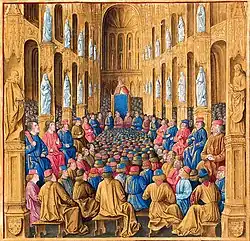
According to the historian Christopher Tyerman, Pope Urban II began recruiting for an eastern expedition soon after the Council of Piacenza, initially in northern Italy. His subsequent visit to France attracted widespread attention, culminating in the proclamation of the First Crusade at the Council of Clermont on 27 November 1095. He presented the venture as an armed penitential pilgrimage, promising spiritual rewards that offered relief to knights' troubled consciences, prompting many to "take the cross", sewing cloth crosses on their robes, as a pledge of commitment.[42][43] Although Urban emphasized the defence of eastern Christians, for most participants the chief aim became the liberation of Jerusalem.[44]
Emperor Alexios I likely expected limited military assistance under imperial control, but Urban's appeal generated unexpected enthusiasm, leading to the formation of several armies, together exceeding 30,000 armed men and perhaps a further 70,000 non-combatants.[45][46][47] Urban appointed Bishop Adhemar of Le Puy as papal legate and set 15 August 1096 as the departure date, instructing the crusaders to assemble at Constantinople.[48] The Byzantine authorities had little time to prepare, and the arrival of large forces beyond imperial control caused alarm. To manage the threat, they adopted what the Byzantinist Jonathan Harris terms a "carrot and stick" strategy, escorting the crusaders with imperial troops to deter attacks while supplying them with provisions.[49]
People's Crusade
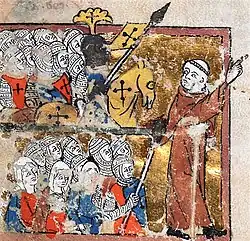
Meanwhile, Peter the Hermit, a charismatic preacher, organised a recruitment movement in northern France and eastern Germany. By March 1096 he had gathered over 10,000 followers and departed months before the official crusading forces. From varied social backgrounds, the group included few knights and was largely ill-equipped.[42][48] Travelling in two contingents through Hungary, the first, led by the knight Walter Sans Avoir, reached Constantinople without serious incident c. 15 July. The second, led by Peter and four knightly captains, clashed with Byzantine forces at Nish over supplies before arriving on 1 August. According to the Gesta Francorum, their plundering of the suburbs led Emperor Alexios to transfer them across the Bosporus into Anatolia. From a base near Nicomedia they raided Seljuk lands, but were almost entirely destroyed by Kilij Arslan I, Sultan of Rum, at the Battle of Civetot on 21 October 1096.[50][51]
Princes' Crusade
The aristocratically led crusading armies entered Byzantine territory from several directions between October 1096 and April 1097. Hugh of Vermandois, brother of Philip I of France, landed at Dyrrachium; Bohemond of Taranto, son of Robert Guiscard, arrived at Avlona; Godfrey of Bouillon, Duke of Lower Lorraine, travelled overland through Hungary; Raymond of Saint-Gilles, Count of Toulouse, entered via the Dalmatian coast; and a final contingent under Robert of Normandy, Robert II of Flanders, and Stephen II of Blois, also disembarked at Dyrrachium.[52][53] Hugh, whose forces had been scattered by a storm, was escorted to Constantinople under close supervision, while the remaining armies were guided by Pecheneg mercenaries. Byzantine officials intercepted inter-army communications and required the crusaders to camp outside the city. Emperor Alexios I demanded oaths binding the leaders to restore former Byzantine territories. Although initially resisted—many claimed divine mandate—most eventually complied; Raymond agreed only to respect the emperor's life and honour. Skirmishes with Byzantine troops were frequent, and Bohemond even proposed an attack on Constantinople. After the oaths, Alexios rewarded the leaders with precious gifts.[54][55]
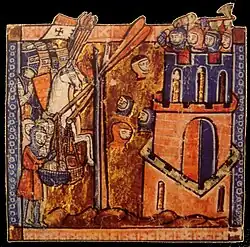
Between February and April 1097 the armies were transported to Anatolia.[51] In May they besieged Nicaea with Byzantine support and defeated a relief force under Kilij Arslan. Despite strong lake-borne supply lines, the city capitulated after eight weeks when a Byzantine flotilla severed access, surrendering directly to Alexios, who forbade its sack.[56] The fall of Nicaea opened the route to Antioch. Declining direct command, Alexios appointed his general Tatikios to accompany the army.[57][58] The campaign weakened Turkomans in western Anatolia and facilitated the Byzantine recovery of Smyrna, Ephesos, and Philadelphia from the local ruler Chaka Bey.[59]
After defeating a major Turkoman force at the Battle of Dorylaeum on 1 July, the crusaders captured several Cappadocian towns, which were soon transferred to Byzantine control. Lilie argues that these inland territories, vulnerable to Turkoman pressure, held limited strategic value for the crusaders. By contrast, Baldwin of Boulogne, brother of Godfrey of Bouillon, and Tancred, nephew of Bohemond of Taranto, established garrisons in the Cilician coastal fortresses seized during an autumn campaign.[60] The main army began the Siege of Antioch in October. The multi-ethnic city, ruled by the Turkoman emir Yağısıyan under the nominal authority of the Seljuk prince Ridwan of Aleppo, possessed formidable defences that prevented a full blockade, while winter shortages severely strained the besiegers.[61][62] Tancred rejoined the army, whereas Baldwin advanced eastwards and, with Armenian support, founded the County of Edessa, the first Crusader state, in March 1098.[63]
In early 1098 Tatikios withdrew to Cyprus for uncertain reasons.[62] Desertions increased as news spread of a relieving army under the Seljuk governor of Mosul, Kerbogha. Among the deserters was Stephen of Blois, whose report to Emperor Alexios at Philomelium portrayed the crusaders’ desperate situation and, together with rumours of an advancing Seljuk force, contributed to the emperor’s decision to abandon his march on Antioch.[64][65] Despite this, the crusaders captured the city on 3 June with internal assistance and, encouraged by the discovery of the so-called Holy Lance, defeated Kerbogha on 28 June. Having played a leading role in both victories, Bohemond subsequently claimed Antioch, although the leaders dispatched envoys to Constantinople urging Alexios to assume control, while intimating that failure to do so would render their earlier oaths void.[66][67]
The advance towards Jerusalem was delayed by the summer heat. Bohemond began to act as ruler of Antioch, granting property and commercial privileges to the Genoese. By early November 1098 he had convinced most crusader leaders, except Raymond, that Byzantine support was no longer forthcoming. They therefore recognised his claim to the city, while requiring him to withdraw from the nearby port of Laodicea, regarded as Byzantine territory. When the crusade resumed in November, Bohemond exploited the departure of much of the army to secure full control of Antioch, thereby consolidating the Principality of Antioch.[68][69] In March 1099 Byzantine envoys demanded the city's surrender, but were rebuffed. They raised formal complaints at the crusader camp at the fortress of Arqa, but these were dismissed on the grounds that Alexios had failed to honour his earlier commitments. Although the envoys promised the Emperor's arrival by late June and offered substantial gifts, only Raymond supported their proposal. The crusaders pressed on and captured Jerusalem on 15 July.[70][71] Godfrey of Bouillon was chosen as the city's first crusader ruler, though his brother and successor Baldwin became the first to be crowned King of Jerusalem on Christmas Day 1100.[72]
Conflicts and cooperation
Rival claims
The establishment of the Crusader states fundamentally transformed the political landscape of the Middle East. Antioch, captured by the Seljuks in 1084, was especially significant as a major commercial centre and leading ecclesiastical see.[73] Its strategic position made any Byzantine campaign against Jerusalem or Edessa unthinkable.[74] Although Jerusalem had been lost centuries earlier, successive emperors continued to claim responsibility for the protection of its holy sites. By contrast, the Byzantines did not challenge the Frankish occupation of Edessa, despite having held the city until 1087.[75]
In 1099–1100, Catholic clerics were appointed to the sees of Jerusalem and Antioch in clear disregard of imperial prerogatives. In Jerusalem, the death of the Orthodox patriarch Symeon II eased the appointment; in Antioch, however, Bohemond exiled the patriarch John the Oxite to facilitate the installation of a Latin incumbent. The Byzantines rejected these appointments and instead named Orthodox patriarchs resident in Constantinople, resulting in parallel Catholic and Orthodox successions in both sees.[76]
During the First Crusade, a Byzantine force seized Laodicea, threatening Bohemond's position at Antioch. He responded by allying with Archbishop Daimbert of Pisa, who arrived in August 1099 with a fleet that had plundered Byzantine islands. The siege was abandoned following the intervention of Raymond of Saint-Gilles and other crusader leaders returning from Jerusalem, after which Raymond entered the city with Byzantine approval. Imperial forces subsequently secured Cilicia and their position was strengthened by Bohemond's capture by Turkomans in August 1100. Meanwhile, Raymond departed for Constantinople to meet with Alexios.[77] Early the following year, Tancred became regent of Antioch and seized Cilician towns, as well as Marash in the interior, from the Byzantines.[78][79]
A new wave of crusading armies reached Constantinople in spring 1101, led by nobles and prelates, including Anselm of Milan, William IX of Aquitaine, and Welf of Bavaria. Alexios required their leaders to swear an oath to restore reconquered imperial territories before transporting them into Anatolia, appointing the generals Tzitas and Raymond as escorts. Although the armies were ultimately destroyed by Turkoman coalitions, they recovered Ankyra for the Byzantines.[80][81] Raymond was among the few leaders to survive. He withdrew from Laodicea and, with Byzantine support, prepared campaigns against Tortosa and Tripoli south of Antioch. Laodicea was soon taken from the Byzantines by Tancred (likely in early 1103, according to Lilie).[82]
Bohemond's crusade
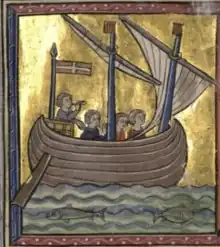
Bohemond was held captive by the Danishmend emir Gazi Gümüshtigin, who released him for 100,000 nomismata despite Alexios's earlier offer of a higher ransom. Alexios again demanded the cession of Antioch, but Bohemond refused.[83][84] On 7 May 1104, forces from Antioch and Edessa were defeated by a Turkoman coalition at the Battle of Harran. Baldwin of Boulogne's successor in Edessa, Baldwin of Bourcq, was captured, and Bohemond appointed Tancred to rule the county.[85] Meanwhile, Byzantine forces seized Laodicea and several Cilician towns. These setbacks led Bohemond to seek Western support and return to Europe by year's end.[86]
Bohemond secured the support of Pope Paschal II for a new crusade and raised a force of French and Italian knights. In autumn 1107 he crossed the Adriatic to attack Dyrrhachium. Anticipating the campaign, Alexios I had recruited Turkoman mercenaries, mobilised imperial troops, and obtained Venetian naval assistance. Avoiding a pitched battle, the Byzantines blockaded Bohemond's army, cut its supply lines, and forced his surrender in September 1108.[87][88] Under the Treaty of Devol, Bohemond declared himself "the loyal man" of Alexios and his heir John. In return for recognition of his lifetime rule over Antioch and nearby territories, he undertook to arrange Tancred's withdrawal from other conquered lands and accept a patriarch for Antioch appointed by Alexios.[89] Although historians differ in their assessments, the treaty suggests Alexios recognised the impossibility of expelling the Normans and instead sought recognition of his suzerainty over Antioch.[90]
The treaty was never implemented: Bohemond did not return to Antioch, and Tancred ignored its provisions, expanding into Cilicia and capturing Laodicea.[91] Alexios responded by encouraging Seljuk attacks, placing the northern Crusader states under pressure.[92] In July 1109, a coalition of Frankish rulers captured Tripoli and granted it to Bertrand, son and successor of Raymond, who had sworn fealty to Alexios.[93][94] Alexios later sought support from Bertrand and Baldwin I of Jerusalem against Tancred, offering financial inducements, but both refused. After Bertrand's death in 1112, his son Pons renewed his oath of fealty to Alexios.[95] Tancred died of illness in the same year and was succeeded by his nephew, Roger of Salerno.[96]
Tensions

Emperor Alexios I died of illness on 15 August 1118. His son and successor, John II, initially faced a conspiracy led by his sister Anna Komnene, followed by invasions on several fronts, which curtailed Byzantine involvement in the affairs of the Crusader states.[97] By the time of his accession, a Byzantine envoy, Ravendinus, had arrived in Antioch to negotiate a marriage alliance, according to the chronicler Orderic Vitalis. The following year, Ravendinus was present at the Battle of the Field of Blood, where the Turkoman ruler Ilghazi inflicted a crushing defeat on Roger of Salerno, who was killed in the fighting.[98][99] Antioch survived largely owing to the intervention of Baldwin II, the new king of Jerusalem, who assumed the regency for Bohemond's absent son, Bohemond II.[90]
Upon his accession, John refused to confirm Venetian commercial privileges, provoking a Venetian naval attack on the island of Corfu during the Venetian Crusade in 1123, followed by raids on Aegean islands the next year as their fleet returned from the Holy Land. Peace was restored in 1126, when John confirmed these privileges.[100][101] In the same year, Bohemond II arrived in Antioch and married Alice, Baldwin II's daughter, but was killed by Danishmendid forces in 1130. Baldwin II again assumed the regency, this time for Bohemond and Alice's six-year-old daughter, Constance. His death the following year triggered renewed conflict between his successor and son-in-law, Fulk of Anjou, and Alice.[102] Taking advantage of the instability, an Armenian ruler in Cilicia, Leo, seized coastal towns from Antioch.[103] In 1136, Antiochene envoys proposed Constance's marriage to John's youngest son, Manuel, a plan supported by John to assert Byzantine control, but thwarted by Fulk, who instead arranged her marriage to the French noble Raymond of Poitiers.[104][105][106]
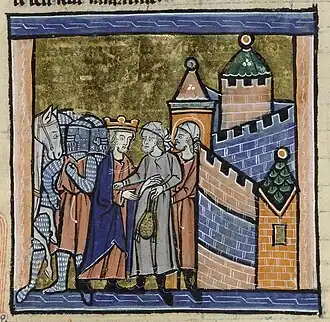
In the early 1130s, John's younger brother, the sebastokrator Isaac Komnenos, unexpectedly defected from the Byzantine Empire and sought support among its eastern Muslim and Christian neighbours. Lilie argues that Isaac's ultimately unsuccessful search for allies intensified John's concerns regarding the Middle East.[107] Three 12th-century historians offer differing explanations for John's decision to launch a military expedition into the region: John Kinnamos and William of Tyre stress the issue of Constance's marriage, while Michael Choniates identifies Armenian expansion as the principal cause.[105][108] In the summer of 1137, John invaded Cilicia, capturing its coastal towns and forcing Leo to take refuge in the Taurus Mountains. He then advanced on Antioch, compelling Raymond to submit in September.[109][110] The terms of the subsequent agreement remain unclear: Kinnamos and Choniates describe Raymond's acceptance of Byzantine suzerainty, while William of Tyre records an additional promise to cede Antioch in exchange for Aleppo, Shaizar, Hama, and Homs, to be conquered with Byzantine assistance. In May 1138, Raymond and Joscelin II of Edessa joined John's campaign against Aleppo, which failed, leading the army to turn against Shaizar, but its ruler secured peace by paying an indemnity. William of Tyre adds that Raymond and Joscelin displayed little enthusiasm for the campaign, reportedly passing the siege playing chess. After the expedition, John made a triumphal entry into Antioch, where Raymond again acknowledged him as overlord.[111]
In autumn 1142, John returned to northern Syria with the explicit aim of conquest. He first attacked Turbessel, the seat of Joscelin, forcing him to surrender a daughter as a hostage. John then advanced on Antioch and, according to Kinnamos, demanded the city, intending to grant it as part of an appanage to Manuel. Raymond refused, arguing—according to William of Tyre—that he ruled in his wife's right and lacked authority to dispose of the principality. John withdrew to winter in Cilicia, sending envoys to Fulk to announce a planned pilgrimage to Jerusalem, from which Fulk dissuaded him.[112][113] John died unexpectedly in a hunting accident on 8 April 1143.[114] The Byzantinist Paul Magdalino observes that John's death prevented "the most ambitious" Byzantine attempt to restore the pre-Islamic empire since the 10th century.[115]
John was succeeded by Manuel, the younger of his two surviving sons. Exploiting the uncertainty of the succession and a Seljuk invasion, Raymond demanded several Cilician towns. His subsequent incursion was repelled by a Byzantine army, while a fleet raided the Antiochene coast.[116][117][118] On 24 November 1144, Zengi besieged Edessa. Raymond was unable to dispatch a relief force, and the city fell in late December.[119] The loss of Edessa compelled Raymond to seek reconciliation with Byzantium, leading to a visit to Constantinople, where he swore fealty to Manuel.[116][117] By contrast, the Cilician Armenians benefited from the changing political circumstances, as Leo's son Thoros II had by the end of the decade united much of Cilicia under his rule.[120]
Second Crusade
The fall of Edessa led Pope Eugenius III to proclaim the Second Crusade in December 1145. The campaign was led by Conrad III of Germany and Louis VII of France, both of whom marched their armies towards Syria through Byzantine territory. As during the First Crusade, news of the expedition caused concern in Constantinople.[121] To secure the alliance against the Normans of Sicily concluded during his father's reign, Manuel married Conrad's sister-in-law, Bertha of Sulzbach, in early 1146.[122] Byzantine envoys were dispatched to both rulers to negotiate provisions for their armies, although clashes between local populations and crusaders proved unavoidable during the march across the Balkans.[123] In the summer of 1147, a naval raid by Roger II of Sicily against the Ionian Islands and Greece heightened Byzantine fears of a coordinated western assault on the empire.[124][125]
The German crusaders reached Constantinople in September and crossed the Bosporus into Anatolia without waiting for the French. Ignoring Manuel's advice to advance through western Anatolia, they engaged the Sultanate of Rum and suffered a decisive defeat at the Battle of Dorylaeum. Conrad narrowly escaped into Byzantine territory and, owing to illness, was unable to resume the crusade until the following spring when he sailed to Acre.[126][127]
The French arrived in October 1147.[124] Within their ranks, a faction influenced by Bishop Godefroy of Langres urged Louis VII to attack Constantinople in retaliation for the expulsion of Catholic clergy from Byzantine-controlled Cilicia. According to the chronicler Odo of Deuil, Manuel persuaded the French to continue the crusade by circulating false reports of a German victory over the Seljuks of Rum. Although Manuel secured oaths from the French leaders to surrender any reconquered former imperial territories in exchange for supplies, the crusaders relied heavily on plundering the local population. Consequently, the local Greeks supported the Turkomans, who repeatedly harassed the French during their march across western Anatolia. Weakened by these attacks, Louis and several leaders embarked at Attalia for Antioch aboard Byzantine ships, leaving the main body of the army behind; during its subsequent march towards Syria, it was almost entirely destroyed by Turkoman forces.[128]
After reaching the Kingdom of Jerusalem, the remnants of the crusading armies laid siege to Damascus, but the operation ended in failure in July 1148.[129] On his return to Germany, Conrad III renewed the anti-Norman alliance with Manuel during a meeting in Thessalonica at the turn of 1148–49. By contrast, the French adopted a hostile stance towards the Byzantines, accusing them of duplicity, inadequate provisioning, and tacit collaboration with the Seljuks, which they blamed for the crusade's overall failure.[130]
Byzantine hegemony
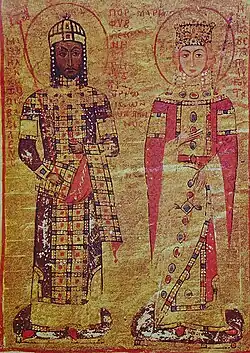
In the aftermath of the Second Crusade, Emperor Manuel faced Norman, Cuman, and Hungarian invasions, as well as Serbian rebellions.[131] In the east, Nur al-Din, son and successor of Zengi in Aleppo, launched raids against the Crusader states. Raymond of Antioch was killed at the Battle of Inab in June 1149, and the following year Joscelin II of Edessa was captured by Turkoman forces. Unable to resist Nur al-Din's advance, Joscelin's wife, Beatrice of Saone, agreed to sell the county's remaining territories to Manuel in exchange for an annuity; within a year, however, Nur al-Din conquered these lands.[132][133]
Seeking to reinforce Byzantine influence in Antioch, Manuel proposed that Raymnond's widow, Constance, marry the Kaisar John Roger, widower of Manuel's sister Maria. Supported by Antioch's citizens, who feared harsher Byzantine taxation, Constance refused and instead married the French knight Raynald of Châtillon in 1153. Meanwhile, an imperial army suffered a serious defeat by Thoros II of Cilicia. Manuel engaged Raynald for an invasion of Cilicia; notwithstanding the success of the Antiochene expedition, Raynald considered his remuneration unduly delayed.[134] In retaliation, Raynald allied with Thoros and launched plundering raids against Cyprus, exploiting Manuel's war with William I of Sicily.[135][136]
In 1158, Manuel concluded a peace treaty with the Normans of Sicily,[137] allowing him to pursue a more assertive policy toward the Crusader states. These were increasingly threatened by the expanding power of Nur al-Din, who had united Damascus and Aleppo. Meanwhile, in the aftermath of the Second Crusade, crusading enthusiasm in the West had declined, and the limited forces reaching Syria proved inadequate for their defence.[138][139] After prolonged debate over a Byzantine alliance, Baldwin III of Jerusalem, with the consent of his kingdom's aristocracy, sent an embassy to Constantinople in 1157 to propose a dynastic marriage. Manuel selected his niece Theodora as Baldwin's bride and provided her with a generous dowry of 100,000 nomismata, along with further funds to cover nuptial expenses.[138][140]
The Byzantine–Jerusalemite alliance proved advantageous to Manuel.[140] When he launched a punitive campaign against Cilicia and Antioch, Baldwin consistently supported the Byzantine position. In early 1159, Raynald was forced to swear fealty to the Emperor and agree to replace the Latin patriarch of Antioch with an Orthodox prelate. Baldwin, who was present, mediated a reconciliation between Manuel and Thoros, who surrendered the Cilician coastal towns and acknowledged Byzantine suzerainty. Manuel's subsequent entry into Antioch symbolised Byzantine supremacy: Baldwin rode behind him without royal insignia, while Raynald served as his marshal.[141] Manuel also pledged support for the Franks against Aleppo, but the joint campaign was soon abandoned after he made peace with Nur al-Din in exchange for the release of Christian captives and an alliance against the Seljuks of Rum.[142] Ultimately, Raynald failed to install an Orthodox patriarch in Antioch.[143]
At the turn of 1160–61, Raynald was captured by Turkomans. Baldwin III appointed Aimery, Latin Patriarch of Antioch, as regent for the underage Bohemond III, Constance's son by her first husband. Widowed in 1159, Manuel sought a Frankish bride. Although Baldwin proposed his cousin Melisende of Tripoli, Manuel instead chose Bohemond's sister Maria, to strengthen Byzantine influence in the principality. This angered Melisende's brother, Raymond III of Tripoli, who used his newly built fleet to raid Byzantine territory.[144] In 1163, Baldwin III died of illness and was succeeded by his brother Amalric. Constance then attempted to assert authority in Antioch, but was expelled by the anti-Byzantine elite with Cilician Armenian support. In 1164, Amalric warned Louis VII of France that, without western aid, the Crusader states would inevitably fall to either Nur ad-Din or the Byzantines, but he soon recognised that such assistance would not materialise.[145][146]
Lure of Egypt
In Lilie's view, Emperor Manuel's intervention in 1159 convinced the Franks that he would not undermine Nur ad-Din, while signalling to Nur ad-Din that the Byzantines would prevent any seizure of Antioch; as a result, both sides focused on the weakening Fatimid Caliphate.[147] Amalric of Jerusalem launched his first invasion of Egypt in September 1163. The following year, Nur ad-Din appointed his Kurdish general Shirkuh to lead an expedition to Egypt, prompting Amalric's return.[148] Nur ad-Din then invaded Antiochene territory and defeated a Byzantine–Antiochene–Cilician Armenian coalition at the Battle of Harim. According to William of Tyre, fear of Byzantine intervention deterred him from attacking Antioch and led to the release of Bohemond III of Antioch and the Byzantine governor of Cilicia, Constantine Kalamanos, for ransom.[149][150] Manuel financed the ransom in return for Bohemond's agreement in 1165 to install the Orthodox patriarch Athanasius I Manasses in Antioch. The Latin patriarch Aimery was exiled.[150][151]
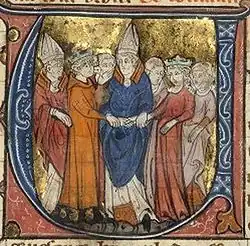
Amalric concluded that the Crusader states depended on Byzantine protection and in 1165 sent an embassy to Constantinople seeking an imperial bride. Around the same time, Manuel's cousin Andronikos Komnenos, after seducing Manuel's sister-in-law Philippa in Antioch, embezzled imperial funds and fled to Jerusalem. Unaware of this, Amalric granted Beirut to Andronikos as a fief, after which he entered an affair with his niece Theodora, Baldwin III's widow.[152] In 1167 Amalric married Manuel's great-niece Maria Komnena, swore fealty to Manuel, and acknowledged him as protector of the holy places. With Byzantine backing, churches and monasteries were restored, and Manuel's portrait appeared in mosaics at the Church of the Nativity.[153][154] Manuel demanded Andronikos's extradition, but he and Theodora fled to Nur ad-Din.[155]
Fearing Amalric's invasion, the Fatimid caliph al-Adid appointed Shirkuh vizier in early 1169, and after his death, Shirkuh's nephew Saladin.[154] In late summer a Byzantine fleet of over 150 galleys reached Cyprus, but delays by the Jerusalemite army left it short of supplies, and a joint Byzantine–Jerusalemite assault on the Egyptian port of Damietta failed in January 1170. Lilie argues that Amalric participated only half-heartedly, as he opposed Byzantine expansion.[156] In the same year, an earthquake destroyed the sanctuary of Antioch Cathedral and killed the Orthodox patriarch, prompting Bohemond to recall the Latin patriarch to his see.[151] A Jerusalemite embassy sought support in the West but met with no success amid the conflicts between France and England and between Emperor Frederick I and the papacy. In March 1171, Amalric travelled to Constantinople and, according to Kinnamos, swore fealty to Manuel I.[157][158] Around the same time, following a Venetian attack on the Genoese quarter in Constantinople, Manuel ordered the arrest of all Venetians throughout his empire, precipitating a prolonged conflict.[159]
In September, after the death of al-Adid, Saladin abolished the Fatimid Caliphate, though his relations with Nur ad-Din soon deteriorated. Nur ad-Din died in May 1174, leaving his underage son, al-Salih, as ruler. Amalric died of illness in July, and the throne of Jerusalem passed to his minor son, Baldwin IV, who suffered from leprosy. By the end of the year, Saladin had secured Damascus, Homs, and Hama, but failed to capture Aleppo, the seat of al-Salih.[160] Renewed conflict between Byzantium and the Seljuks of Rum led to war, culminating in Sultan Kilij Arslan II defeat of Manuel's army at the Battle of Myriocephalum. In the following year, however, Byzantine forces routed Turkoman raiders.[161] In August 1177, as preparations were made for a joint attack on Egypt, a Byzantine fleet arrived at Acre, but the Jerusalemite royal council voted against the campaign, and the fleet returned home. No further joint action followed the abortive expedition, although negotiations between Manuel and envoys from Jerusalem continued until his death on 24 September 1180.[162]
Rift
Emperor Manuel was succeeded by his eleven-year-old son, Alexios II Komnenos, who ruled under the regency of his mother, Maria of Antioch. Her position was soon challenged by rival claimants, including Alexios's stepsister Maria and her husband, Renier of Montferrat. The empire's adversaries exploited this instability, with the Seljuks of Rum and Ruben III of Cilicia advancing in southern Anatolia.[163] The same year Bohemond III of Antioch repudiated his Byzantine wife, Theodora.[164]
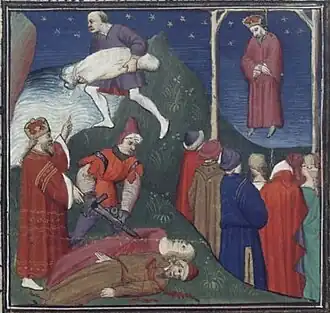
In April 1182, Andronikos Komnenos seized power in a coup supported by popular unrest, during which a mob sacked the Italian merchants' quarter in Constantinople and massacred most of its inhabitants. News of the massacre provoked strong anti-Byzantine sentiment in both the Crusader states and western Europe.[165][166] Andronikos carried out a sweeping purge of his opponents and ordered the execution of Alexios. He permitted the Venetians to return to Constantinople and offered compensation for the property confiscated from them under Manuel. Early in 1185, Manuel's grandnephew Isaac Komnenos seized Cyprus and assumed the imperial title, and in June William II of Sicily invaded Byzantine territory from the west.[167]
A letter by an unidentified Western author, preserved in Magnus of Reichersberg's chronicle, asserts that William's invasion induced Andronikos to conclude an alliance with Saladin against the Seljuks of Rum and the Crusader states. As no other source attests to such an alliance, the report's reliability is questionable. According to Harris, it may instead reflect a pledge by Saladin, in the event of his capture of Jerusalem, to recognise Andronikos's claim to act as protector of the holy places and the indigenous Christian communities.[168] Nevertheless, as Magdalino observes, under Andronikos and his successors Byzantium "opted out of the crusading movement" and "abandoned the search for a high-level entente with one or more of the major western powers".[169]
William's capture of Thessalonica in August 1185 prompted Andronikos to initiate a further purge. One of its intended victims, the aristocrat Isaac Angelos, rose in rebellion with popular backing. Andronikos was lynched by a mob, and Isaac was proclaimed emperor in his stead. The imperial army recovered Thessalonica, slaughtering thousands of Normans, and subsequently retook Dyrrachium. Isaac concluded peace with the Seljuks of Rum and with Hungary. However, the extraordinary levy imposed to finance his marriage to Margaret of Hungary provoked a revolt among the Bulgarians and Vlachs in the Balkans.[170]
Third Crusade
On 4 July 1187, Saladin destroyed the field army of the Kingdom of Jerusalem at the Battle of Hattin.[171] Magnus of Reichersberg's correspondent blamed Emperor Isaac II Angelos, alleging that he had urged Saladin to conquer Jerusalem. Harris, however, regards this claim as "demonstrably false", though amid growing anti-Byzantine sentiment it could readily gain credence in the West. By the end of the year Saladin had secured Jerusalem and much of the kingdom. Reports soon circulated across Catholic Europe alleging an alliance between him and Isaac. Muslim and eastern Christian sources, by contrast, refer only to discussions concerning a mosque in Constantinople and the transfer of the Church of the Holy Sepulchre to the Orthodox Patriarch of Jerusalem.[172]
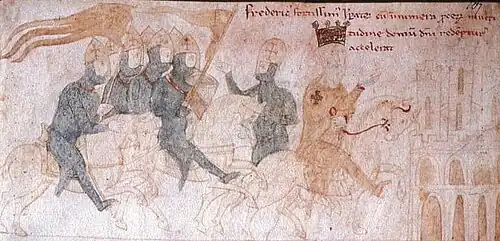
Pope Gregory VIII proclaimed the Third Crusade shortly after news of the disaster at Hattin reached Rome in October 1187. In response, Emperor Frederick I, Richard I of England and Philip II of France took the cross and began raising forces for the campaign.[173] Of the three rulers, only Frederick chose the overland route, opening negotiations with anti-Byzantine leaders, including the Serbian ruler Stefan Nemanja. As Frederick's earlier expansion in Italy had brought him into conflict with Byzantium, his participation in the crusade aroused alarm in Constantinople. Emperor Isaac accordingly dispatched an embassy to express support for the expedition. An agreement was concluded at Nuremberg in the autumn of 1188, whereby the Byzantines granted the German crusaders free passage and access to markets, while Frederick promised a peaceful transit through Byzantine territory.[174]
Despite the agreement, when the German crusaders entered Byzantine territory in July 1189, supplies proved inadequate. Frederick's envoys were arrested in Constantinople, and a Byzantine embassy demanded hostages, accusing him of conspiring with the Serbs and intending to place his son, Frederick of Swabia, on the imperial throne. Frederick responded by seizing Philippopolis, while his son defeated a Byzantine force nearby. The crisis reinforced western suspicions of Isaac's alliance with Saladin, and rumours that the Byzantines were attempting to poison the crusaders spread among the Germans. Frederick even contemplated an assault on Constantinople. Although Isaac did inform Saladin of the crusaders' arrival, Harris argues that he was employing traditional Byzantine diplomacy rather than obstructing the crusade. A settlement was finally reached, and in March 1190 the Germans crossed into Anatolia via the Dardanelles, well away from Constantinople.[175][176] The Germans captured Konya, the capital of Rum, but the drowning of Emperor Frederick in the River Saleph on 10 June brought the expedition to an abrupt end, and only a few of his forces reached Syria.[177]
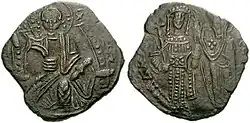
Departing on crusade in July 1190, Richard and Philip wintered in Sicily before resuming their voyage in the spring of 1191.[178] The French fleet reached Syria without incident, but the English fleet was scattered by a storm and regrouped at Cyprus. Seizing the opportunity, Richard conquered the island within three weeks. Isaac Comnenus, the self-proclaimed emperor, was imprisoned, and Richard sold Cyprus to the Knights Templar—an order of warrior monks founded after the First Crusade—for 100,000 bezants. When the Templars proved unable to suppress a revolt by the local population, they returned the island to Richard, who subsequently sold it to Guy of Lusignan, the former King of Jerusalem, for 60,000 bezants. Cyprus, the first Byzantine territory to be conquered and retained by a crusading force, remained under Lusignan rule for more than three centuries.[179][180] Despite tensions between Richard and Philip, the Third Crusade achieved notable successes, restoring parts of the Kingdom of Jerusalem through the recapture of Acre and Richard's victory over Saladin at the Battle of Arsuf.[181]
Crusaders against Byzantium
Pressure
Emperor Frederick I's son and successor, Henry VI, took up his father's unrealised crusading project. In 1194 he pressed the claim of his wife, Constance, to the Kingdom of Sicily, notwithstanding the pre-emptive diplomacy of Emperor Isaac II, who renewed commercial privileges for Genoa and Pisa and arranged the marriage of his daughter, Irene, to Roger, heir to Constance's rival, Tancred. Following the German occupation of Sicily, Henry married Irene to his brother, Philip of Swabia.[182]
Meanwhile, Bulgarian and Vlach rebels, aided by Cuman raiders, had secured control of the Balkan Mountains under the leadership of the brothers Peter and Asen, who assumed the title of tsar (emperor) of Bulgaria. Isaac sought an alliance with Hungary against them, but during his campaign in April 1195 he was deposed, captured, and blinded by his younger brother, Alexios III Angelos.[183][184] The new emperor soon faced renewed turmoil: a revolt led by an impostor claiming to be the late Alexios II Komnenos, Bulgarian and Turcoman raids, and mutinies within the army.[185]
Henry VI took the cross at Bari in April 1195 and soon dispatched envoys to Constantinople demanding free access to Byzantine ports, a naval contribution, and 5,000 pounds of gold in tribute, threatening invasion in the event of non-compliance. Recognising that the empire could not withstand a full-scale assault, Alexios III agreed to pay 1,000 pounds of gold and imposed an extraordinary levy, known as the Alamanikon ("German tax"), resorting even to the seizure of gold and silver ornaments from imperial tombs to meet the cost.[186][184] Byzantium was spared by Henry’s unexpected death and the ensuing civil war in Germany.[187][188] Meanwhile, western imperial influence strengthened along Byzantium's eastern frontiers, as both Leo of Cilician Armenia and Aimery of Cyprus acknowledged the suzerainty of Henry VI in return for royal crowns.[189] Nevertheless, the Byzantines maintained what Lilie terms "empty claims", as illustrated by the chrysobull of 1198 granted to the Venetians, which included Antioch and Laodicea among the cities in which they were accorded commercial privileges, and by the styling of the Venetian doge as "most loyal to the emperor".[190][191]
Fourth Crusade
In the year of his accession (1198), Pope Innocent III proclaimed the Fourth Crusade. His appeal was especially well received among French nobles who had fallen into conflict with their king, Philip II, such as Theobald III of Champagne and Baldwin IX of Flanders.[192][193] Aware of mounting anti-Byzantine sentiment in western Europe, Emperor Alexios III and Patriarch John X of Constantinople addressed letters to the Pope in February 1199. Alexios expressed the hope of Jerusalem's recovery without committing himself to participation in a crusade, requested the convocation of an ecumenical council to heal the schism between the Catholic and Orthodox Churches, and criticised the conduct of Frederick I's army during the Third Crusade.[194] In reply, Innocent urged the prompt reunion of the Churches under papal supremacy and called upon the emperor to support the projected expedition. According to Harris, the repeated use of the term subventio in the papal letter indicates that Innocent primarily envisaged financial assistance.[195]
The crusade leaders concluded a treaty with Venice in April 1201, undertaking to pay 85,000 marks in four instalments by April 1202 for the construction of ships capable of transporting more than 33,000 crusaders and their provisions. In the summer, they chose Boniface I of Montferrat as the expedition's paramount leader. He was the elder brother of Renier, son-in-law of Emperor Manuel I, who had fallen victim to the purge carried out under Andronikos I.[196][197] When the crusaders proved unable to pay the full amount, the Venetians agreed to defer the remaining 35,000 marks in return for their support in the capture of Zara, a Dalmatian town under Hungarian suzerainty. Meanwhile, Alexios Angelos, son of the deposed Isaac II, fled Constantinople to seek western support against his uncle, Emperor Alexios III. In January 1203 he approached the crusade leaders, offering to place the Byzantine Church under papal authority, to pay 200,000 marks, and to join the crusade with a force of 10,000 in return for their assistance in restoring his father to the throne.[198][199]

Despite strong opposition from the rank-and-file, the principal leaders—notably Boniface, Baldwin, and the Venetian doge Enrico Dandolo—accepted Alexios's offer for strategic and logistical reasons, and the fleet reached Constantinople on 24 June 1203. Although Pope Innocent had warned Emperor Alexios III in November 1202 that "the fire in distant regions" might spread to Byzantine territory should he fail to support the crusade, in June 1203 he explicitly forbade the crusaders to attack Constantinople; his envoys, however, did not reach them.[200][201] Although the imperial army was at least equal in strength to the crusaders, numbering nearly 20,000 men, Alexios III fled the capital when the Venetians captured towers along the city walls on the Golden Horn on 17 July. The following day the blind Isaac II was restored to the throne, and on 1 August his son was crowned co-emperor as Alexios IV. He paid 100,000 marks to the crusaders and, in a letter issued jointly with Patriarch John, acknowledged papal primacy.[202][203]
Alexios IV was unable to pay the remaining 100,000 marks, probably, as Harries argues, because his customs revenues declined after fires destroyed Constantinople's commercial districts during the siege, while land tax receipts fell as extensive territories beyond the capital remained under the control of Alexios III. Although the crusaders helped expel his uncle from Thrace, his heavy taxation and tensions between Byzantines and crusaders made him deeply unpopular. On 29 January 1204, the aristocrat Alexios Doukas Mourtzouphlos staged a coup and took the throne as Alexios V. The crusaders regarded him as a usurper who had murdered his lawful sovereign, and during a skirmish seized from him a lavishly decorated icon of the Mother of God, which they interpreted as a sign that the city's divine protection had passed to them.[204]
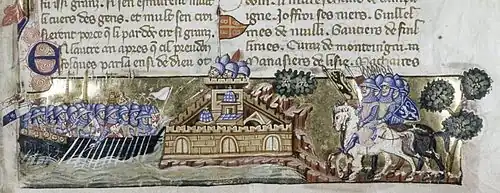
In preparation for a renewed siege of Constantinople, the crusader leaders and the Venetians concluded an agreement in March 1204. It provided for the election of a Catholic (Latin) emperor, who would receive one quarter of both the city and the empire; Venice would receive another quarter of the city and three-eighths of the empire, while the remainder would be divided as fiefs among the crusader leaders. They also agreed that if a crusader were elected emperor, a Venetian would become patriarch, and conversely.[205][206] The crusaders' first assault failed, prompting them to expel prostitutes from their camp. Their second attack, on 12 April, succeeded, forcing Alexios V to flee. The victory was followed by a three-day sack of Constantinople, during which the crusaders massacred thousands of inhabitants, raped women, and desecrated churches. The total value of the plunder reached 800,000 marks[207]—equivalent to the ten-year income of what Tyerman describes as "a substantial western state".[208] The spoils were distributed unequally, with Venice receiving 450,000 marks.[207]
For the crusaders, their victory signified divine favour against a schismatic adversary unwilling to cooperate in the defence of the holy places. From a strategic perspective, control of the wealthy Byzantine Empire promised to strengthen the position of the Crusader states. This confidence was reflected in the words of Pope Innocent, who declared that, through their conquest, "the Holy Land might be more easily liberated from pagan hands", when he authorised them to abandon the crusade.[209]
The Latin Empire and the Byzantine successor states
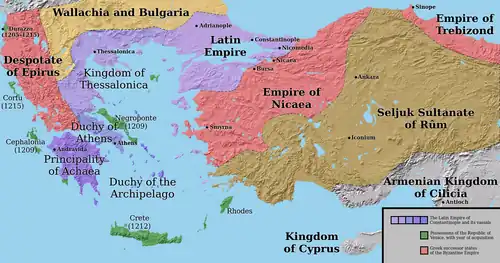
Boniface of Montferrat married Margaret of Hungary, widow of Emperor Isaac II, to strengthen his claim to the imperial throne. However, Venetian opposition to the pro-Genoese Boniface ensured the election of Baldwin of Flanders as the first Latin Emperor of Constantinople, crowned in Hagia Sophia on 16 May 1204.[210][211] The Venetians then appointed Thomas Morosini as the first Latin Patriarch. The victors formalised their agreement on the partition of the Byzantine Empire, though much territory remained unconquered.[212]
During the ensuing period, the Latins conquered extensive territories of the Byzantine Empire, establishing new states such as the Kingdom of Thessalonica, the Principality of Achaea, and the Duchy of Athens. The Latin Empire thus became, in the words of the historian David Jacoby, "a mosaic of political entities", connected by frequently shifting and complex networks of vassalage.[213] Meanwhile, the Venetians seized Crete, several Ionian Islands, and Dalmatian ports, while denying their Genoese and Pisan competitors access to trade within the Latin Empire.[214]
Initially, the Latins encountered little resistance, and many among the local population even welcomed them with rejoicing, regarding them as protectors against enemies such as the Bulgars. By contrast, members of the traditional Byzantine elite, often associated with burdensome taxation, were widely blamed for the empire's collapse. Although Catholic bishops replaced Orthodox prelates in dioceses under Latin rule, parish life at the local level remained largely unchanged.[215] The Latin defeat by the Bulgars at the Battle of Adrianople and the capture of Emperor Baldwin I soon exposed the fragility of Latin rule and led to the consolidation of three Byzantine successor states. The first, the Empire of Trebizond, was founded early in 1204 by Alexios I and David Komnenos, grandsons of Emperor Andronikos I, and began expanding westwards along the Black Sea coast of Anatolia. They soon came into conflict with the Empire of Nicaea, established in western Anatolia by Theodore I Laskaris, son-in-law of Emperor Alexios III. The third state, the Despotate of Epirus, was founded by Michael I Komnenos Doukas, a relative of the Angelos emperors and Boniface's former ally.[216]
After Patriarch John X died in exile in 1206, the Orthodox population and clergy of Constantinople sought Pope Innocent's approval to elect a successor, but were thwarted by Latin opposition. At their initiative, Theodore I secured the election of a new Orthodox patriarch, Michael IV, at Nicaea in 1208, who soon crowned Theodore emperor.[217] The Nicaean emperors regarded themselves as the lawful successors of the Roman emperors; however, a new identity emerged at their court that emphasised the Greek ancestry of the Nicaeans. This was manifested in a new oratorical style that abandoned the self-designation "Romans" in favour of "Hellenes". This new self-designation expressed the perceived superiority of their refined culture over the Latins, who dismantled classical bronze statues in order to mint coins.[218] In 1209, Patriarch Michael urged the Nicaean soldiers to fight their emperor's "unjust and arrogant enemies", promising absolution of sins to those who died in the struggle, thereby adopting the Catholic concept of crusading in clear contradiction to traditional Byzantine theology.[219] As religious intolerance intensified in the Latin Empire in the early 1210s, a number of Orthodox inhabitants chose to migrate to Epirus or Nicaea.[220]
Relations between the Churches of Nicaea and Epirus grew strained under Theodore, successor to Michael I of Epirus. With the support of a local synod, he secured the appointment of bishops to sees recovered from Latin control, thereby disregarding the authority of the patriarch resident in Nicaea. During his reign, the territory of Epirus doubled in extent, and in 1224 he captured Thessalonica, bringing the Latin kingdom there to an end. To assert his claim to Constantinople, he persuaded Archbishop Demetrios of Ochrid to crown him emperor c. 1225. His expansion was checked in 1230, when he was defeated by Ivan Asen II of Bulgaria at the Battle of Klokotnitsa.[221]
After the death in 1216 of Henry, brother and successor of Emperor Baldwin I, the Latin Empire faced a series of succession crises and acute financial difficulties. As the emperors' direct authority extended only over Constantinople and a narrow surrounding hinterland, fiscal revenues proved insufficient, compelling the regime to mint coins from whatever materials were available, including lead stripped from the roof of the imperial palace, and to pawn or sell relics such as the Crown of Thorns, which was ultimately acquired by Louis IX of France.[222] Under these circumstances, only western support could secure the survival of the Latin Empire and the papacy often assisted in raising western troops by granting crusading indulgence to participants. Already a letter by Pope Innocent III writes of "lay crusaders" fighting in Baldwin I's army "by reason of hope of remission [of sins] and the indulgence that the Apostolic See offers them" on 7 November 1204.[223][224] As rivalries among the Ayyubides-Saladin's kins and relatives-prevented them from effectively attacking the Crusader states, crusading enthusiasm often targeted the Latin Empire's enemies, and knights from the Jerusalemite kingdom sometimes entered into the service of the Latin emperors.[225]
The first crusading campaign explicitly proclaimed in support of the Latin Empire was announced by Pope Innocent in the aftermath of the Battle of Adrianople. He argued that a Byzantine restoration would obstruct access to the Holy Land, asserting longstanding Byzantine uncooperativeness and increased hostility after the sack of Constantinople. He further declared that participants would be released from all prior pilgrimage vows, except those pertaining to the Holy Land, thereby establishing the first documented precedent for the commutation of vows. The crusading force, led by Bishop Nivelon of Soissons, was defeated by Theodore of Epirus; however, some of its members subsequently fought in Emperor Henry’s army against Boril of Bulgaria in 1208.[226]
References
- ^ Lock 2006, p. 358.
- ^ Harris 2022, p. 13.
- ^ Lock 2006, pp. 358–359.
- ^ Harris 2022, pp. 23, 30.
- ^ a b Lock 2006, p. 359.
- ^ Harris 2022, pp. 26–27.
- ^ Harris 2022, pp. 34–37.
- ^ Backman 2022, pp. 132–133, 137–144.
- ^ Jotischky 2017, p. 113.
- ^ Jotischky 2017, p. 29.
- ^ Jaspert 2006, p. 10.
- ^ Backman 2022, pp. 76, 80–83, 154–159.
- ^ Backman 2022, pp. 160–162, 166–169.
- ^ Backman 2022, pp. 186–188.
- ^ Backman 2022, pp. 186–188, 254–255.
- ^ Jaspert 2006, pp. 16–17.
- ^ Backman 2022, pp. 250–251.
- ^ Jaspert 2006, pp. 10–11.
- ^ Harris 2022, p. 11.
- ^ Harris 2022, pp. 33–34, 47.
- ^ Harris 2022, pp. 11–18.
- ^ Angold 2017, pp. 583–585.
- ^ Ellenblum 2012, pp. 38, 86, 96–106, 123–130.
- ^ a b Angold 2017, p. 601.
- ^ Jotischky 2017, pp. 24–27.
- ^ Backman 2022, pp. 291–301.
- ^ Angold 2017, p. 602.
- ^ Lock 2006, p. 14.
- ^ Harris 2022, pp. 54–55.
- ^ Angold 2017, pp. 602–603.
- ^ Lock 2006, p. 15.
- ^ Papadakis 1994, pp. 74–75.
- ^ Jaspert 2006, p. 25.
- ^ Papadakis 1994, p. 75.
- ^ Angold 2017, pp. 610–612.
- ^ Treadgold 1997, pp. 614–620.
- ^ Papadakis 1994, pp. 76–77.
- ^ Lock 2006, p. 249.
- ^ Treadgold 1997, p. 619.
- ^ Jotischky 2017, p. 51.
- ^ Lilie 2004, p. 3.
- ^ a b Tyerman 2019, p. 71.
- ^ Harris 2022, p. 63.
- ^ Lilie 2004, p. 1.
- ^ Lilie 2004, pp. 2–3.
- ^ Treadgold 1997, pp. 619–620.
- ^ Angold 2017, p. 622.
- ^ a b Lock 2006, p. 20.
- ^ Harris 2022, pp. 63–66.
- ^ Harris 2022, p. 67.
- ^ a b Lock 2006, p. 21.
- ^ Lilie 2004, pp. 4–5.
- ^ Lock 2006, pp. 20–21.
- ^ Harris 2022, pp. 69–71.
- ^ Lilie 2004, pp. 8–12.
- ^ Lilie 2004, pp. 28–29.
- ^ Angold 2017, pp. 622–623.
- ^ Harris 2022, p. 74.
- ^ Harris 2022, p. 68.
- ^ Lilie 2004, p. 30.
- ^ Tyerman 2019, p. 85.
- ^ a b Harris 2022, p. 75.
- ^ Lilie 2004, pp. 30–31.
- ^ Jaspert 2006, pp. 42–43.
- ^ Harris 2022, p. 77.
- ^ Lock 2006, p. 23.
- ^ Harris 2022, pp. 77–78.
- ^ Harris 2022, pp. 78–79.
- ^ Lock 2006, pp. 23–24.
- ^ Lilie 2004, pp. 42–45.
- ^ Lock 2006, pp. 24–25.
- ^ Lock 2006, pp. 25–26.
- ^ Harris 2022, p. 83.
- ^ Lilie 2004, p. 61.
- ^ Harris 2022, pp. 83–84.
- ^ Harris 2022, pp. 84–85.
- ^ Lilie 2004, pp. 61–67.
- ^ Lock 2006, p. 26.
- ^ Lilie 2004, p. 70.
- ^ Lock 2006, pp. 142–144.
- ^ Harris 2022, pp. 64, 68, 85–86.
- ^ Lilie 2004, pp. 70–71.
- ^ Harris 2022, pp. 86–87.
- ^ Lilie 2004, p. 71.
- ^ Lock 2006, p. 28.
- ^ Lilie 2004, pp. 72–73.
- ^ Treadgold 1997, p. 626.
- ^ Lilie 2004, pp. 74–75.
- ^ Harris 2022, p. 88.
- ^ a b Jotischky 2017, p. 73.
- ^ Jotischky 2017, pp. 73–74.
- ^ Lilie 2004, p. 85.
- ^ Lock 2006, p. 30.
- ^ Lilie 2004, p. 82.
- ^ Lilie 2004, pp. 85–87.
- ^ Harris 2022, p. 90.
- ^ Harris 2022, pp. 90–91.
- ^ Lilie 2004, p. 95.
- ^ Lock 2006, p. 34.
- ^ Lilie 2004, p. 97.
- ^ Lock 2006, p. 145.
- ^ Lock 2006, pp. 140–141.
- ^ Lilie 2004, pp. 105–106.
- ^ Lilie 2004, pp. 103–104.
- ^ a b Harris 2022, p. 92.
- ^ Jotischky 2017, p. 81.
- ^ Lilie 2004, pp. 110–111.
- ^ Lilie 2004, pp. 109–112.
- ^ Treadgold 1997, p. 633.
- ^ Lock 2006, p. 43.
- ^ Harris 2022, pp. 92–95.
- ^ Lilie 2004, pp. 135–138.
- ^ Harris 2022, pp. 95–97.
- ^ Lock 2006, p. 45.
- ^ Magdalino 2017, p. 633.
- ^ a b Harris 2022, p. 105.
- ^ a b Magdalino 2017, p. 636.
- ^ Lilie 2004, p. 144.
- ^ Lock 2006, p. 46.
- ^ Lilie 2004, p. 166.
- ^ Harris 2022, pp. 106–107.
- ^ Treadgold 1997, p. 640.
- ^ Harris 2022, pp. 107–108.
- ^ a b Lock 2006, p. 48.
- ^ Lilie 2004, p. 155.
- ^ Treadgold 1997, pp. 640–641.
- ^ Lock 2006, pp. 48–49.
- ^ Lilie 2004, pp. 155–158.
- ^ Lock 2006, p. 49.
- ^ Harris 2022, pp. 110–111.
- ^ Treadgold 1997, pp. 641–642.
- ^ Harris 2022, p. 116.
- ^ Lilie 2004, pp. 163–164.
- ^ Lilie 2004, pp. 167–168.
- ^ Jotischky 2017, p. 99.
- ^ Lilie 2004, p. 171.
- ^ Magdalino 2017, p. 638.
- ^ a b Lilie 2004, p. 175.
- ^ Tyerman 2019, p. 161.
- ^ a b Harris 2022, p. 120.
- ^ Lilie 2004, pp. 176–183.
- ^ Harris 2022, p. 117.
- ^ Lilie 2004, p. 191.
- ^ Lilie 2004, pp. 184–185.
- ^ Lock 2006, p. 56.
- ^ Lilie 2004, pp. 187–188.
- ^ Lilie 2004, p. 189.
- ^ Lock 2006, pp. 56–57.
- ^ Lilie 2004, p. 190.
- ^ a b Lock 2006, p. 57.
- ^ a b Harris 2022, p. 118.
- ^ Lilie 2004, pp. 192–195.
- ^ Harris 2022, pp. 120–121.
- ^ a b Lock 2006, p. 58.
- ^ Lilie 2004, p. 195.
- ^ Lilie 2004, pp. 200–202.
- ^ Lilie 2004, pp. 202–209.
- ^ Jotischky 2017, p. 100.
- ^ Treadgold 1997, p. 648.
- ^ Lock 2006, pp. 60–62.
- ^ Treadgold 1997, p. 649.
- ^ Lilie 2004, pp. 215–216, 219–220.
- ^ Treadgold 1997, pp. 650–651.
- ^ Harris 2022, p. 142.
- ^ Harris 2022, pp. 132–137.
- ^ Lock 2006, p. 67.
- ^ Treadgold 1997, pp. 648, 652–654.
- ^ Harris 2022, pp. 139–142.
- ^ Magdalino 2017, p. 648.
- ^ Treadgold 1997, pp. 654–657.
- ^ Lock 2006, p. 71.
- ^ Harris 2022, pp. 146–149.
- ^ Jaspert 2006, p. 50.
- ^ Harris 2022, pp. 149–151.
- ^ Harris 2022, pp. 151–155.
- ^ Treadgold 1997, p. 658.
- ^ Tyerman 2019, p. 210.
- ^ Lock 2006, pp. 75–76.
- ^ Harris 2022, pp. 160–161.
- ^ Tyerman 2019, p. 211.
- ^ Jaspert 2006, p. 51.
- ^ Magdalino 2017, pp. 650–651.
- ^ Fine 2009, pp. 13–16, 27.
- ^ a b Lock 2006, p. 80.
- ^ Treadgold 1997, pp. 659–661.
- ^ Harris 2022, pp. 167–169.
- ^ Treadgold 1997, p. 661.
- ^ Magdalino 2017, p. 651.
- ^ Harris 2022, p. 167.
- ^ Lilie 2004, p. 243.
- ^ France 2005, p. 176.
- ^ Tyerman 2019, p. 237.
- ^ Lock 2006, p. 158.
- ^ Harris 2022, p. 166.
- ^ Harris 2022, p. 170.
- ^ Tyerman 2019, pp. 237, 240.
- ^ Lock 2006, pp. 66, 83.
- ^ Harris 2022, pp. 173–174.
- ^ Magdalino 2017, pp. 651–652.
- ^ Harris 2022, pp. 170–171, 175.
- ^ Lock 2006, pp. 84–85.
- ^ Treadgold 1997, p. 664.
- ^ Lock 2006, p. 85.
- ^ Harris 2022, pp. 179–183.
- ^ Fine 2009, p. 62.
- ^ Lock 2006, p. 86.
- ^ a b Queller & Madden 1997, p. 294 (note 60).
- ^ Tyerman 2019, p. 250.
- ^ Harris 2022, p. 187.
- ^ Treadgold 1997, pp. 709–710.
- ^ Queller & Madden 1997, pp. 201–202.
- ^ Fine 2009, pp. 62–63.
- ^ Jacoby 2017, pp. 759–762.
- ^ Harris 2022, p. 188.
- ^ Harris 2022, pp. 189–190.
- ^ Angold 2017, pp. 733–734.
- ^ Angold 2017, pp. 734–735.
- ^ Harris 2022, p. 193.
- ^ Harris 2022, p. 195.
- ^ Harris 2022, p. 198.
- ^ Fine 2009, pp. 112–116, 119–126.
- ^ Harris 2022, p. 197.
- ^ Harris 2022, pp. 199, 268 (note 36).
- ^ Andrea 2008, pp. 112, 114.
- ^ Harris 2022, p. 199.
- ^ Chrissis 2013, pp. 24–29.
Bibliography
- Andrea, Alfred J. (2008) [2000]. Contemporary Sources For The Fourth Crusade. The Medieval Mediterranean: Peoples, Economies and Cultures, 400–1500. Vol. 29 (Revised ed.). BRILL. ISBN 978-90-04-11740-2.
- Angold, Michael (2017) [2008]. "Belle époque or Crisis; The Greek Rump States and the Recovery of Byzantium". In Shepard, Jonathan (ed.). The Cambridge History of the Byzantine Empire, c. 500–1492. Cambridge University Press. pp. 583–626, 731–758. ISBN 978-0-521-83231-1.
- Backman, Clifford R. (2022) [2009]. The Worlds of Medieval Europe (Fourth ed.). Oxford University Press. ISBN 978-0-1975-7153-8.
- Chrissis, Nikolaos G. (2013). Crusading in Frankish Greece: A Study of Byzantine-Western Relations and Attitudes, 1204-1282. Brepols. ISBN 978-2-503-53423-7.
- Ellenblum, Ronnie (2012). The Collapse of the Eastern Mediterranean: Climate Change and the Decline of the East, 950–1072. Cambridge University Press. ISBN 978-1-1070-2335-2.
- Fine, John V. A. (2009) [1994]. The Late Medieval Balkans: A Critical Survey from the Late Twelfth Century to the Ottoman Conquest. The University of Michigan Press. ISBN 978-0-472-08260-5.
- France, John (2005). The Crusades and the Expansion of Catholic Christendom, 1000–1714. Routledge. ISBN 978-0-415-37127-8.
- Harris, Jonathan (2022). Byzantium and the Crusades. Bloomsbury Publishing. ISBN 978-1-3501-9978-1.
- Jacoby, David (2017) [2008]. "The Latin Empire of Constantinople and the Frankish States". In Shepard, Jonathan (ed.). The Cambridge History of the Byzantine Empire, c. 500–1492. Cambridge University Press. pp. 759–778. ISBN 978-0-521-83231-1.
- Jaspert, Nikolas (2006) [2003]. The Crusades. Routledge. ISBN 978-0-4153-5968-9.
- Jotischky, Andrew (2017) [2004]. Crusading and the Crusader States (Second ed.). Routledge. ISBN 978-1-1388-0806-5.
- Lilie, Ralph-Johannes (2004) [1993]. Byzantium and the Crusader States, 1096–1204. Clarendon Press. ISBN 978-0-19-820407-7.
- Lock, Peter (2006). The Routledge Companion to the Crusades. Routledge Companions to History. Routledge. doi:10.4324/9780203389638. ISBN 978-0-415-39312-6.
- Magdalino, Paul (2017) [2008]. "The Empire of the Komnenoi (1118–1204)". In Shepard, Jonathan (ed.). The Cambridge History of the Byzantine Empire, c. 500–1492. Cambridge University Press. pp. 627–663. ISBN 978-0-521-83231-1.
- Papadakis, Aristeides (1994). The Christian East and the Rise of the Papacy. The Church in History. Vol. IV. St Vladimir's Seminary Press. ISBN 978-0-88141-057-0.
- Queller, Donald E.; Madden, Thomas F. (1997). The Fourth Crusade: The Conquest of Constantinople. The Middle Ages (Second ed.). University of Pennsylvania Press. ISBN 978-0-8122-1713-1.
- Treadgold, Warren (1997). A History of the Byzantine State and Society. Stanford University Press. ISBN 978-0-8047-2630-6.
- Tyerman, Christopher (2019). The World of the Crusades: An Illustrated History. Yale University Press. ISBN 978-0-3002-1739-1.