Bismuth organometallic chemistry
The stabilization of bismuth's +3 oxidation state due to the inert pair effect yields a plethora of organometallic bismuth-transition metal compounds and clusters with interesting electronics and 3D structures.[1]
Structure

As is typical for bismuth compounds, the 6s electron pair is mainly inert. Organometallic Bi(III) compounds are Lewis acids, similar to group 13 element organometallic chemistry.[2]
Also similar to boron compounds, bismuth forms a wide variety of metal clusters.[2] Most synthetic routes use bismuth trichloride as the bismuth metal source.[6]
Below, compounds are sorted roughly by increasing electron delocalization.
Classical σ bonding
In the simplest case, Bi forms a simple σ bond to another metal. For example, cyclopentadienyldicarbonyliron (Fp) is isolobally a pseudohalide:[7][8]
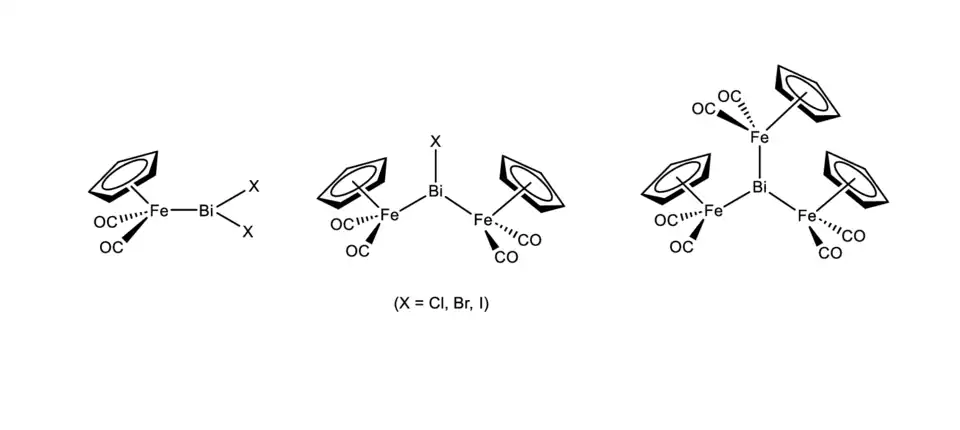
With cobalt tetracarbonyl instead of Fp, there exist similar compounds,[7] which are Lewis acids. The formal adduct with cobaltocenium tetracarbonylcobalt is the tetrahedral, paramagnetic [Cp2Co][Bi{Co(CO)4}4] complex.[3]
An analogous manganese compound forms a delocalized Mn-Bi-Mn bond:[2][6]

Polybismuth ligands
Other clusters contain a formal dibismuthene or dibismithyne unit, coordinated through the Dewar–Chatt–Duncanson interaction.[2] For example, oligo-trimethylsilylbismuth(I) reacts with pentacarbonyltungsten tetrahydrofuran to give a cluster with a Bi-Bi bond length corresponding to a single bond:[9][10]
![Cyclobismuthane reaction with metal carbonyl complexes[9][10]](./_assets_/0c70a452f799bfe840676ee341124611/Cyclobismuthane_reaction_with_metal_carbonyl_complexes.png)
Another example comes in the form of a zirconocene unit, side-coordinated to a dibismuth mesitylene moiety (pictured below).[11]
In 2009, Pearl et al. described the synthesis and isomerization of heterometallic complexes containing bismuth and rhenium. The precursors used in synthesis were an alkene-coordinated carbonyl rhenium complex and BiPh3.[5] The reaction yields two types of heteronuclear bismuth-rhenium complexes and a homodinuclear rhenium one as a side product. Upon heating, the hexametallic tribismuth-trirhenium heteronuclear complex undergoes isomerization to cis- and trans-clusters containing the bicyclo [3.3.0] core. Under subsequent irradiation both stereoisomers convert to a common spiro [4.3] cluster compound:[5]
![Isomerization of bismuth-rhenium cluster carbonyl compounds[5]](./_assets_/0c70a452f799bfe840676ee341124611/Isomerization_of_Bi-Re_complexes.png)
Clusters like closo-[Bi3Cr2(CO)6]3- and [Bi3Mo2(CO)6]3- have been reported to stabilize the ozone-like structure of [Bi3]3-.[4] The [Bi3]3- species, isostructural and isoelectronic with ozone, can be analyzed independently as a moiety bound to the metal carbonyl complexes. The reported Bi-Bi distance falls in between the single and double bond region and is elongated compared to Bi=Bi bond in the [Bi4]2- cluster, the later displaying a bond order of 1.25.[4] This experimental observation is being rationalized by some amount of π-donation to the metal carbonyl center and simultaneously π* back-bonding to the bismuth cluster from the metallocene complex.[4]
PSEPT-type clusters
Bismuth atoms may appear at a wide variety of positions in a polyhedral skeleton:[2][12]
![Examples of dibismuthene complexes[2][12][11]](./_assets_/0c70a452f799bfe840676ee341124611/Examples_of_dibismuthene_complexes.png)
Strained cluster complexes with monodentate as well as bridging carbon monoxide units have also been isolated, such as [{Cp(μ2-CO)Fe}3(μ3-Bi)] and [(μ3-Bi)Co3(CO)6(μ-CO)3]:[2][13]
![Synthesis of [{Cp(μ2-CO)Fe}3(μ3-Bi)][2]](./_assets_/0c70a452f799bfe840676ee341124611/Synthesis_of_Bi-Fe_cluster.png)
Spiro-like clusters such as [{Ru2(CO)8}(μ4-Bi){(μ-H)Ru3(CO)10} and cubane-like ones as [Bi4Co*4] are representatives as well. The former displays a tetracoordinate bismuth metallic center along with a dicoordinated hydride ligand. The structure of the latter is cubic with the edges alternating bismuth and cobalt metallic centers:[2]
![Spiro-like and cubane-like bismuth clusters[2]](./_assets_/0c70a452f799bfe840676ee341124611/Bismuth_clusters.png)
Applications
Organobismuth compounds have been proposed as non-toxic nucleophile partners in Suzuki-Miyaura-type coupling reactions. Transmetallation to organopalladium compounds occurs by two different mechanisms:[2]
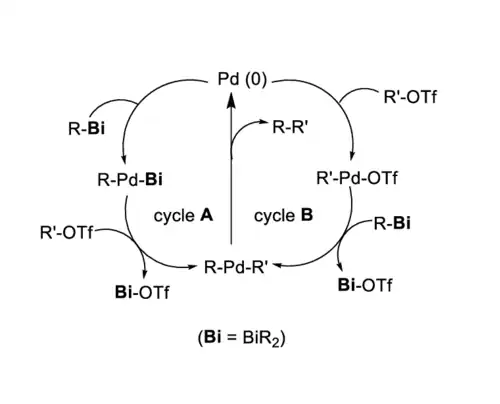
In cycle A, Pd(0) oxidative addition occurs faster with the nucleophile's C-Bi bond; in cycle B, it occurs faster with the electrophile's C-O one.
"Paddlewheel" complexes
Inspired from the dirhodium tetraacetate bimetallic salt, synthetic chemists decided to explore the synthesis of paddlewheel mixed heteronuclear bismuth-rhodium salts. The synthesis involves treatment of the [Rh2(O2CR)4] salt with the dibismuth tetrafluoroacetate [Bi2(O2CCF3)4] equivalent.[14][15] Depending on the nature and sterics of the R ligand, the resulting mixed salt has either two tBu R-substituents resulting in the cis mixed salt or a single Me R-substituent provenient from the dirhodium precursor:
![Synthesis of bismuth "paddlewheel" complexes[14][15]](./_assets_/0c70a452f799bfe840676ee341124611/Rhodium-bismuth_paddlewheel_complexes.png)
The mixed salts display increased air and moisture sensitivity compared to the parental dimetallic salts and show Lewis acidity at the rhodium center.[2]
See also
References
- ^ Braunschweig, Holger; Cogswell, Paul; Schwab, Katrin (January 2011). "Synthesis, structure and reactivity of complexes containing a transition metal–bismuth bond". Coordination Chemistry Reviews. 255 (1–2): 101–117. doi:10.1016/j.ccr.2010.07.002.
- ^ a b c d e f g h i j k l m Braunschweig, Holger; Cogswell, Paul; Schwab, Katrin (2011-01-01). "Synthesis, structure and reactivity of complexes containing a transition metal–bismuth bond". Coordination Chemistry Reviews. 255 (1): 101–117. doi:10.1016/j.ccr.2010.07.002. ISSN 0010-8545.
- ^ a b Leigh, J. Scott; Whitmire, Kenton H. (1988). "[Cp2Co][Bi{Co(CO)4}4 ]: A Paramagnetic, Ten-Electron, Tetrahedral Complex of Bismuth". Angewandte Chemie International Edition in English. 27 (3): 396–398. doi:10.1002/anie.198803961. ISSN 0570-0833.
- ^ a b c d Xu, Li; Ugrinov, Angel; Sevov, Slavi C. (2001-05-01). "Stabilization of Ozone-like [Bi3]3- in the Heteroatomic closo -Clusters [Bi3Cr2(CO)6]3- and [Bi3Mo2(CO)6 ]3-". Journal of the American Chemical Society. 123 (17): 4091–4092. doi:10.1021/ja0038732. ISSN 0002-7863. PMID 11457165.
- ^ a b c d Adams, Richard D.; Pearl, William C. (2009-10-05). "Rhenium−Bismuth Carbonyl Cluster Compounds". Inorganic Chemistry. 48 (19): 9519–9525. doi:10.1021/ic901176x. ISSN 0020-1669. PMID 19711899.
- ^ a b Von Seyerl, Joachim; Huttner, Gottfried (1980-08-19). "Wismut(I)-chlorid, BiCl, als komplexligand: darstellung und struktur von [C5H5(CO)2Mn)2BiCl]2". Journal of Organometallic Chemistry. 195 (2): 207–212. doi:10.1016/S0022-328X(00)90005-6. ISSN 0022-328X.
- ^ a b Cullen, W. R.; Patmore, D. J.; Sams, J. R. (1973). "Synthesis of transition metal derivatives of arsenic, antimony, and bismuth with M-E sigma bonds". Inorganic Chemistry. 12 (4): 867–872. doi:10.1021/ic50122a032. ISSN 0020-1669.
- ^ Cullen, W. R.; Patmore, D. J.; Sams, J. R.; Newlands, M. J.; Thompson, L. K. (1971-01-01). "Cyclopentadienyldicarbonyliron derivatives of arsenic, antimony and bismuth with M–Fe σ-bonds (MAs, Sb, Bi)". Journal of the Chemical Society D: Chemical Communications (16): 952–953. doi:10.1039/C29710000952. ISSN 0577-6171.
- ^ a b Balázs, Lucia; Breunig, Hans Joachim; Lork, Enno (2002-07-03). "Synthesis of the Dibismuthene Complex [{μ-η2-(cis-Me3SiCH2Bi)2}{W(CO)5}2] from a Cyclobismuthane and [W(CO)5(thf)]". Angewandte Chemie International Edition. 41 (13): 2309–2312. doi:10.1002/1521-3773(20020703)41:13<2309::AID-ANIE2309>3.0.CO;2-M. ISSN 1433-7851. PMID 12203575.
- ^ a b Breunig, Hans Joachim (2005). "Organometallic Compounds with Homonuclear Bonds between Bismuth Atoms, 70 Years after Paneth' Report on the Violet Dimethyl Bismuth Compound". Zeitschrift für anorganische und allgemeine Chemie. 631 (4): 621–631. doi:10.1002/zaac.200400476. ISSN 0044-2313.
- ^ a b Wang, Yuzhong; Quillian, Brandon; Yang, Xiao-Juan; Wei, Pingrong; Chen, Zhongfang; Wannere, Chaitanya S.; Schleyer, Paul v. R.; Robinson, Gregory H. (2005). "A Metallocene-Complexed Dibismuthene: Cp2Zr(BiR)2 (Cp = C5H5; R = C6H3-2,6-Mes2)". J. Am. Chem. Soc. 127 (21): 7672–7673. doi:10.1021/ja051704h. PMID 15913345.
- ^ a b Martinengo, Secondo; Ciani, Gianfranco (1987-01-01). "Bismuth–cobalt heteronuclear carbonyl cluster compounds. Synthesis and X-ray characterization of the neutral [BiCo3(CO)9] and of the paramagnetic anion [Bi2Co4(CO)11]–". Journal of the Chemical Society, Chemical Communications (20): 1589–1591. doi:10.1039/C39870001589. ISSN 0022-4936.
- ^ Whitmire, Kenton H.; Leigh, J. Scott; Gross, Michal E. (1987-01-01). "Isolation and characterization of the 'strained' cluster complex, (μ3-Bi)Co3(CO)6(μ-CO)3; the application of thermogravimetric analysis to rational cluster reactions". Journal of the Chemical Society, Chemical Communications (12): 926–927. doi:10.1039/C39870000926. ISSN 0022-4936.
- ^ a b Dikarev, Evgeny V.; Li, Bo; Zhang, Haitao (2006). "Tuning the Properties at Heterobimetallic Core: Mixed-Ligand Bismuth−Rhodium Paddlewheel Carboxylates". J. Am. Chem. Soc. 128 (9): 2814–2815. doi:10.1021/ja058294h. PMID 16506756.
- ^ a b Dikarev, Evgeny V.; Li, Bo; Rogachev, Andrey Yu.; Zhang, Haitao; Petrukhina, Marina A. (2008-08-01). "Metal-Site-Controlled Arene Coordination in a Heterobimetallic Bi−Rh Complex with Pyrene". Organometallics. 27 (15): 3728–3735. doi:10.1021/om8001763. ISSN 0276-7333.