Begonia woodii
| Begonia woodii | |
|---|---|
| |
Scientific classification 
| |
| Kingdom: | Plantae |
| Clade: | Tracheophytes |
| Clade: | Angiosperms |
| Clade: | Eudicots |
| Clade: | Rosids |
| Order: | Cucurbitales |
| Family: | Begoniaceae |
| Genus: | Begonia |
| Species: | B. woodii
|
| Binomial name | |
| Begonia woodii Merr., 1925[1]
| |
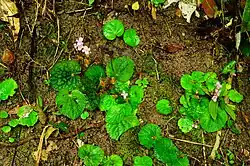
Begonia woodii is a species of flowering plant in the family Begoniaceae, endemic to the island province of Palawan in the Philippines.[2][3] It is a rhizomatous geophyte,[2] that inhabits crevices in dense forest.[4][5] It was first described in 1925 by Elmer Drew Merrill.[1] The species is considered Vulnerable by the country's Department of Environment and Natural Resources.[6]
Description
A small but glabrous herb. Stems typically short, about 1.5 cm long. Leaves are usually solitary, green in color, almost obliquely ovate in shape, 3-6 cm in length by 2.5-5 cm width, the leaf base is cordate, the apical portion is acute to somewhat acuminate, margins are irregularly toothed to toothed-crenate. Staminate flowers are pink in color, about 1 cm in diameter, with approximately 20 anthers. Capsules are 3-winged, measuring 8 to 10 mm wide including the wings.[5]
Etymology
The species is named after Governor-General Leonard Wood who provided Merrill with an opportunity to carry out botanical fieldworks in Malampaya Bay.[5]
Distribution
The type of the species was collected in Malampaya Bay in Palawan, Philippines by Merrill in August 1922.[4][5] There was also a photographic record of the species from Lagen Island.[3]
Habitat and ecology
The species was known to inhabit crevices in shaded cliffs, among the dense forest at an altitude of about 50 meters above sea level.[4][5]
References
- ^ a b "Begonia woodii Merr". International Plant Names Index (IPNI). Royal Botanic Gardens, Kew; Harvard University Herbaria; Australian National Botanic Gardens. Retrieved 25 December 2025.
- ^ a b "Begonia woodii Merr". Plants of the World Online. Board of Trustees of the Royal Botanic Gardens, Kew. Retrieved 20 December 2025.
- ^ a b Pelser, Pieter B.; Barcelona, Julie F.; Nickrent, Daniel L., eds. (22 November 2025) [First published 2011]. "Begoniaceae". Co’s Digital Flora of the Philippines. Retrieved 25 December 2025.
- ^ a b c Hughes, Mark; Coyle, Clare; Rubite, Rhett R. (2010). "A revision of Begonia section Diploclinium (Begoniaceae) on the Philippine island of Palawan, including five new species" (PDF). Edinburgh Journal of Botany. 67 (1): 139–170. doi:10.1017/S0960428609990266. Retrieved 20 December 2025.
- ^ a b c d e Merrill, Elmer D. (1925). "Additions to Our Knowledge of the Philippine Flora, I". Philippine Journal of Science. 26 (4): 478–479. Retrieved 30 December 2025.
- ^ "Updated national list of threatened Philippine plants and their categories (DAO 2017-11)" (PDF). Department of Environment and Natural Resources. DENR. 2017. Retrieved 30 December 2025.