Beatrice Erskine Lane Suzuki
Beatrice Erskine Lane Suzuki | |
|---|---|
Suzuki Biwako | |
 | |
| Personal life | |
| Born | 21 April 1878 Newark, New Jersey, United States |
| Died | 16 July 1939 (aged 61) Japan |
| Nationality | American |
| Spouse | D. T. Suzuki (m. 1911) |
| Children | Paul Suzuki |
| Notable work(s) | Kōya San; Buddhism and Practical Life; Mahayana Buddhism |
| Known for | Promoting Buddhism and Theosophy in Japan; cross-cultural religious writing |
| Religious life | |
| Religion | Buddhism |
| School | Mahayana Buddhism |
| Dharma names | Suzuki Biwako |
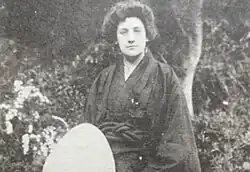
Beatrice Erskine Lane Suzuki (21 April 1878 – 16 July 1939), also known in Japan as Suzuki Biwako (鈴木琵琶子), was an American Theosophist, writer, and lecturer who played a significant role in the early 20th-century transmission of Theosophy and Mahayana Buddhism between the United States and Japan. She was an intellectual figure in her own right.[1]
Early life and education
Lane was born in Newark, New Jersey. She studied at Radcliffe College, graduating in 1898. During her studies she was taught by philosopher William James, as well as Josiah Royce and George Herbert Palmer.[2]
After graduation, she moved to New York and pursued graduate study at Columbia University, earning a Master of Arts degree in social work in 1908.[1]
Marriage and life in Japan
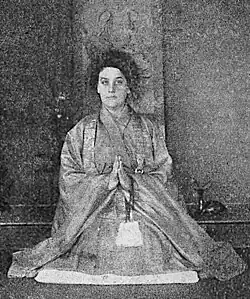
Lane first encountered D. T. Suzuki after attending one of his lectures in 1906. The two married in a buddhist wedding in 1911 in Japan, reportedly at the Yokohama Consulate, with a reception held at the Hotel New Grand. The couple had one son, Paul Suzuki.[2]
After relocating permanently to Japan, Lane Suzuki became active in religious and intellectual circles. From 1921, she taught English at the preparatory school of Otani University and was involved in the activities of the Eastern Buddhist Society. She contributed writings on Japanese religion and culture, addressing Western audiences.[3]
Theosophy and organizational work
Lane Suzuki was active in the Theosophical Society. In 1920, she and her family joined the Tokyo International Lodge. In 1924, she established a Theosophical lodge in Kyoto oriented toward intellectual study. Unlike other lodges that attracted primarily middle-class women, her Kyoto lodge focused on philosophical and religious inquiry. The lodge closed in 1929 due to declining membership.
She also showed interest in the Order of the Star in the East, though D. T. Suzuki reportedly viewed that movement critically.[4]
Animal welfare and personal interests
Lane Suzuki was committed to vegetarianism and animal protection. She is said to have founded an animal sanctuary in Kamakura known as Jihi-en (慈悲園, "Garden of Compassion"). She avoided wearing fur later in life and was described as a prolific reader, reportedly reading several novels per day.[1]
Writings
Lane Suzuki published numerous books and essays on Buddhism and Japanese culture, many aimed at Western readers:
- 1931: Kōya San: the Home of Kobō Daishi and His Shingon Doctrine.
- 1932: Noḡaku: Japanese Nō Plays.
- 1933: Buddhism and Practical Life.
- 1934: Buddhist Readings.
- 1938: Mahayana Buddhism. London: The Buddhist Lodge.
- 1940: Impressions of Mahayana Buddhism. The Eastern Buddhist Society; London: Luzac and Company.
- 1959: Mahayana Buddhism: A Brief Outline.
After her death, D. T. Suzuki compiled Impressions of Mahāyāna Buddhism, a collection of thirty-one of her essays.
Death
Lane Suzuki died in Japan on 16 July 1939. After moving to Japan in 1911, she left the country only once, making a brief trip to the United States in 1916.
Legacy
Although long overshadowed by her husband D. T. Suzuki, Beatrice Lane Suzuki has increasingly been recognized by scholars as an important figure in early 20th-century cross-cultural religious exchange. Her writings helped interpret Mahayana Buddhism and Japanese religious culture for Western audiences at a formative stage in the globalization of Zen.
Lane Suzuki’s work contributed to the development of English-language Buddhist literature prior to the widespread popularization of Zen in the mid-20th century. Through her books, lectures, and involvement in the Theosophical Society, she participated in shaping Western understandings of Buddhism not only as a philosophical system but also as a lived religious practice.
Recent scholarship has reexamined her intellectual role within the Suzuki household, emphasizing that she was not merely a collaborator or assistant but an independent author and thinker. Her activities in founding study circles, promoting Theosophy in Japan, and engaging in interreligious dialogue demonstrate her active participation in transnational religious networks.
In addition to her literary contributions, her advocacy of vegetarianism and animal protection, including the establishment of the animal sanctuary Jihi-en (慈悲園) in Kamakura, reflects the ethical dimensions of her religious commitments.
Her life and work are now cited in studies of Theosophy, women in Buddhism, and the early Western reception of Japanese religious thought.
See also
References
- ^ a b c http://www.seiryo-u.ac.jp/u/research/gakkai/ronbunlib/e_ronsyu_pdf/No131/01_ueda131.pdf
- ^ a b Snodgrass, Judith (2024-08-30). "Beatrice Lane Suzuki (1875–1939)". St Andrews Encyclopaedia of Theology.
- ^ Algeo, Adele S. "Beatrice Lane Suzuki: An American Theosophist in Japan". Archived from the original on 2022-05-17. Retrieved 2026-02-13.
- ^ "Wayback Machine" (PDF). repo.komazawa-u.ac.jp. Archived from the original (PDF) on 2024-12-17. Retrieved 2026-02-13.
External links
