Battle of San Juan (1797)
| Battle of San Juan (1797) | |||||||
|---|---|---|---|---|---|---|---|
| Part of the War of the First Coalition and the Anglo-Spanish War of 1796-1808 | |||||||
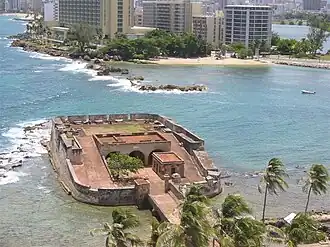 The Fortín de San Gerónimo | |||||||
| |||||||
| Belligerents | |||||||
.svg.png) Great Britain Great Britain |
.svg.png) Spain Spain | ||||||
| Commanders and leaders | |||||||
| |||||||
| Strength | |||||||
|
| ||||||
| Casualties and losses | |||||||
| |||||||
The Battle of San Juan occurred within an ill-fated British assault in 1797 on the Spanish colonial port city of San Juan in Puerto Rico during the 1796–1808 Anglo-Spanish War. The assault was carried out facing the historic town of Miramar. Spanish countermeasures broke the British force and the siege of San Juan by the latter.
Background
Spain aligned itself with France by signing the Second Treaty of San Ildefonso in 1796. Britain then targeted both countries' Caribbean colonies. Admiral Sir Henry Harvey's fleet picked up Sir Ralph Abercromby's army in Barbados. Together, they captured Trinidad from the Spanish, before heading for San Juan.[3][4]
Battle
On 17 April 1797, Lieutenant-General Sir Ralph Abercromby's fleet of 68 vessels appeared offshore Puerto Rico with a force of 7,000, which included German auxiliaries and French émigrés. Two of his frigates then blocked San Juan harbor.[3][4]
The governor, Field Marshal Don Ramón de Castro y Gutiérrez, had already mobilized his 4,000 militia and 200 Spanish garrison troops which, combined with 300 French privateers, 2,000 armed peasantry, and paroled prisoners, brought his troop strength up to almost equal that of the British. He also had 376 cannon, 35 mortars, 4 howitzers and 3 swivel guns.[3][4]
Abercromby landed 3,000 troops on 18 April and took control of Cangrejos. Castro moved his forces to Escambrón and the Spanish First Line of Defense.[3][4]
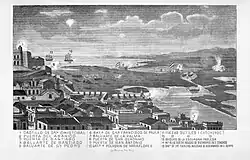
On 21 April, the British started a 7-day artillery duel with the Spanish forts of San Gerónimo and San Antonio, located at the Boquerón Inlet. At the same time, further Spanish forces put pressure on the British positions, the Spanish recaptured Martín Peña Bridge, while the militia led by José "Pepe" Díaz (1776 – April 30, 1797) and Sergeant Francisco Díaz (1777 – ?), both cousins, raided behind British lines, bringing back prisoners. Then, on the 29th and 30th, the Spanish crossed the Boquerón Inlet, and forced the British to pull back.[3][4][5]
Aftermath
On 1 May, the Spanish learned the British were gone, leaving behind arms, stores and ammunition.[3][4]
References
- ^ Pierce Flores, Lisa (2009). The History of Puerto Rico. ABC-CLIO. p. 49. ISBN 978-0-31335-419-9.
- ^ a b Córdoba, Pedro Tomás de (1832). Memorias geográficas, históricas, económicas y estadísticas de la isla de Puerto-Rico. Vol. III. Valeriano de Sanmillan. p. 109.
- ^ a b c d e f Van Middeldyk, R.A. (1903). Brumbaugh, Martin (ed.). The History of Puerto Rico: From the Spanish Discovery to the American Occupation. D. Appleton and Company. pp. 139–141. Retrieved 6 March 2019.
- ^ a b c d e f The Forts of Old San Juan. Washington, D.C.: Division of Publications, National Park Service, U.S. Dept. of the Interior. 2018. pp. 68–71. ISBN 9780912627625.
- ^ Marley, p. 362
Further reading
- Alonso, Mariá M. and Milagros Flores (1997). The Eighteenth Century Caribbean and the British Attack on Puerto Rico in 1797. San Juan: National Park Service, Department of the Interior, Publicaciones Puertorriqueñas. ISBN 978-1-881713-20-3
- Marley, David (1998). Wars of the Americas: a chronology of armed conflict in the New World, 1492 to the present. ABC-CLIO. ISBN 978-0-87436-837-6
External links
- History of the Fixed Regiment of Puerto Rico by Coronel Héctor Andrés Negroni
- Alonso, María M. "Chapter XIV – Abercromby's Siege". The Eighteenth Century Caribbean & The British Attack on Puerto Rico in 1797. Archived from the original on 30 June 2006. Retrieved July 7, 2006.