Battle of Marienburg (1422)
| Battle of Marienburg | |||||||
|---|---|---|---|---|---|---|---|
| Part of the Golub War | |||||||
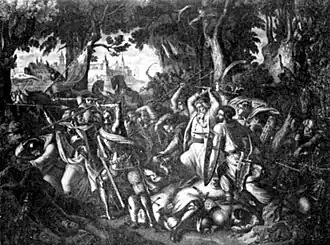 Moldavian victory over the Teutonic Knights (1422) | |||||||
| |||||||
| Belligerents | |||||||
 Moldavia Moldavia |
 Teutonic Order Teutonic Order | ||||||
| Commanders and leaders | |||||||
|
Alexander I |
Paul von Rusdorf | ||||||
| Strength | |||||||
| 400 Moldavian horsemen | 4,000 Teutonic Knights and mercenaries | ||||||
| Casualties and losses | |||||||
| 150 killed and wounded |
3,000 killed 200 wounded 500 captured 300 deserted | ||||||
The Battle of Marienburg occurred during the Golub War, near Marienburg Castle (Malbork Castle), between the Moldavian cavalry of Alexander I and the Teutonic Knights of Paul von Rusdorf supported by mercenaries. It took place on 27 September 1422.
Prelude
During the early 15th century, Moldavian Voivode Alexander I was on good terms with the Kingdom of Poland. He provided support for the Polish forces during the Polish–Teutonic Wars, including in 1422.[1]
Alexander I intended to strengthen his ties with the Grand Duchy of Lithuania, which resulted in his marriage to the Lithuanian princess Rimgailė. She attempted to convert him to Catholicism, but her efforts were unsuccessful, even as Alexander intended to face the Teutonic Knights near Marienburg Castle (Malbork Castle) in support of Poland and Lithuania during the Golub War.[2]
Battle
Detailed description of the battle appears in Jan Długosz's chronicle. Jan Długosz was a Polish chronicler who also chronicled the Battle of Grunwald and numerous other events related to the Polish–Teutonic Wars.
According to Jan Długosz, the Moldavian cavalry took advantage of the fact that the Teutonic Knights lacked archers. Existing archers on the Teutonic were dispersed by Moldavians, forcing them to them flee into the forest. This provocation also lured the Teutonic Knights and mercenaries out of the castle, which were then targeted by archers on the Moldavian side. First line of the knights were covered with arrows, confusing and scattering the rest of the Teutonic army. Moldavian cavalry took the opportunity to deliver a decisive blow and inflict heavy losses on the enemy.
Aftermath
According to Polish chronicler Jan Długosz, the 400 Moldavian horsemen "defeated a big army of the enemy and victoriously came back to the camp of the royal army loaded with a huge loot".[3] Moldavians suffered 150 killed and wounded. However, the Teutonic Knights, alongside mercenaries, suffered heavy losses of 3,000 killed, 200 wounded, 500 captured and 300 deserted, practically their entire force.
The Moldavian victory in battle didn't lead to capture of the Marienburg Castle (Malbork Castle), but it contributed to ending the Golub War on the same day, with the signing of Treaty of Melno as the Teutonic Order was put under pressure. This victory also raised the prestige of Alexander I in the Kingdom of Poland and Grand Duchy of Lithuania, which allowed Moldavia to claim ownership over the Pokuttia region.
See also
References
- ^ Kurt W. Treptow (1996). Historical Dictionary of Romania. Vol. 2. Scarecrow Press. p. 24. ISBN 0810831791.
- ^ Paweł Jaworski (2017). "The Romanian Journal for Baltic and Nordic Studies". University of Wrocław. p. 45.
- ^ Constantin C. Giurescu (1974). Chronological History of Romania. Editura enciclopedică română. p. 78.
Bibliography
- Roman Grodecki (1995). Dzieje Polski średniowiecznej [The history of medieval Poland] (in Polish). Vol. 2. Kraków: Wydawnictwo Platan. pp. 103–125. ISBN 83-7052-230-0.
- Mieczysław Haftka (1999). „Zamki Krzyżackie w Polsce – Szkice z Dziejów“ ["Teutonic Castles in Poland – Sketches from History"] (in Polish). Muzeum Zamkowe w Malborku. p. 117. ISBN 83-86-206-27-6.