António Calvário
António Calvário | |
|---|---|
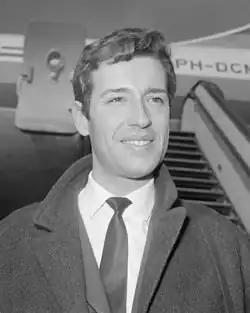 Calvário in 1965 | |
| Background information | |
| Born | António Calvário da Paz 17 October 1938 |
| Occupations | Singer, actor, writer |
| Years active | 1957–present |
António Calvário da Paz (born 17 October 1938) is a Portuguese singer, actor, and writer. He is best known for winning the first edition of Festival da Canção and representing Portugal at the Eurovision Song Contest in 1964 with the song "Oração", which was the country's debut entry in the contest.
Early life
Calvário was born in Lourenço Marques (now Maputo), Portuguese Mozambique, on 17 October 1938.[1][2][3][4] His parents were António da Paz (29 January 1890 – TBA), who was a mechanic from Estômbar, Portugal, and Adelaide Nunes Calvário (1913 or 1914 – 2004).[5] He has a younger brother, Rui (born October 1942).[6]
His father worked in Portimão and Setúbal, Portugal, until he decided to sneak into the hold of the ship that brought him to Portuguese Mozambique, where he owned a small truck that transported goods between Lourenço Marques and Catembe and managed two sawmills in the interior of Marracuene. He eventually returned to Portugal, where he met and fell in love with Nunes Calvário. However, her family opposed their future marriage due to differences in social status, so the couple fled to Africa.[6]
After moving to Vila Luísa at the age of five, Calvário began his studies at the Roque de Aguiar School (Escola Roque de Aguiar).[7] There, he performed two songs, one from The Merry Widow and "Maria Helena", with his classmate, after the institution's headmaster asked him to participate in the final concert.[6]
When Calvário was eight years old, he moved to Portugal with his family.[7][8] After a month-long voyage aboard the Pátria, acquired by the National Navigation Company (Companhia Nacional de Navegação), which ended on 10 April 1949, they disembarked in Lisbon and then traveled to and stopped in Portimão, where the household reunited with the rest of its members.[6]
Calvário completed his primary education with his aunt Rudolfa, then went on to the municipal high school and a college in Portimão. According to the singer, he had to perform at a party, because the school principal mistook him for another student, but he was supported by his piano teacher, Elisa Dutra, who appreciated his voice.[8][9] As a result, he began studying singing at the age of fifteen, although his initial priority was the piano. In his fifth year of high school, the artist attended the Academic College (Colégio Académico) in Lisbon. There, the artist continued his music studies under the guidance of his grandmother's first cousin, Corina Freire,[3][10][11] although his parents were originally opposed, as they planned for him to complete his studies, study law, and become a lawyer. The defining moment in his career was "a coin toss" that resulted in his musical ambitions prevailing.[1][6]
Career
1957–1963: Debut in the music industry, Emissora Nacional, and participation in contests
In 1957, a group of Calvário's friends signed him up for an audition at Emissora Nacional. He was eventually chosen, beating out more than 30 competitors with his performance of the song "Canta Brasil", earning him an exemption from training at the Centre for the Preparation of Artists for Radio (Centro de Preparação de Artistas para a Rádio).[6] The singer started working the following year.[11]
Having performed with the Tavares Belo Orchestra and participated in various shows since joining the Centre, in 1960, Calvário competed in the second edition of Festival da Canção Portuguesa in Porto with the song "Regresso", written by Resende Dias and Maria Almira. In the end, he won the competition.[3] The artist's victory was so overwhelming that he ended up going on tour both in Portugal and beyond.[6] That same year, he signed a contract with the Portuguese record label Valentim de Carvalho, which was an obligation under the rules of the contest.[1][11]
Calvário's first fee was 50.svg.png) (escudos) for singing at Os Franceses on the radio programme Vozes de Portugal in Barreiro,[2] and later each performance at the show Serões para Trabalhadores on Emissora Nacional brought him 500 (escudos).[5][6]
(escudos) for singing at Os Franceses on the radio programme Vozes de Portugal in Barreiro,[2] and later each performance at the show Serões para Trabalhadores on Emissora Nacional brought him 500 (escudos).[5][6]
In 1961, Calvário won the title of "King of Radio" ("Rei da Rádio") in the Coliseu dos Recreios in Lisbon, which he repeated in 1963, 1965, 1966, and 1972.[6][12]
1964–1977: Eurovision Song Contest, Festival da Canção, and ban on performances
On 2 February 1964, Calvário took part in the inaugural edition of Festival da Canção, I Grande Prémio TV da Canção Portuguesa 1964. Competing with two songs, "Oração" and "Para cantar Portugal", the former was declared the winner of the competition, and the artist earned the opportunity to represent Portugal at the Eurovision Song Contest 1964 in Copenhagen, Denmark. It was the country's debut in the contest.[5][13][14][15] However, his entire journey was difficult, as the participation of Spain and Portugal had been criticised due to the dictatorships of Franco and Salazar. As a result, only the singer himself went on behalf of the Portuguese delegation. The entry's conductor was Kai Mortensen, who approved of João Nobre's arrangement. On 21 March in the Eurovision live show, Calvário finished in thirteenth, last, place with "nul points",[16][17][18] alongside entrants from Germany, Switzerland, and Yugoslavia.[6][19] The boycotters still managed to make their mark during the event: a man trespassed onto the stage after the Swiss contestant's performance holding a banner that read "Boycot [sic] Franco & Salazar". At that moment, viewers were shown a shot of the scoreboard, and once the protester was removed by a television technician, the programme went on.[20] Calvário also attended the aftershow party at the restaurant Ambassadeur and was awarded a silver trophy, along with the other fifteen competing acts.[3][21] At the same time, a French record company showed interest in recording "Oração" and some of the artist's songs in French, but Valentim de Carvalho, his label, did not give permission.[10]
In March 1969, RTP selected Calvário to represent Portugal at the first edition of Festival de la Canción Latina en el mundo at Teatro Ferrocarrilero in Mexico City, Mexico, with two songs, "Canção da Juventude", written by Pedro Jordão and Joaquim Pedro Gonçalves, and "Terra de Flores". The former took fourth place in the competition, making him the best singer performing for a European country that year.[6][10][22][23][24]
That same year, Calvário co-produced and starred in Constantino Esteves' film O Diabo Era Outro. However, it suffered a major financial setback, as it was severely delayed, reducing the original budget of 2,000–2,500 to 4,000 contos. The singer had to take out a bank loan for 2,000 contos, which he later repaid by performing "wherever they would give me work", including circus shows.[3][6][10][12][25][26]
1978–2007: "Mocidade, mocidade", grand return, and local activity
After five years of oblivion, Calvário made a successful comeback in 1978 with the song "Mocidade, mocidade", which marked his return to the revue industry.[12]
In 2003, journalist Luis Guimarães published a biographical book about Calvário called António Calvário: a canção de uma vida through Garrido Editores.[6][27]
Calvário participated in an episode of TVI's programme "Circo das Celebridades", which was aired on 19 March 2006. The show features local celebrities testing their circus skills,[28][29] and the performer later said that "it was an unexpected invitation, but one I would never refuse".[3]
2008–2024: Histórias da minha vida, guest appearances, and later years
In March 2008, Calvário celebrated the fiftieth anniversary of the beginning of his professional music career: he released the CD Nos palcos da vida with two previously unreleased songs "Cheguei estou aqui" and "Só a cantar", written by Ondina Santos and Vítor Talhadas (the challenge was proposed by Carlos Pacheco, president of the community Boa Esperança),[30] and his autobiography Histórias da minha vida, through Editora Guerra & Paz, to mark the occasion.[5][8][10]
Calvário and Simone de Oliveira made an appearance on stage during the final of Festival da Canção 2014, which took place on 15 March 2014.[31]
The following year, on 3 March 2015, Calvário and Suzy opened the first semi-final of Festival da Canção 2015.[32][33] Later, in September of that year, he concluded in an interview with ESCPORTUGAL that the festival should prioritise famous names, explaining that in its early years, "the big names caused a great stir", unlike in the later era.[13]
2018 marked the launch of a two-hour revue titled "Volta a Portugal em Revista", directed by Renato Pino and featuring Calvário and Natalina José. The show has been performed throughout Portugal, including in cities such as Caldas da Rainha,[34] Estremoz,[35] and Lavradio.[2]
Calvário appeared as a guest in the first semi-final of Festival da Canção 2024 on 24 February 2024.[36][37]
Personal life and political views
Calvário, who is a Catholic, expresses tolerance towards same-sex marriage, stating that "homosexuality can be an option, a way of life that dates back to the dawn of humanity". Speaking about abortion, the artist calls it a "necessary evil". He also distrusts the Internet, adding that it is a "double-edged sword that has allowed for very serious situations, dangerous encounters, kidnappings, child pornography, undue exposure of privacy, truly criminal fabrications", but believes that cloning and artificial insemination "do not contradict the laws of the Bible" and approves of organ transplantation.[6]
In May 2025, over 70 past Eurovision participants, including Calvário, signed an open letter to the European Broadcasting Union (EBU) demanding that Israel be banned from the contest, accusing the Israeli Public Broadcasting Corporation (IPBC/Kan), the country's participating broadcaster, of being "complicit in Israel's genocide against the Palestinians in Gaza", referring to the humanitarian crisis caused by Israel's actions in the Gaza war.[38]
Calvário has never been married.[1][39]
Discography
_op_Schiphol_afgehaald_door_Wim_Ibo%252C_Bestanddeelnr_917-5973.jpg)
| Title | Year | Album or EP | Ref. |
|---|---|---|---|
| "Sem ti" | 1960 | Unknown | [40] |
| "Nunca é tarde" | |||
| "Sinceramente" | |||
| "De pé atrás" | |||
| "Regresso" | II Festival da Canção Portuguesa | ||
| "Oração de amor" | Oração de amor | ||
| "O nosso segredo" | |||
| "Serenata a Coimbra" | |||
| "Amor é dissabor" | |||
| "Vielas de Lisboa" | Canta melodias de Nóbrega e Sousa | ||
| "Fio de esperança" | |||
| "Fim de romance" | |||
| "Nasci contra o vento" | |||
| "Amanhã se Deus quiser" (with Maria de Lourdes Resende) | O Papá e a Mamã | ||
| "Melodia de Natal" (with Maria de Lourdes Resende) | |||
| "O Papá e a Mamã" (with Maria de Lourdes Resende) | |||
| "Lua de mel no Estoril" | 1961 | Carnaval do Estoril | |
| "Estoril, lindo Estoril" | |||
| "O meu chapéu" | O meu chapéu | ||
| "Aqui onde me vês" | |||
| "Caixa de música" | |||
| "Alta roda" | |||
| "A Terra" (with Maria de Lourdes Resende) | A Terra | ||
| "Olha o papão" | |||
| "O teu aniversário" (with Maria de Lourdes Resende) | |||
| "De cá para lá" | 3º Festival da Canção Portuguesa | ||
| "Porque voltei" | |||
| "Desse amor melhor" | 1962 | Canta desse amor melhor | |
| "Maria dos olhos grandes" | |||
| "Agora" | |||
| "Cantiga de quem está só" | |||
| "Perdão para dois" | Perdão para dois | ||
| "Nossa Senhora do Amor" | |||
| "La escalera" | |||
| "Tu nunca saberás" | |||
| "Porta fechada" | 3º Festival de Aranda do Douro | ||
| "Dúvida" | |||
| "Rita e Manecas" | Melodias de Sempre Nº3 | ||
| "O dia mais longo" | 1963 | O dia mais longo | |
| "Estou tão só" | |||
| "Canta comigo" | |||
| "Falsidade" | |||
| "Fado Hilário" | Fado Hilário | ||
| "Tem pena Maria" | |||
| "Eu e Deus" | |||
| "Vuela, vuela hacía mí" | |||
| "Avé Maria dos namorados" | Avé Maria dos namorados | ||
| "Prisioneiro" | |||
| "Regressou a Primavera" | |||
| "Llorando me dormi" | |||
| "El Cuchipe" | Com Los Guaireños | ||
| "A rua dos meus ciúmes" | |||
| "Índia" | |||
| "Pájaro Chovy" | |||
| "O Velhinho" | Boas Festas! | ||
| "Sinos de Belém" | |||
| "Noite Santa" | |||
| "Fim do Ano" | |||
| "Ó meu Senhor" | 1964 | Ó meu Senhor | |
| "O pecador" | |||
| "Gloria in excelsis Deo" | |||
| "Bendíceme" | |||
| "Oração" | Oração | ||
| "Notre Dame d'Amour" | |||
| "Alma de boémio" | |||
| "Tricana" | |||
| "Ou sim ou não" | Uma hora de amor[a] | ||
| "Sim errei" | |||
| "É tão bom amar" | |||
| "Quando se fala de amor" | |||
| "Eu nasci para cantar" | Uma hora de amor[b] | ||
| "É tão bom amar" | |||
| "Tu és o meu amor" | |||
| "Sonho de amor" | |||
| "Sabor a sal" | Unknown | ||
| "Ai de mim" | |||
| "Amor sem lei" | |||
| "Canção de vida" | |||
| "Natal de Belém" | Natal de Belém | ||
| "Natal branco" | |||
| "Natal das crianças" | |||
| "Canções da despedida" | |||
| "Eu queria cantar-te um fado" | 1965 | Fados | |
| "Vamos voltar" | |||
| "Minha dor" | |||
| "Quero rir" | |||
| "Meu coração de madeira" | Unknown | ||
| "Tormenta para dois" | |||
| "Mira como bailo yo" | |||
| "Nunca mais chega o meu dia" | |||
| "O amor tem sempre um sítio p'ra morrer" | Rapazes de Táxis | ||
| "Não sei de ti" | |||
| "Amore scusami" | |||
| "Abençoado amor" | |||
| "Ce monde" | Unknown | ||
| "Namorados de domingo" | |||
| "Hello Dolly" | |||
| "Regresso" | |||
| "Lisboa antiga" | Lisboa à noite | ||
| "A rua onde mora o meu bem" | Canções de My Fair Lady | ||
| "O rei de Roma" (with Simone) | |||
| "Um bocadinho só" (with Conjunto Sem Nome and Jorge Costa Pinto e sua Orquestra) | |||
| "Encontro para amanhã" | 1966 | Encontro para amanhã | |
| "Esos ojitos negros" | |||
| "Sabor a nada" | |||
| "Aquela que eu amo" | |||
| "Calendário" | 1968 | Calendário | [41] |
| "Dentro de outro mundo" | |||
| "Ao vento e às andorinhas" | |||
| "Pouco mais" | |||
| "O sol voltará" | O sol voltará | [42] | |
| "Um barco vem do mar" | |||
| "Olhos de veludo" | |||
| "Vai mais devagar" | |||
| "O nosso mundo" | O nosso mundo | [43] | |
| "Canção ao meu piano velho" | |||
| "Balada para D. Inês" | |||
| "Verão" | |||
| "Chorona" | 1969 | Chorona | [44] |
| "A primeira pedra" | |||
| "Adeus Isabel" | 1988 | Adeus Isabel | [45] |
| "Santa Luzia" |
Filmography
Film
| Title | Year | Role | Ref. |
|---|---|---|---|
| Uma Hora de Amor | 1964 | António Luís | [46] |
| Rapazes de Táxis | 1965 | João | [47] |
| Sarilho de Fraldas | 1966 | António | [48] |
| O Amor Desceu em Pára-Quedas | 1968 | Jorge | [49] |
| O Diabo Era Outro | 1969 | Rui Mendonça | [50] |
| Longe da Vista | 1998 | Himself | [51] |
Theatre
Revues
| Title | Date | Venue | Ref. |
|---|---|---|---|
| Chapéu Alto | 1963 | Teatro ABC, Lisbon | [6] |
| Zero, Zero, Zé - Ordem P'ra Pagar | 1966 | Teatro Variedades, Lisbon | |
| Esta Lisboa Que Eu Amo | 1966 | Teatro Monumental, Madrid | |
| Duas Pernas... 1 Milhão | 1967 | Teatro Capitólio, Lisbon | |
| Peço a Palavra! | 1969 | Teatro Variedades, Lisbon | |
| Põe-te na Bicha | 1978 | Teatro ABC, Lisbon | |
| A Invasão | 1979 | Teatro da Trindade, Lisbon | |
| Andamos Todos ao Mesmo! | 1991 | ||
| Mais Riso é o Que é Preciso! | 2015 | ||
| Volta a Portugal em Revista | 22 March 2019 | Pimpões, Caldas da Rainha | [34] |
| 14 September 2019 | Teatro Bernardim Ribeiro, Estremoz | [35] | |
| 24 November 2019 | Sociedade Filarmónica Agrícola Lavradiense, Lavradio | [2] | |
| Calvário: Uma Vida de Canções | 2021–present |
Notes
References
- ^ a b c d Carvalho Ferreira, Catarina (7 December 2018). ""As admiradoras escreviam: 'Se não estiver comigo, é porque é maricas'"" ["The admirers wrote: 'If he's not with me, it's because he's a sissy'"] (in European Portuguese). Notícias ao Minuto. Retrieved 20 December 2025.
- ^ a b c d "«A minha vida foi feita a fazer aquilo que gosto» afirma António Calvário «O primeiro cachet que ganhei foi aqui no Barreiro»" ["My life has been spent doing what I love," says António Calvário. "The first paycheck I ever earned was here in Barreiro."] (in European Portuguese). Jornal Rostos. 24 November 2019. Retrieved 29 December 2025.
- ^ a b c d e f Costa, Andreia (4 February 2024). "António Calvário. "Nunca dei vivas a ninguém, nunca cantei canções políticas, mas disseram-me: 'Nunca mais cantas na rádio'"" [António Calvário. "I never cheered for anyone, I never sang political songs, but they told me: 'You'll never sing on the radio again.'"] (in European Portuguese). Observador. Retrieved 26 November 2025.
- ^ "António Calvário" (in European Portuguese). Pessoas Cinema Português. Retrieved 21 December 2025.
- ^ a b c d "António Calvário" (in European Portuguese). RTP. Retrieved 25 November 2025.
- ^ a b c d e f g h i j k l m n o Araújo, António (3 March 2024). "António Calvário: a idade da inocência" [António Calvário: the age of innocence] (in European Portuguese). Diário de Notícias. Retrieved 25 November 2025.
- ^ a b "António, o meu colega da escola primária" [António, my classmate from primary school] (in European Portuguese). Correio da Manhã. 7 June 2009. Retrieved 27 November 2025.
- ^ a b c "Há uma força cá dentro" [There is a force within] (in European Portuguese). Correio da Manhã. 16 March 2008. Retrieved 20 December 2025.
- ^ Garrancho, José (15 August 2016). "António Calvário: O eterno Rei da Rádio" [António Calvário: The Eternal King of Radio] (in European Portuguese). Barlavento. Retrieved 23 December 2025.
- ^ a b c d e "António Calvário edita CD e autobiografia nos 50 anos de carreira de "cantor recreativo"" [António Calvário releases CD and autobiography to mark 50 years as a "recreational singer"] (in European Portuguese). RTP. 1 June 2008. Retrieved 30 November 2025.
- ^ a b c "ANTÓNIO CALVÁRIO E SIMONE DE OLIVEIRA, por João Carlos Callixto" [ANTÓNIO CALVÁRIO AND SIMONE DE OLIVEIRA, by João Carlos Callixto] (in European Portuguese). RTP. Retrieved 20 December 2025.
- ^ a b c Bonifácio, João (30 April 2007). "O Rei da Rádio voltou a cantar o amor" [The King of Radio is singing about love again] (in European Portuguese). PÚBLICO. Retrieved 6 February 2026.
- ^ a b Costa, Nelson (6 September 2015). "António Calvário: "No festival a prioridade deve ser dada aos nomes mais sonantes"" [António Calvário: “At the festival, priority should be given to the most well-known names”] (in European Portuguese). ESCPORTUGAL. Retrieved 19 January 2026.
- ^ António Calvário (in European Portuguese). RTP. 20 May 2019. Retrieved 12 February 2026.
- ^ "Grande Prémio Eurovisão" [Grand Prix Eurovision] (in European Portuguese). RTP. Retrieved 12 February 2026.
- ^ "Portugal na Eurovisão. Nem a "Oração" salvou Calvário em 1964" [Portugal at Eurovision. Not even "Oração" saved Calvário in 1964] (in European Portuguese). Diário de Notícias. 20 March 2018. Retrieved 12 February 2026.
- ^ "Portugal na Eurovisão em números" [Portugal in Eurovision in numbers] (in European Portuguese). Correio da Manhã. Retrieved 12 February 2026.
- ^ "Eurovisão 1964! António Calvário foi o primeiro português no Festival" [Eurovision 1964! António Calvário was the first Portuguese contestant at the Festival] (in European Portuguese). Rádio Geice. 14 March 2024. Retrieved 12 February 2026.
- ^ "Copenhagen 1964". Eurovision.com. European Broadcasting Union. Retrieved 12 February 2026.
- ^ "Incident in Tivoli". Het Parool (in Dutch). 23 March 1964. p. 6. Retrieved 13 February 2026 – via Delpher.
- ^ "Natligt melodi-punktum" [Nocturnal melody punctuation]. Politiken (in Danish). 23 March 1964. p. 10. OCLC 224543818.
- ^ Palomar, Carlos (1 May 1969). "Música Popular" [Popular Music] (PDF). Esperanza Pulido (in Mexican Spanish). p. 35. Retrieved 28 January 2026 – via Instituto Nacional de Bellas Artes y Literatura.
- ^ "Nº33" (in European Portuguese). Onda Pop. 11 May 2015. Retrieved 26 January 2026.
- ^ "ANTÓNIO CALVÁRIO por João Carlos Callixto" [ANTÓNIO CALVÁRIO by João Carlos Callixto] (in European Portuguese). RTP. Retrieved 26 January 2026.
- ^ "Nº97" (in European Portuguese). Onda Pop. 28 October 2018. Retrieved 2 February 2026.
- ^ Jesus, Vanessa (23 April 2021). "António Calvário desabafa: "Quando precisei todos me viraram as costas"" [António Calvário vents: “When I needed them, everybody turned their backs on me”] (in European Portuguese). A Televisão. Retrieved 2 February 2026.
- ^ "«Confissões de um Franciscano»" [«Confessions of a Franciscan»]. Agência ECCLESIA. 3 April 2006. Retrieved 24 January 2026.
- ^ Homem Marques, Catarina (18 March 2006). "Circo das Celebridades pronto para se estrear na TVI" [Circo das Celebridades is ready to debut on TVI] (in European Portuguese). PÚBLICO. Retrieved 24 January 2026.
- ^ "Senhoras e senhores o circo vai começar" [Ladies and gentlemen, the circle is about to begin] (in European Portuguese). Correio da Manhã. 19 March 2006. Retrieved 20 December 2025.
- ^ Varela, Ana Sofia (25 July 2020). "'Momentum' é primeiro CD inédito de Ondina Santos e Vítor Talhadas" [‘Momentum’ is the first unreleased CD by Ondina Santos and Vítor Talhadas] (in European Portuguese). Algarve ao Vivo. Retrieved 18 January 2026.
- ^ Festival da Canção 2014 – Final – Parte II [Festival da Canção 2014 – Final – Part II] (in European Portuguese). RTP. 15 March 2014. Retrieved 22 January 2026.
- ^ Costa, Nelson (3 March 2015). "Portugal: Esta noite, semifinal 1 do Festival da Canção 2015" [Portugal: Tonight, Semi-Final 1 of Festival da Canção 2015] (in European Portuguese). ESCPORTUGAL. Retrieved 19 January 2026.
- ^ Festival da Canção 2015 – 1ª Semifinal [Festival da Canção 2015 – 1st Semi-Final] (in European Portuguese). RTP. 3 March 2015. Retrieved 19 January 2026.
- ^ a b Cipriano, Carlos (22 March 2019). "António Calvário – "A minha maior paixão é a carreira que abracei"" [António Calvário – “My greatest passion is the career I have chosen”] (in European Portuguese). Gazeta das Caldas. Retrieved 30 January 2026.
- ^ a b Serrano, Augusta (21 August 2019). "António Calvário e Natalina José em Estremoz com 'Volt'a Portugal em Revista"" [António Calvário and Natalina José in Estremoz with ‘Volt’a Portugal em Revista”] (in European Portuguese). Rádio Campanário. Retrieved 6 February 2026.
- ^ "[email protected]" (in European Portuguese). 3 February 2024. Retrieved 23 December 2025 – via Instagram.
- ^ Festival da Canção 2024 Episódio 1 - de 24 fev 2024 [Festival da Canção Episode 1 - 24 February 2024] (in European Portuguese). RTP. 24 February 2024. Retrieved 23 December 2025.
- ^ "Dozens of ex-Eurovision contestants demand exclusion of Israel from contest". Artists for Palestine UK. 6 May 2025. Retrieved 25 November 2025.
- ^ "AOS 86 ANOS, ABRE O JOGO SOBRE O AMOR: "TEM DE HAVER NAMORICOS"" [AT 86 YEARS OLD, HE OPENS UP ABOUT LOVE: "YOU HAVE TO HAVE ROMANCES"] (in European Portuguese). Nova Gente. 10 January 2025. Retrieved 21 December 2025.
- ^ "Discografia inicial de António Calvário (1960-1965)" [Early discography of António Calvário (1960-1965)]. inverso.pt (in European Portuguese). 5 January 2008. Retrieved 29 December 2025.
- ^ "António Calvário" (in European Portuguese). Fonoteca Municipal do Porto. Retrieved 22 January 2026.
- ^ "António Calvário" (in European Portuguese). Fonoteca Municipal do Porto. Retrieved 22 January 2026.
- ^ "António Calvário" (in European Portuguese). Fonoteca Municipal do Porto. Retrieved 22 January 2026.
- ^ "António Calvário" (in European Portuguese). Fonoteca Municipal do Porto. Retrieved 22 January 2026.
- ^ "Adeus Isabel" (in European Portuguese). Fonoteca Municipal do Porto. Retrieved 22 January 2026.
- ^ "Uma Hora de Amor" (in European Portuguese). Pessoas Cinema Português. Retrieved 22 December 2025.
- ^ "Rapazes de Táxis" (in European Portuguese). Pessoas Cinema Português. Retrieved 22 December 2025.
- ^ "Sarilho de Fraldas" (in European Portuguese). Pessoas Cinema Português. Retrieved 22 December 2025.
- ^ "O Amor Desceu em Pára-Quedas" (in European Portuguese). Pessoas Cinema Português. Retrieved 22 December 2025.
- ^ "O Diabo Era Outro" (in European Portuguese). Pessoas Cinema Português. Retrieved 22 December 2025.
- ^ "Longe da Vista" (in European Portuguese). Pessoas Cinema Português. Retrieved 22 December 2025.
Cited sources
- Guimarães, Luis (2003). António Calvário: a canção de uma vida. Garrido Editores. ISBN 978-9728738969.
- Calvário, António (2008). Histórias da minha vida. Editora Guerra & Paz. ISBN 978-9898014993.
External links
- António Calvário discography at Discogs
- António Calvário at IMDb