Alfonsas Svarinskas
Alfonsas Svarinskas | |
|---|---|
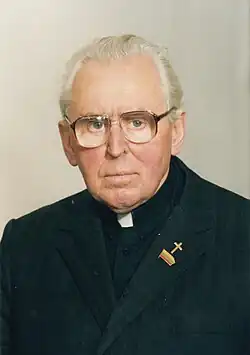 Alfonsas Svarinskas in the 1990s | |
| Orders | |
| Ordination | October 3, 1954 by Bishop Pranciškus Ramanauskas |
| Personal details | |
| Born | January 21, 1925 Kadrėnai, Deltuva parish, Ukmergė County, Lithuania |
| Died | July 17, 2014 (aged 89) Vilnius, Lithuania |
| Alma mater | Kaunas Priest Seminary (unfinished due to Soviet persecution) |
Alfonsas Svarinskas (January 21, 1925 – July 17, 2014) – Lithuanian Roman Catholic priest, Monsignor. He was a freedom fighter, political figure, military chaplain, Lithuanian Army Reserve Colonel.
Svarinskas was arrested three times by the occupying Soviet authorities, spent a total of 22 years in Soviet gulags and was nicknamed "The Incorrigible" by the KGB.[1]
After Lithuania regained independence in 1990, he was the only priest to be part of its parliament – the Supreme Council – Reconstituent Seimas – from September 1991 until November 1992, when the Council dissolved itself.[1]
1925–1946
Svarinskas was born into a farmer's family.[2] His grandma taught him the basics of reading.[2] In 1932–1936 he studied at primary school in Vidiškiai, in 1936–1942 at Antanas Smetona Gymnasium in Ukmergė. In 1942–1946 he studied at Kaunas Priest Seminary.[2]
Soviet occupation
Resistance
Having become involved in underground resistance activities while still in gymnasium, he continued them in the seminary.[2] In the spring of 1946, he began to be persecuted by Soviet security officers, so he left his studies at the seminary unfinished and joined the Lithuanian partisans. In the summer of 1946, he was a liaison for the underground Vytis military district Šarūnas partisan group operating in the Ukmergė area, choosing the pseudonym Laisvūnas. He supplied the partisans with medicines, press, and documents.
On December 21, 1946, he was arrested, interrogated for 3 months and brutally tortured. For anti-Soviet activities, he was sentenced to 10 years in a labor camp and 5 years without rights.[2]
1st Gulag
In 1947–1956, he was imprisoned in the Abez camp (Komi Republic, Russia), where he worked as a night watchman and paramedic.[2] On October 3, 1954, Bishop of Telšiai Pranciškus Ramanauskas, who was also imprisoned in the camp, secretly ordained Svarinskas as a priest.[2]
1956–1958: Brief return to Lithuania
In 1956, he returned to Lithuania. In 1956–1957 he served as an priest-altarist in the parish of Kulautuva (Kaunas district). On Christmas Eve of 1957, Soviet secret services raided his house and found several pre-war books from independent Lithuania, most notably "History of Lithuania" by Adolfas Šapoka.[2]
From January 1958 he was a vicar for 3 months in the parish of Betygala (Raseiniai district). In April 1958, he was arrested again. The pretext was the Easter procession, that included fifty schoolchildren, as well as his anti-Soviet sermon, and so he was sentenced to 6 years for possession of "anti-Marxist and anti-Soviet" literature.[2]
2nd Gulag
In 1958–1964, he was imprisoned in the Dubravlag, located in Mordovia.[2] In 1961, the Supreme Court of the LSSR also sentenced him in absentia, recognizing Svarinskas as an especially dangerous recidivist. Svarinskas was transferred to a special regime prison.
Two of his years in the gulag were under particularly severe conditions, called the "Stone Bag" (Russian: Каменный мешок). Throughout his time spent in the first two gulags, Svarinskas met Petras Paulaitis (who would spend 35 years of his life in Soviet gulags), as well as other prominent people, such as Gen. Jonas Juodišius, prof. Lev Karsavin, Ukrainian Archbishop Josyf Slipyj, Fr. Liudas Puzonas, Canon Petras Raudas, Fr. Vladislav Bukovinskis, and more.
1964–1983: ministering in Lithuania
On April 9, 1964, he was released and returned to Lithuania. Only 20 months later, he received permission to work as a priest again, and was constantly monitored by secret services. In 1965–1971, he was the vicar of the Church of the Holy Trinity in Miroslavas and the vicar of the Church of the Discovery of the Holy Cross in Kudirkos Naumiestis. In 1971–1976, he was the pastor of the Church of St. Casimir in Igliauka, and also served the Church of the Liberation of St. Peter in Patilčiai. Since 1972, he contributed to the underground publication "Chronicle of the Lithuanian Catholic Church".
In 1976–1983, he was the priest of the Church of the Holy Cross in Viduklė. There, he began a new stage of the struggle for Lithuanian independence. He called on believers to defend religious freedom and their civil rights, organized processions and religious celebrations for Catholics, and educated youth. On November 13, 1978, together with other priests, he founded the Catholic Committee for the Defense of Believers' Rights and published its documents. While serving in Viduklė, in 1981 he renovated the local church and churchyard, where he rebuilt the Chapel of Jesus of Nazareth.
3rd Gulag
On January 26, 1983, he was arrested for the third time in Viduklė. On May 6, 1983, he was sentenced to 7 years in a strict regime camp and 3 years in exile. From 1983 to 1988, he was imprisoned in the strict regime camps of Chusavoy (Perm Oblast, Soviet Russia). In 1987, the Lithuanian Film Studios made the libelous propaganda film “Who are you, priest Svarinskai?” („Kas jūs, kunige Svarinskai?“) was created (director Ferdinandas Kauzonas, scriptwriter Justinas Lazauskas, cinematographer Juozas Matonis). While that film was being made, Svarinskas told Kauzonas that: "If returned now and I was appointed, I would defend the Church again. If the priest does not compromise himself, the godless in Lithuania will be incapable of compromising the priest."[3]
1988–1990: Svarinskas exiled to the West
While visiting Moscow in 1988, Ronald Reagan, President of the United States, asked Mikhail Gorbachev, the leader of the USSR, to release Svarinskas. On July 11, 1988, Svarinskas was released and returned to Viduklė, and on August 23, he was deported to Germany without the right to return to Lithuania. He lived in Frankfurt am Main. In 1988–1990, he visited Lithuanian-inhabited locations across North and South America, Europe, and Australia, communicated with many world figures as a figure of the Lithuanian resistance, and met with Pope John Paul II 12 times.
In independent Lithuania
Only after Lithuania regained its independence did he return to Lithuania on June 19, 1990.
In 1990–1991, he was the Chancellor of Cardinal Vincentas Sladkevičius. 1991–1992 Deputy of the Supreme Council – Reconstituent Seimas. In 1991–1996, he was the Chief Chaplain of the Lithuanian Armed Forces, the first clergyman to hold this position in Lithuania. He was also given the rank of Reserve Colonel.
- Svarinskas as Chaplain
-
 Chaplain Svarinskas in a military uniform
 -
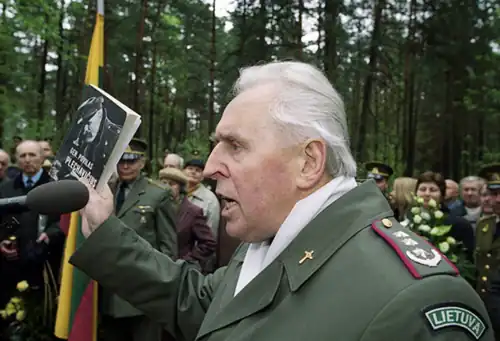 Chaplain Svarinskas preaches

In 1997–1998, he was the Rector of Church of St. Michael the Archangel, Kaunas and Assistant Priest of the Minor Church of the Resurrection of Christ. In 1998–2000, he was the priest at Church of St. John the Baptist in Kavarskas. Since March 30, 2000, he was the priest-resident of Church of St. Peter and St. Paul in Ukmergė.[4] He was buried in the Dukstyna cemetery (Ukmergė district). In 2017, LRT Television created the documentary film "Alfonsas Svarinskas". The authors of the film: Andrius Gudauskas (screenwriter), Juozas Sabolius (director), editor Miroslavas Stankevičius.
In 1996, Svarinskas founded the Didžioji Kova military district Partisan Park in Kadrėnai, and in 2007, he began construction of a monument to Lithuanian Partisans in Kryžkalnis (the Chapel of Kryžkalnis was completed in 2018).
Commemoration
- 1989 Honorary Citizen of Lecco (Italy)
- 1998
 Order of the Cross of Vytis, 3rd degree
 - 2000
 Independence Medal
 - 2001
 Lithuanian Armed Forces Creator-Volunteer Medal
 - 2009 Honorary Citizen of Raseiniai[5]
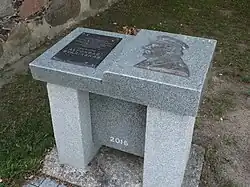
- 2017 Memorial plaque with bas-relief in Viduklė (sculptor Osvaldas Neniškis)
- 2018 Monument in the Kryžkalnis Chapel (sculptor Antanas Kmieliauskas)
References
- ^ a b Mačiukas 2026.
- ^ a b c d e f g h i j LGGRTC 2014.
- ^ veidas.lt 2014.
- ^ anykstenai.lt 2010.
- ^ raseiniai.lt 2013.
Sources
- anykstenai.lt (2010). "Alfonsas SVARINSKAS". Anykštėnų biografijų žinynas (in Lithuanian).
- LGGRTC (2014). "Alfonsas Svarinskas". Genocid.lt. Archived from the original on 11 February 2015.
- Mačiukas, Žydrūnas (2026). "Apie parodą „Kunigas Legenda. Monsinjoras Alfonsas Svarinskas (1925–2014)"". lrs.lt (in Lithuanian).
- Puidokas, Mindaugas (14 September 2018). "Alfonsas Svarinskas". Visuotinė lietuvių enciklopedija (in Lithuanian).
- raseiniai.lt (2013). "Garbės piliečiai". Raseinių rajono savivaldybė (in Lithuanian). Archived from the original on 2 October 2013.
- veidas.lt (28 July 2014). "Nepataisomasis Dievo ir Lietuvos tarnas". veidas.lt (in Lithuanian).
Biography
- Svarinskas, Alfonsas (2014). Stakišaitis, Donatas; Šulcienė, Lina (eds.). Nepataisomasis: Monsinjoro Alfonso Svarinsko atsiminimai (PDF) (in Lithuanian). Vol. I. Vilnius: Versmė. ISBN 978-9955-589-91-4.
- Svarinskas, Alfonsas (2018). Stakišaitis, Donatas; Šulcienė, Lina (eds.). Nepataisomasis: Monsinjoro Alfonso Svarinsko atsiminimai (PDF) (in Lithuanian). Vol. II. Vilnius: Versmė. ISBN 978-609-474-120-3.
External links
- Keli štrichai monsinjoro Alfonso Svarinsko portretui, 2005-03-10 Archived 2014-03-08 at the Wayback Machine
- Erškėčiais grįstas kunigystės kelias, 2009-10-02 Archived 2016-03-04 at the Wayback Machine
Documentary films about Svarinskas
- Dokumentinis filmas „Kas jūs, kunige Svarinskai?..“, 1987 m.
- Dokumentinis filmas „Alfonsas Svarinskas“ 2017 m. Archived 2019-01-17 at the Wayback Machine
- Alfonsas Svarinskas - documentary film by LRT in 2017 (Author Dr. Andrius Gudauskas and director Juozas Sabolius)
Svarinskas' website
- https://www.prodeoetpatria.lt/ - website founded by Alfonsas Svarinskas