This is a list of air cargo and airmail related events as well as a summary for the decade 1920–1929 (references to be found via the main Wikipedia links where not explicitly referenced here):
Summary for the decade
(Based on the content of this page where unreferenced:)
Civil Developments
Early airlines appeared worldwide, often with airmail as a main driver for the business and routes. Many new routes were tried and scheduled. Landmark long-distance and overseas flights were performed, demonstrating the potential of air travel, airmail and air cargo, while also raising public awareness of aviation's possibilities.
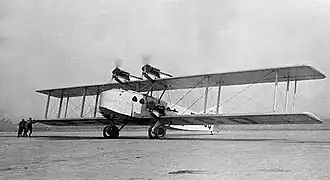
In Europe, the foundations of modern air cargo and airmail were established, driven by surplus aircraft and personnel from World War I. Former military bombers such as the Farman F.60 Goliath were converted for civilian use, carrying both passengers and freight.[1]
In the United States, airmail as well as commercial air freight services expanded over the continent. The Kelly Act (1925) triggered a spate of airline foundations and reorganizations in the U.S. because private companies could now bid for airmail routes. Commercial air cargo volumes in the United States saw explosive, near-exponential growth in the late 1920s.[2]
Aircraft reliability improved in the 1920s, enabling longer scheduled services and even overwater flights, but capacity for cargo remained limited. The focus was largely on light, high-value items such as letters, newspapers, diplomatic documents, medical supplies, and luxury goods. Cargo handling was rudimentary: there were no standard containers or mechanised loading systems, and many airports were simple ex-military airfields.[1]
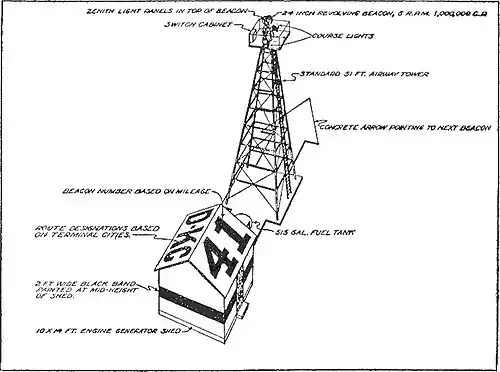
The introduction of visual airway beacons and the start of the transition to radio-based navigation (low-frequency radio ranges, NDB/RDF developments) within the same decade, were developments that gave a crucial advance making night and all-weather airmail / air cargo operations more reliable.
By the end of the 1920s, although air transport was still far from replacing rail or sea freight, it had proven itself as a rapid conduit for crucial goods. The decade laid critical groundwork: operational models combining cargo and passenger services, nascent air-freight networks, and more mature aircraft technology. These developments set the stage for the expansion of international air cargo in the decades that followed.[1]
Military Developments
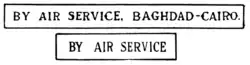
Military air transport roles continued to shape early civil routes, often to colonial destinations: military squadrons and aircraft (e.g., RAF aircraft and later larger types such as the Vickers Vernon) were used for early airmail routes (for example Cairo–Baghdad service), and some military-style aircraft were repurposed for civilian mail/cargo duties.
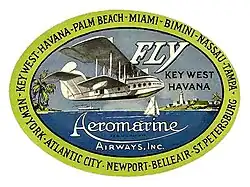
The first airmail arrives at Amsterdam Schiphol Airport via KLM in a rented De Havilland DH-16 from LondonPhotograph of airmail loaded for U.S. pathfinding transcontinental flightSorting airmail in U.S.Aeromarine baggage label
Undated – (Cuba) First airmail flight in Cuba by Cuban aviator Jaime González.[3]
July 5 – (Netherlands - England) First airmail from the Netherlands to England by KLM pilot Hinchcliffe with the Airco DH.9 G-EAMX. KLM signed an agreement with the Dutch Royal Mail (signed on March 29, 1920) thus securing the transportation of airmail between the two cities.[5]
September 8 – (United states) The United States Post Office's transcontinental airmail service final leg is added, across the Rocky Mountains from Omaha, Nebraska to Sacramento, California. Because flying at night is dangerous, the mail is carried along the route by train during the hours of darkness. The route significantly reduced coast-to-coast mail transit time compared to rail: A train alone needed 108 hours to cross the continental United States coast to coast, but this mix of air and rail decreased the time to 78 hours.[7][8][9]
Croydon Airport, August 1929Baghdad-Cairo Desert Route cachets
Undated – (United Kingdom) The world's first cargo handling warehouse opens at Croydon airport in South London, facilitating the handling and storage of national and international goods transported by air via the airport.[11]
Undated – (United States) First U.S. airmail night flights. Concerned that the transcontinental U.S. Air Mail service established in September 1920 had turned out to be little faster – although much more expensive – than train-only service because the United States lacks a system of lighted navigation beacons, meaning that air mail pilots could not fly safely at night and trains had to carry air mail along the route during the hours of darkness, Assistant Postmaster General of the United StatesOtto Praeger stages four experimental day-and-night air mail flights as a publicity stunt before incoming PresidentWarren G. Harding can take office on March 4 and appoint his successor. The flights consist of two eastbound and two westbound trips between New York City and San Francisco, California. The two westbound flights become stranded in Dubois, Pennsylvania, and Chicago, Illinois. The first eastbound flight ends in tragedy when the de Havilland DH-4B carrying the mail stalls and crashes after takeoff from Elko, Nevada. The only real success is by the second eastbound flight, whose pilot manages to fly at night from North Platte, Nebraska, to Chicago.[12]
Undated – (United Kingdom) The world's first airline to transport a racehorse is said to be Instone Air Line in this year. Instone is probably also the world's first airline to transport live animals because of another transport: a grouse from Scotland to London; undated but between 1919 and 1924).[4]
December 5 – (Australia) First regular scheduled (airmail + passengers) air service in Australia by Western Australian Airways (Norman Brearley). Western Australian Airways (established Dec 1921) won a subsidised airmail/passenger contract and inaugurated services that same month.[14]
1922
Airplane on the inaugural flight of the first Qantas service from Charleville to Cloncurry, Queensland, 1922
November 2 – (Australia) Qantas started scheduled service between Charleville and Cloncurry after the first major air contract was landed in November 1922, its first regular airmail/passenger route.[15]
November 15 – (Japan) First scheduled passenger / cargo airline services in Japan, linking Sakai, Osaka, and Tokushima. It was the Sakai-Takamatsu route, established by Inoue Choichi's Japan Air Transport Research Institute. It operated three round-trip flights per week, handling both passengers and cargo, with a one-way fare of 40 yen.[16]
1923
Fokker T-2 - DPLA
April – (United Kingdom / Iraq) Aircraft of the British Royal Air Force's Iraq Command flew 280 Sikh troops from Kingarban to Kirkuk in the first British air trooping airlift operation.
May 2–3 – (United States) First U.S. nonstop transcontinental flight — Lts. Oakley G. Kelly and John A. Macready flew a Fokker T-2 nonstop across the U.S. (Roosevelt Field → San Diego area), showing the potential for long-range point-to-point air transport (implications for transcontinental mail/cargo routing and for heavier transport aircraft design).[17][18]
Unloading Airmail in Omaha, Nebraska on July 1, 1924The Fokker VII at the airport in Medan where it was the first aircraft to land on the flight between the Netherlands and the Indies on November 24, 1924
October 1 - November 24 – (Netherlands - Indonesia} KLM's first intercontinental test flight to the Dutch East Indies, an intercontinental proving flight from Amsterdam toward Batavia (Jakarta) using a single-engine Fokker F.VII (registration H-NACC) carrying 281 pieces of mail.[24]
1925
Stout 2AT-2Hadley Field first arrived bag of overnight airmail
February 2 – (United States) Air Mail Act of 1925 (Kelly Act) passed. U.S. Congress passed the Contract Air Mail Act, permitting the Post Office to contract private companies to carry airmail. This law is widely seen as the legal/financial trigger for commercial airlines; it created the market (paid mail routes) that allowed private carriers and manufacturers to grow.[25]
April 20 – (Japan) First scheduled airmail services in Japan. Seeing the success of the scheduled passenger/cargo airlines started in 1922, the Ministry of Communications began experimental air transport of mail using these routes.[16]
July 1 – (United States) The United States Post Office Department inaugurates 24-hour transcontinental air mail service. Previously, mailplanes had not flown at night and trains had carried the mail during the hours of darkness, but the completion of a coast-to-coast system of lighted beacons has allowed night flying to become practical along the entire route. The day-and-night flying allows the transcontinental air mail service to deliver mail notably faster than train-only service for the first time.[26]
February 15 – (United States) First commercial contract airmail flights start after the Post Office began turning airmail routes over to private carriers under the 1925 "Kelly Act" (Contract Air Mail / CAM) legislation.[30]
May 20 – (United States) Air Commerce Act signed into law by President Coolidge. This created the first federal framework for civil aviation in the U.S.: pilot/aircraft licensing, safety rules, and the Department of Commerce role in fostering air commerce; a major regulatory milestone that shaped safe, reliable air routes used by mail and cargo carriers.[31]
June 1 – (United States) Florida Airways established the first daily air passenger service in the United States to be operated over a Federal air mail contract route. Stout 2-AT Pullman "Miss Miami"
May 20-21 – (United States - France) Charles Lindbergh's solo New York to Paris flight with the "Spirit of St. Louis" made aviation a mass-media phenomenon ("the Lindbergh Boom"), raised public & investor interest in commercial air transport and airmail, and helped accelerate expansion of passenger and mail services worldwide.
(United States) U.S. air mail is now fully operational under commercial contracts (CAM system completed) after the Kelly Act (1925) and ensuing awards - the U.S. Post Office had transitioned the last government-flown transcontinental mail to commercial Contract Air Mail carriers.
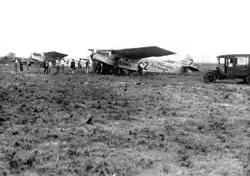
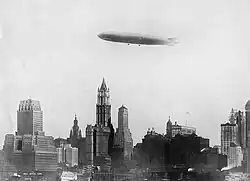
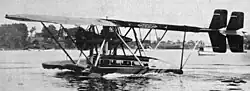
Leaside aerodrome, first regular airmail deliveryFokker F.VIIa P-POZM with Lorraine 12Eb engineGraf Zeppelin over New York City 1928
February 20 – (Cuba) Havana (Pan-American) Convention on Commercial Aviation finalized to set out early rules for commercial aviation among American states (sovereignty, freedoms, etc.), helping to clear the way for international air services (including airmail/cargo) across the Americas.[36]
March 8 – (United States) The Foreign Airmail Act broadened the authority of the United States Post Office Department in the field of international airmail. The legislation authorized the Post Office to enter into contracts, lasting up to ten years, for the transportation of mail between the United States and foreign countries or U.S. insular territories.[37]
May 17 – (United States) An amendment to the Air Mail Act of 1925 allowed air carriers that had satisfactorily operated mail routes for at least two years to exchange their existing contracts for air mail route certificates with terms of up to ten years. The amendment was intended to safeguard airline investments in aircraft and equipment, whose service life exceeded that of the original short-term contracts. During this period, airmail contracts represented the principal source of revenue for most U.S. airlines.[37]
July 17 – (United States) Thompson Aeronautical Corporation (TAC) won Contract Air Mail route 27 (CAM 27) from the U.S. Post Office, servicing the Chicago-Muskegon-Bay City-Pontiac, MI, route, starting service on July 17, 1928, with 6 Stinson Detroiter aircraft.[38]
September 18 – (Germany - United states) First flight of the LZ 127 Graf Zeppelin followed by first transatlantic commercial/airship flight and airmail delivery in October.
December 4 – (United States) The Aeronautics Branch issued regulations governing the entry and clearance procedures for aircraft transporting foreign cargo and passengers into the United States. The regulations took effect on February 1, 1929.[37]
December 12–14 – (United States) International Civil Aeronautics Conference (Washington, D.C.), a high-level international conference convened (with Presidential involvement) to evaluate civil aviation's progress and future — helped set global attention (and some technical/policy exchange) around standards, safety and international cooperation that would shape future airmail and commercial air services.[39]
Inter-Island Airways (Hawaiian Airlines) Sikorsky S-38 on the bay at Kona, HawaiiSikorsky S-38 Pan American Airways L'Aéronautique March,1929DH.61 Apollo Airmail 1929DLZ127 Round the World 1929
February – (United States - Panama) Charles Lindbergh piloted Sikorsky S-38 operations for Pan Am in February 1929, inaugurating key Miami - Cristóbal (in the Panama Canal Zone) airmail/passenger operations. Pan Am rapidly secured Pan-American air-mail routes and by mid-1929 was moving scheduled airmail south into Colombia/Peru/Chile, creating persistent air-mail supply lines across the Americas.[42]
(Japan) The Japan Air Transport Corporation (JAT) began scheduled airmail and air cargo services.
(United States) Thompson Aeronautical Corporation (TAC) opened an overnight mail route from Bay City to Cleveland, via Detroit.[38]
April 23 – (Australia) The first airmail to Brisbane by QANTAS, using a de Havilland DH.61 'Apollo' aircraft. This marked a milestone in Australian aviation, establishing a regular airmail service to the city from other Qantas routes.[44]
August 8 - September – (Germany) LZ 127 Graf Zeppelin round-the-world flight carrying souvenir/official mail. The rigid airship Graf Zeppelin departed Lakehurst 8 August 1929 on its celebrated circumnavigation; part of the trip's financing and public interest came from carriage of souvenir and official airmail on the entire circuit (Lakehurst - Friedrichshafen - Tokyo - Los Angeles - Lakehurst). This flight is one of the iconic 1920s "air-post" spectacles — enormous mail and philatelic interest.
This decade, the following airlines or air cargo related companies or organizations were founded that were or would become important for air cargo and airmail history:
1920
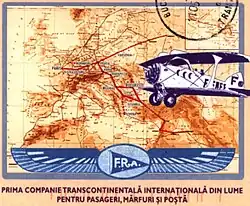
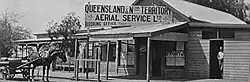
Maefort logo, 1920Compagnie franco-roumaine de navigation aérienne (CFRNA), PosterThe early office of QANTAS, between 1920 and 1930
Undated – (Hungary) Maefort, or Magyar Aeroforgalmi Rt. (Hungarian Air Transport Joint Stock Company) - initially founded to carry mail. The company added passenger services in 1921.[45]
Undated – (Belgian Congo) Ligne Aérienne du Roi Albert (LARA) - a short-lived colonial airline (1920–1922) set up to exploit an aerial route along the Congo River using Levy Lepen hydroplanes. LARA carried ~2 tonnes of mail during its short existence and opened long riverine legs where ground infrastructure was absent.
Undated – (New Zealand) Mount Cook Airline - had its origins NZ Aero Transport Co. in Timaru, which later evolved into Mount Cook Air Services and Mount Cook Airline (a regional NZ operator until merged into Air New Zealand in 2019). The early company ran sightseeing and local passenger/freight routes and helped pioneer regional air access (including carrying freight/mail in rural New Zealand).
January – (Norway) A/S Aero - a short-lived Norwegian firm founded by Tancred Ibsen, operating demonstration, advertising and limited mail flights in summer 1920 from the Oslo area.
January 1 – (France) CFRNA (Compagnie franco-roumaine de navigation aérienne) - a French–Romanian airline that operated Paris ↔ Central / Eastern Europe routes and later renamed CIDNA (and eventually merged into Air France in 1933). CFRNA provided passenger, mail and cargo services on transcontinental European routes (Paris - Bucharest via key stops). It's often described as the first operative transcontinental airline in aviation history.
November 16 – (Australia) Qantas (Queensland and Northern Territory Aerial Services Ltd.) - founded in Winton, Queensland; later grew into Australia's flag carrier. Qantas began as a regional operator connecting remote communities in the Australian interior and performed early mail/passenger duties across the outback, Australia's sparsely settled areas.
1921
Aeromarine baggage label, 1921
Undated – (Estonia) Aeronaut (A-S Aeronaut) ; Aeronaut - the first Estonian airline, operating international/regional routes from Tallinn (Tallinn–Helsinki, Tallinn–Stockholm, Tallinn–Riga–Königsberg and domestic lines). By creating scheduled international links from 1921 onward it helped integrate Estonia into early Northern/ Baltic airmail networks.
Undated Spring – (United States) Aeromarine West Indies Airways - founded / reorganized: reorganized as Aeromarine Airways in spring 1921 (original company began 1920; organized operations through 1921). The airline transported passengers, mail and freight beginning in 1921 and is credited as one of the first U.S. international airlines to carry U.S. airmail and express cargo (Key West–Havana services). It's noteworthy as an early U.S. international mail/cargo carrier and as one of the "first total-service" airlines (passenger + mail + express).
May 10 – (Poland) Aerotarg (Poznań Airline Society "Aero-Targ") - established to serve the Poznań International Fair and carried airmail for the Polish Post (special stamps issued). Its short-lived operations nevertheless included regular Poznań–Warsaw and Poznań–Danzig flights, transporting about 3,000 kg of parcels during the fair. Ceased operations 16 June 1921.
July 12 – (Mexico) Mexicana de Aviación (Compañía Mexicana de Aviación) - Mexico's first airline and one of the world's oldest single-brand carriers. Mexicana developed domestic and international routes and later operated a dedicated cargo subsidiary (Mexicana Cargo, noted in historical records for the 1980s). As Mexico's primary early carrier it was a major conduit for domestic airmail and later for scheduled freight/cargo operations in the country and region. Ceased operations 28 August 2010.
November 24 – (Germany - Russia) Deruluft (Deutsch-Russische Luftverkehrs A.G.), a German–Soviet joint airline - a formal international air carrier connecting Germany and Soviet Russia — initially focused on official passengers and postal traffic.[46]
December 5 – (Australia) Western Australian Airways, renamed West Australian Airways 1926 - founded by Norman Brearley. The company bid for and received government subsidised air-mail & passenger contracts in 1921 and later won Australia's first interstate airmail contract (Perth–Adelaide in 1928/1929). It was Australia's first scheduled airline and a pioneer in using aircraft for rural/long-distance mail and freight distribution.
1922
Dornier Mercur of Deruluft at the inauguration of Stettin Airstrip in 1927. From left Swedish communications minister Carl Meurling and Stockholm vice-mayor Yngve Larsson.
June – (United States) Model Airways - an experimental scheduled flight service operated by the U.S. Army Air Service. It served as a pilot program to demonstrate the feasibility of military and commercial air transport within the United States. The program was designed to test the logistics of moving personnel and cargo on fixed schedules, establishing a precursor to modern operational support airlift. Service began between Bolling Field (Washington, D.C.) and McCook Field (Dayton, Ohio), and quickly grew to encompass a network of 10 airfields, including Scott Field in Illinois and bases in Texas. The service primarily utilized modified de Havilland DH-4 biplanes, which were two-seater aircraft originally built for combat during World War I. In total by 1926 over 1.2 million miles were flown, and more than 1,200 passengers and approximately 62,000 pounds of cargo were carried. The program was disbanded in 1926 following the passage of the Air Commerce Act, which restricted government agencies from competing with private aviation enterprises. The Model Airways is considered the first large-scale scheduled airline service in the U.S. and a foundational model for national airway networks, but also it allowed the Army to develop standard procedures for cross-country flying, including the use of landing fields, beacons, and aeronautical charts.[47]
June 3 – (Poland) Aerolot (Polska Linja Lotnicza / Aerolloyd) - the first regular airline in the Polish lands and built Poland's early scheduled route network (Danzig–Warsaw–Lwów and later other links). Aerolot became the nucleus of the later national carrier LOT.
July 31 – (Latvia / Germany) Latvijas Gaisa Satiksmes Akciju Sabiedriba (Latvian–German airline) - founded as a Junkers-backed regional operator flying international services in the Baltic region and carried freight and mail on its Osteuropa/Union routes. It was part of the early European web of scheduled services that transported passengers, cargo and postal consignments between capitals.
November 19 – (Hungary) Malert (Magyar Légiforgalmi R.T.) - established Hungary's scheduled air links in the 1920s (Budapest - Vienna / Belgrade / Warsaw / Prague etc.) and was the principal Hungarian inter-capital operator in the interwar years; those scheduled services were used for mail and light cargo as part of state and commercial postal arrangements.
1923
A poster calling for Soviet citizens to buy stock in DobrolyotSabena Belgian Air Line poster from the 1930s
Undated – (United Kingdom) British Marine Air Navigation Co. Ltd. - a short-lived early UK operator with marine/floatplane focus and carried both passengers and mail, though it is best known for its passenger services. The company began operating the world's first scheduled flying boat service in 1923, with flights to Cherbourg, Le Havre, and the Channel Islands.
Undated – (United States) Florida Airways - an early U.S. regional carrier that later participated in the CAM (Commercial Air Mail) era.
January 1 – (France) Air Union - one of the main French operators of the 1920s that carried passengers, mail and freight on domestic and international routes; its network and equipment later became part of the national consolidation that formed Air France in 1933, which carried major airmail and air-freight contracts.
March – (Soviet Union) Dobrolyot (precursor of Aeroflot) - established in the Soviet Union as the Russian Society of Volunteer Air Fleet; its charter explicitly included mail and cargo services and airport/weather-station construction.
March 16 – (United States) Bee Line - reorganised in 1926 as Colonial Air Transport and won/operated CAM airmail routes in the U.S. (CAM-1 and other early subsidized airmail routes).
May 23 – (Belgium) Sabena (Société anonyme belge d'Exploitation de la Navigation aérienne) - the Belgian national flag carrier created to take over the pioneering SNETA services. Sabena carried international and colonial mail/cargo (and later freight) across Europe and to Belgian colonies.
June – (Soviet Union) Ukrpovitroshliakh / Ukrvozdukhput - the first USSR regional airline; one of the early Soviet carriers running passenger and mail/cargo services.
October 6 – (Czechoslovakia) Czechoslovak Airlines (ČSA) - one of the oldest continuously operating carriers (until recent cessation). ČSA began with domestic Prague–Bratislava services and quickly took on government postal/transport tasks — essential to establishing reliable domestic air mail and later international cargo/passenger links in Central Europe.
November 1 – (Finland) Finnair - founded as Aero O/Y with first operations and early flights following in 1924. Early operations used Junkers F.13 floatplanes and carried mail as well as passengers.[48]
December – (Italy) Aero Espresso Italiana (AEI) - ran international routes in the eastern Mediterranean (Brindisi–Athens–Istanbul / Rhodes) and operated flying-boat services that carried international airmail as well as passengers.
1924
Imperial Airways Fly There PosterLogo of Syndicato Condor Lda., Brazilian airline (1927-1943)
Undated – (United States) Johnson Flying Service - one of the oldest U.S. mountain/supplemental carriers; although not primarily an airmail carrier, it provided early commercial air services in remote regions (charter, freight, later forest-service support).
Undated – (Slovakia) Slov-Air - began as a corporate/utility flying section (Bata) in 1924; historically focused on agricultural, utility and later helicopter/medical work rather than scheduled airmail it had limited direct impact on early international airmail systems but was notable for specialised cargo/utility aviation in Czechoslovakia/Slovakia.
March 27 – (Sweden) AB Aerotransport (ABA) - an early Swedish national carrier which quickly established international and regional routes and began carrying mail (Stockholm–Helsinki and later mail links to Amsterdam/London).
May 5 – (Germany / South America) Condor Syndikat (German trade/air operations, active 1924–1927) - a German venture operating in South America, carrying passengers and mail on early Rio–Porto Alegre services and helped establish German airline commercial interests.
September 3 – (Tajikistan) Tajik Air - the first regular airline service in (what is now) Tajikistan — crucial for connecting remote mountain settlements where surface transport was slow or impossible; airmail and small cargo delivery to highland valleys were immediate and lasting uses of these routes.
1925
Fokker-Grulich F.II of the Swiss airline Balair, with Swiss registration CH-151, 1926 . This aircraft was converted from a Fokker-built F.II by Deutsche Aero Lloyd's technical manager Karl Grulich and had a 230 hp (170 kW) BMW IV engine. (Photo has been manually retouched.)Western Air Express Fokker F.10 side
Undated – (Switzerland) Belair / Balair - the early Balair (Balair I) operated seasonal services and performed government-subsidized routes that included mail carriage; by 1930 it had already carried passengers, cargo and notable quantities of mail (32–143 tons reported in early years).
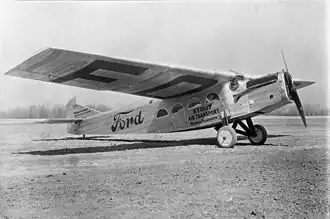
Undated – (United States) Stout Air Services - founded by William B. Stout, closely linked to Stout (and Ford) aircraft production. It was one of the earliest regularly scheduled passenger carriers in the U.S. and carried mail/cargo on early routes. Stout's operations and aircraft (Stout 2-AT and later the Stout 3-AT which developed into the Ford Trimotor) were used on airmail and freight services.
January 19 – (Italy) Società Anonima Navigazione Aerea (SANA) - founded in Genoa as an Italian seaplane operator concentrating on western Mediterranean routes (Genoa–Rome–Naples–Palermo and international links). It carried passengers and postal shipments by flying boat — an important element in Mediterranean airmail and freight in the interwar period. Merged into Ala Littoria in 1934.
February – (Poland) Towarzystwo Komunikacji Lotniczej Aero (Aero S.A.) - one of the Polish carriers of the mid-1920s carrying passengers and mail; Aero later merged into the national consolidation that formed LOT Polish Airlines.
March 2 – (United States) Huff Daland Dusters - started as an aerial crop-dusting company, was not a mail or cargo carrier, but it grew into Delta Air Lines, currently one of the world's largest airlines, carrying passengers, mail and cargo.
April 19 – (United States) Ryan Airline Company - founded in San Diego and ran one of southern California's earliest scheduled services (Los Angeles–San Diego). Ryan built and operated mail and small passenger services (Ryan M-1 and other types) and operated early scheduled feeder routes that supported mail/cargo networks.
May 21 – (United States) National Air Transport - founded for the purpose of carrying parcels and to compete for Contract Airmail (CAM) routes, was awarded several CAM routes and became a major U.S. airmail carrier. It is bought by Boeing in 1930 to later become United Airlines.[2][54]
July 13 – (United States) Western Air Express (later Western Airlines) - formed to bid for and operate Contract Airmail Routes (CAMs).
September 15 – (Bolivia) Lloyd Aéreo Boliviano (LAB) - commenced service 23–24 Sep 1925 and was Bolivia's flag carrier from 1925 until 2010. LAB operated domestic and later international passenger and freight services. In early decades it carried significant volumes of mail and cargo in a country where air links were crucial for connecting remote regions.
1926
Fokker F.II D-783 Luft Hansa Dübendorf - between 1926 and 1930
October 14 – (United States) The Materiel Division of the U.S. Army Air Corps was set up by combining the former Air Service's Airplane Engineering Division and Fairfield Aviation General Supply Depot under the newly established Army Air Corps. It undertook USAAC's aviation research & development, flight testing, procurement, supply and maintenance activities.[55]
July – (United States) Thompson Aeronautical Corporation (TAC) - organized in July 1926 and won early Contract Air Mail routes from the U.S. Post Office. In 1931, the airline-operating side of Thompson Aeronautical became a subsidiary of the parent company operating as Transamerican Airlines Corporation (TAC)[38]
September 15 – (Argentina) Aeroposta Argentina S.A. - an Argentine airline established as a subsidiary of the French airmail carrier Aéropostale (Compagnie générale aéropostale). In 1929, Aéropostale expanded its airmail network within South America, including the first domestic air services on routes to Asunción, Paraguay, Santiago de Chile, and the Argentine cities of Bahía Blanca, Comodoro Rivadavia and Río Gallegos. The task of opening the new air routes was assigned, among others, to the French aviators Antoine de Saint-Exupéry and Jean Mermoz. Saint-Exupéry served as director of the newly formed company based in Buenos Aires, while Mermoz was appointed chief pilot. Saint-Exupéry conducted Aeroposta's inaugural flight on 1 November 1929, from the airfield at Villa Harding Green to Comodoro Rivadavia.
1928
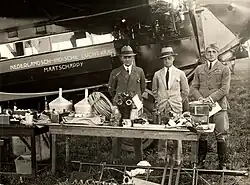
Cargo of a Dutch East Indies NILM Fokker airliner heading / headed for Jakarta, Indonesia (a Dutch colony at that time). The pilots (from left to right): J.J. Mol, S. Elleman, M. van Hazelen). Schiphol airport Amsterdam, the Netherlands, 1928.
July 16 – (Dutch East Indies) KNILM - Koninklijke Nederlandsch-Indische Luchtvaart Maatschappij (in English: Royal Dutch Indies Airways) - the flag carrier of the former Dutch East Indies, originally founded as NILM. Headquartered in Amsterdam, KNILM was not a subsidiary of the better-known KLM (Royal Dutch Airlines), despite the similar name. The airline had its headquarters in Amsterdam and an office in on the grounds of Tjililitan Airfield (current Halim Perdanakusuma International Airport) in Batavia (current Jakarta). KNILM did not fly to the Netherlands, as the Amsterdam-Batavia weekly service was operated by KLM.[56] Its operations facilitated the transport of airmail, freight, and people across the Dutch East Indies and to other parts of Southeast Asia. [57]
October 30 – (Japan) Japan Air Transport Corporation (JAT) - established by the Japanese government the as the national flag carrier under the Ministry of Communications. JAT absorbed the Japan Air Transport Institute and two other small companies and began scheduled airmail and air cargo services in 1929.
December 29 – (Poland) LOT Polish Airlines - formed from a merger and commenced scheduled operations 1 January 1929; airmail was carried from the beginning of the company's existence.[58]
1929
Union Airways airliner ZK-AEG Karoro at Milson aerodrome, Palmerston North about 4 November 1936
March – (United States) Railway Express Agency (REA) - an early American air freight agent. In March 1929, the assets and operations of American Railway Express Inc. (founded 1918) were transferred to Railway Express Agency (REA). REA was owned by 86 railroads in proportion to the express traffic on their lines; no one railroad or group of railroads controlled the agency. In response to customer demand, REA added a Chicago-based refrigerator car line. In 1927, REA began an Air Express Division.[60]
March 5 – (Chile) Línea Aérea Nacional (LAN) - Chile's government-sponsored postal/airline (often styled as Línea Aeropostal Santiago–Arica) was established to provide domestic air service and postal carriage.[61]
July 24 – (South Africa) Union Airways - a national/regionally focused carrier whose early role included airmail.[62]
First flights
This decade, the following aircraft that were or would become important for air cargo and airmail history had their first flight:
216 Squadron RAF Vickers Victorias at Ismailia, Egypt, c1929 (A A Koch)A Luft Hansa Dornier Do J II f Bos, registered D-AFAR and named Samum in Bathurst (1938)
August 22 – (United Kingdom) Vickers Type 56 Victoria - a British biplanefreighter and troop transport aircraft used by the Royal Air Force. The Victoria flew for the first time in 1922 and was selected for production over the Armstrong Whitworth Awana. Eight Victorias of 70 Squadron played an important part in the Kabul Airlift of November 1928–February 1929, when in severe winter conditions, RAF aircraft evacuated diplomatic staff and their dependents together with members of the Afghan royal family endangered by a civil war. The aircraft also helped to pioneer air routes for Imperial Airways.[63]
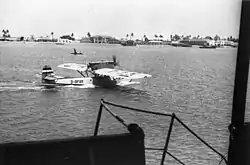
November 6 – (Germany) Dornier Do J Wal ("whale") designated Do 16 - a twin-engine German flying boat of the 1920s designed by Dornier Flugzeugwerke. Numerous airlines operated Wals on scheduled passenger and mail services with great success. The biggest and last versions of the Wal, the eight and ten tonne variants (both versions also known as Katapultwal[64]), were operated by Lufthansa on their South Atlantic airmail service from Stuttgart, Germany to Natal, Brazil.[65]
1923
Blériot Bl-115 prototype F-ESBB. (This aircraft crashed on 23 June 1923; in 1924 it was rebuilt with radial engines as the Bl-135.)
May 9 – (France) Blériot 115 - a French biplaneairliner of the 1920s, best remembered for the part it played in the French exploration of air routes in Africa.
1924
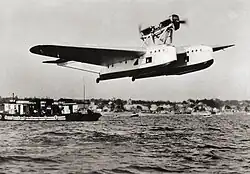
Savoia Marchetti S.55 Taking Off From Manhasset Bay in 1929.
Undated – (Netherlands) Fokker F.VII (A/B, 1m/3m variants) - became a popular single-engine as well as trimotor type for early airlines and airmail routes, as well as for early military transport (C/TA/RA variants).
December 7 – (Italy) Savoia-Marchetti S.55 - a twin-hull flying boat used for long-range mail/record flights.
1925
Douglas C-1 side view. (U.S. Air Force photo)Boeing Model 40 over mountains circa 1930sBlériot 155 airliner F-AICQ Clement Ader. This aircraft was in service from May - October 1926. It crashed on 2 October 1926 as the result of the first in-flight fire on a civil airliner with the loss of 7 lives.
Undated – (United States) Douglas mailplanes (M-1/M-2/M-3/M-4) - a family of 1920s American single-seat mail planes designed and built by the Douglas Aircraft Company. The aircraft were used to run the main routes of the United StatesAir Mail service until the introduction of three-engined aircraft in 1928.[66]
January 3 – (United Kingdom) Fairey Fox - a British light bomber and fighterbiplane of the 1920s and 1930s, originally produced in Britain for the RAF, but continued in production and use in Belgium long after it was retired in Britain. One aircraft saw some use carrying freight in Papua New Guinea with the Pacific Aerial Transport Company (PAT) for a short time in 1936.[67]
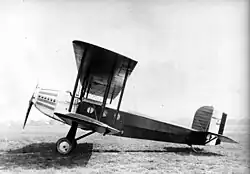
May 2 – (United States) Douglas C-1 - a cargo/transport aircraft produced by the Douglas Aircraft Corporation for the United States Army Air Service starting in 1925. The C-1 was the first aircraft assigned in the new C- category and was the first purpose-built cargo/transport aircraft. It featured an enclosed passenger compartment capable of carrying six passengers or about 2,500 lb (1,100 kg) of cargo. A trap door was placed in the lower fuselage to allow large and/or heavy cargo (particularly aircraft engines) to be lifted directly into the cargo compartment. An auxiliary door for passengers and light cargo was included on the right side of the center fuselage.
July 29 – (France) Blériot 155 (or Bl-155) - a French airliner of the 1920s. It was a four-engined biplane developed from the Blériot 115 and 135, but larger than these aircraft. Two were built for use by Air Union on their Paris-London route. Both were lost in accidents in 1926.
1926
Stinson SB-1 Detroiter NC872 with Northwest Airways IncTravel Air 5000 with National Air Transport in flightQueensland Railways Study Tour of American rail systems, 1929-30West Australian Airways DH.66
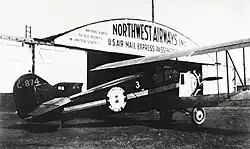
January 25 – (United States) Stinson Detroiter SB/SM variants - a six-seat cabin airliner for passengers or mail/freight, designed and built by the Stinson Aircraft Syndicate, later the Stinson Aircraft Corporation. Two distinct designs used the Detroiter name, a biplane and a monoplane.
February 14 – (United States) Ryan M-1 / M-2 - a mail plane by Ryan Aeronautical.[71] A front cockpit could accommodate two passengers side by side, or one passenger and a sack of mail, or just mail sacks and no passenger.
June 11 – (United States) Ford Trimotor - an American three-enginedtransport aircraft; its rugged, all-metal construction and multi-engine reliability made it a workhorse for early passenger, mail and freight services worldwide; widely used in the airline industry.[66] Mail was carried in the fuselage after the passenger seats were removed to create a cargo area. Some versions of the 5-AT model also had special "drop-down" cargo holds located under the lower inner wing sections to increase capacity.[72]
September 30 – (United Kingdom) De Havilland DH.66 Hercules - a British 1920s seven-passenger, trimotor airliner built by de Havilland Aircraft Company. With the Hercules, Imperial Airways took over responsibility for the airmail service from the Royal Air Force, which had been operating the obsolete Airco DH.10 Amiens. The Hercules effectively provided long-distance service to far-flung regions for Imperial Airways. Although slow, they pointed the way for future airliners.[73]
1927
The Soviet Union 1969 CPA 3828 stamp (Airplane Polikarpov Po-2 (U-2), 1927. Centaur)Lockheed Vega 1 L'Air December 15,1928
Undated – (United States) Stearman C3 - an American-built civil biplane aircraft of the 1920s, designed by Stearman Aircraft of Wichita, Kansas. The C3MB was a special mail-carrying aircraft based on the C3 with the forward cockpit enclosed as a dedicated cargo compartment. This version was operated in 1928 by National Parks Airways on airmail route CAM 26 from Salt Lake City, Utah to Pocatello, Idaho and Great Falls, Montana.[74]
Undated – (United States) Travel Air 4000 - an American general-purpose biplane used for both mail and cargo, as well as for passenger flights, training, and aerobatics. Specialized versions were built or converted to serve as dedicated mailplanes, featuring a mail compartment in place of the front cockpit. Other variants were also used by bush pilots to haul freight to remote areas.[75]
June 24 – (Soviet Union) Polikarpov Po-2 - originally designed as a trainer and utility aircraft, it served a variety of civil and military roles, including the transport of mail, supplies, and personnel, particularly in areas with limited infrastructure. Its ability to take off and land on short, rough, or improvised airstrips made it ideal for operating in remote locations, where larger, more modern aircraft could not easily reach. After World War II, the Po-2 continued in service for many years with various national air forces and civilian operations, with specific mentions of its use for mail delivery in Poland and for general "light transport" with Aeroflot in the Soviet Union.
July 4 – (United States) Lockheed Vega - an American five- to seven-seat high-wing monoplane airliner built by the Lockheed Corporation starting in 1927. It became famous for its use by a number of record-breaking pilots who were attracted to its high speed and long range. Amelia Earhart became the first woman to fly solo across the Atlantic Ocean in one, and Wiley Post used his to prove the existence of the jet stream after flying around the world twice.
1928
Sikorsky S-38 Pan American Airways L'Aéronautique March,1929Star Air Service Curtiss Robin A
Undated – (United States) Loening C-2 Air Yacht - an amphibious airliner, operated in scheduled revenue service and as a mail freighter/air-ferry in the late 1920s–1930s.[76]
Undated – (United States) Loening C-4C, later the Keystone-Loening K-85 Air Yacht - an amphibious utility biplane built in the United States in the late 1920s, following the merger of the Loening and Keystone companies. It was operated on scheduled regional routes carrying passengers and mail/freight.
April 15 – (United States) Travel Air 6000 (later known as the Curtiss-Wright 6B when Travel Air was purchased by Curtiss-Wright) - a six-seat utility aircraft, a.o. operated in 1928 by National Air Transport on their US mail and passenger routes from Chicago to New York, Chicago to Dallas and Chicago to Kansas City.[77]
August 7 – (United States) Curtiss Robin - introduced in 1928, is an American high-wing monoplane built by the Curtiss-Robertson Airplane Manufacturing Company. The aircraft was used for U.S. ontract air mail routes, rural newspaper delivery (dropping bundles), and general mail transport in other countries. It carried light cargo, often alongside passengers or in place of rear seats and was used as a military transport.[79]
December 29 – (United States) Boeing Model 95 - a single-engine biplane built to supplement Model 40 mail operations.
1929
Pitcairn PA-7 Sport Mailwing Aero Digest April,1930Blériot 195 left front L'Aéronautique April,1929Flying Boat Dornier Do X
Undated – (United States) Waco JYM / JWM (mail variants) - small-series Waco variants marketed/used for mail carriage.
January 15 – (United States) Stearman M-2 Speedmail (nicknamed the Bull Stearman) - a mail-carrier aircraft produced by the Stearman Aircraft Company of Wichita, Kansas. The Speedmail was a single-seat biplane, with two large cargo compartments in place of a front cockpit.
March 9 – (France) Blériot 195 - a monoplane long-range mail plane design of which only one aircraft was built.
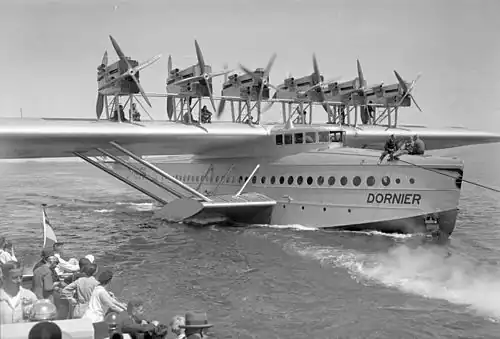
July 12 – (Germany) Dornier Do X - the largest, heaviest, and most powerful flying boat in the world when it was produced by the Dornier company of Germany in 1929. First conceived by Claude Dornier in 1924,[80] planning started in late 1925 and after over 240,000 work-hours it was completed in June 1929.[81] Although mainly a passenger transport plane, the Do X and other Dornier flying boats were considered for mail/air postal duties on long stretches and experimental routes, but never used for the purpose.
Context
The air cargo and airmail events of this decade took place within the following historical context:
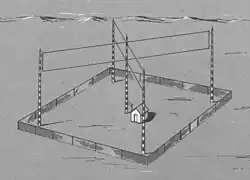
LightLaneTower(United Kingdom, Europe and the United States) Networks of airway beacons (or: aerial lighthouses) were established during the 1920's and 1930's, improving night/all-weather airmail operations and encouraging dependable mail/cargo schedules. Reliable ground aids were essential for scheduled airmail and commercial cargo services.[82][83]
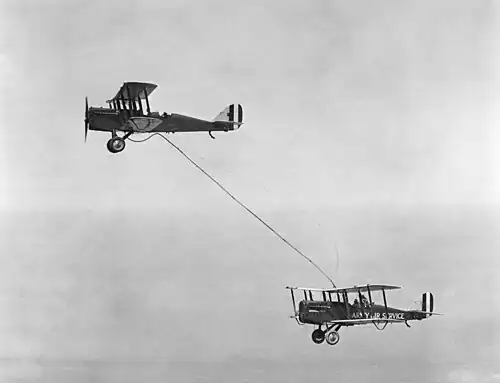
Refueling, 1923June – (United States) First demonstration of inflight refuelling (beginning June 1923) — The U.S. Army Air Service demonstrated fuel transfer between two Airco DH-4B planes (demonstration in late June; a record endurance refuelled flight followed in August). This proved the concept that would later enable extended-range transport and military air-supply missions.[84][16]
Early low-frequency radio station based on crossed loop antennas; later installations used Adcock antennas for improved performance.February – November – (United States) Introduction / operational rollout of the low-frequency "four-course" radio range (LFR / AN range) and expansion of airway radio beacons in the U.S. used on revenue airmail routes, starting with demonstrations / first operational ranges in early 1928, followed by revenue flights later in the year. These ground-based radio beams and beacon/light networks made scheduled night and all-weather airmail/cargo operations safer and more reliable.[85]
Eddie Hubbard piloted the Boeing B-I flying boat shown here from 1920 to 1927, flying air mail on the first regularly scheduled international airmail route between Seattle and Victoria, B.C.. The plane could carry two passengers plus mail and cargo. After seven years of service without losing a single piece of mail, the B-1 was retired from airmail service in 1927. The plane now hangs on exhibit at the Museum of History & Industry in Seattle.
U.S. Airmail poster advertising the ten-cent rate, 1927. This airmail poster reminded its audience that airmail is good for business. It announces that the "first to arrive gets first attention". Text at the bottom of the poster reminds readers of the new ten cents per half-ounce airmail rate. The poster includes an illustration of a biplane at the top. Businesses were generally supportive of airmail service and were among its most frequent users during the service's first decade. The Post Office Department used this poster increase that customer base. The price for airmail bounced up and down over the next few years, with rates tied to different levels of service, including distance. On February 1, 1927, when this poster was published, airmail rates were set at ten cents per half-ounce.
Air Union Orient poster for airmail by seaplane into the Mediterranian, c.1929
^Ballantine, Collin and Pamela Tang. "Chinese airlines: airline colours of China." Airlife, 1995. p. 6. Chinese Ministry of Communications which declared Eurasia to be a Chinese State-owned airline. The airline then fell into more trouble as a direct result of the continuing Japanese occupation. The fleet of airliners was based in Hong Kong[...]"
^Ballantine, Collin and Pamela Tang. "Chinese airlines: airline colours of China." Airlife, 1995. p. 5. "The outcome of this venture was Eurasia Airlines, operating six- seater Junkers W33 airliners across Asia into China."
^1 May 1930 Timetable (Archive). KNILM. Retrieved on 22 August 2014. "Hoofdkantoor en agentschappen AMSTERDAM Hoofdkantoor, N. Spiegelstraat 5[...]BATAVIA Hoofdkantoor voor Indië, Sluisbrug[...]na 5 uur Mtg 671. Vliegveld Tjilitian"
^Andrews, C.F.; Morgan, E.B. (1988). Vickers Aircraft since 1908. London: Putnam. ISBN 0-85177-815-1.
^Das Flugzeug im Zeppelin-Konzern und seinen Nachfolgebetrieben. Tübingen; Berlin: Ernst Wasmuth Verlag; Zeppelin Museum Friedrichshafen. 2006. ISBN 3-8030-3316-0.


.jpg)
.jpg)


.jpg)
.jpg)



.jpg)
.jpg)

.jpg)
.jpg)






.jpg)

_-_LBS_SR01-01983.tif.jpg)


.jpg)


.jpg)
.jpg)



%252C_1927._Centaur).png)


.jpg) Eddie Hubbard piloted the Boeing B-I flying boat shown here from 1920 to 1927, flying air mail on the first regularly scheduled international airmail route between Seattle and Victoria, B.C.. The plane could carry two passengers plus mail and cargo. After seven years of service without losing a single piece of mail, the B-1 was retired from airmail service in 1927. The plane now hangs on exhibit at the Museum of History & Industry in Seattle.
Eddie Hubbard piloted the Boeing B-I flying boat shown here from 1920 to 1927, flying air mail on the first regularly scheduled international airmail route between Seattle and Victoria, B.C.. The plane could carry two passengers plus mail and cargo. After seven years of service without losing a single piece of mail, the B-1 was retired from airmail service in 1927. The plane now hangs on exhibit at the Museum of History & Industry in Seattle..jpg) U.S. Airmail poster advertising the ten-cent rate, 1927. This airmail poster reminded its audience that airmail is good for business. It announces that the "first to arrive gets first attention". Text at the bottom of the poster reminds readers of the new ten cents per half-ounce airmail rate. The poster includes an illustration of a biplane at the top. Businesses were generally supportive of airmail service and were among its most frequent users during the service's first decade. The Post Office Department used this poster increase that customer base. The price for airmail bounced up and down over the next few years, with rates tied to different levels of service, including distance. On February 1, 1927, when this poster was published, airmail rates were set at ten cents per half-ounce.
U.S. Airmail poster advertising the ten-cent rate, 1927. This airmail poster reminded its audience that airmail is good for business. It announces that the "first to arrive gets first attention". Text at the bottom of the poster reminds readers of the new ten cents per half-ounce airmail rate. The poster includes an illustration of a biplane at the top. Businesses were generally supportive of airmail service and were among its most frequent users during the service's first decade. The Post Office Department used this poster increase that customer base. The price for airmail bounced up and down over the next few years, with rates tied to different levels of service, including distance. On February 1, 1927, when this poster was published, airmail rates were set at ten cents per half-ounce..jpg) Air Union Orient poster for airmail by seaplane into the Mediterranian, c.1929
Air Union Orient poster for airmail by seaplane into the Mediterranian, c.1929