| Æthelweard |
|---|
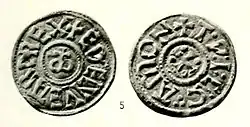 The obverse and reverse of a coin from the reign of Æthelweard. |
|
| Reign | c. 845 – 25 December 854 |
|---|
| Predecessor | Æthelstan |
|---|
| Successor | Edmund |
|---|
|
| Died | 854 |
|---|
Æthelweard (died 854) was a 9th-century king of East Anglia, the long-lived Anglo-Saxon kingdom which today includes the English counties of Norfolk and Suffolk. Little is known of Æthelweard's reign and even his regnal dates are not known for certain. He was succeeded by Edmund, who was said to have been crowned on 25 December 854.
9th century East Anglia
Prior to the arrival of the Vikings, the 6th century Kingdom of the East Angles was rich and powerful, with a distinctive ecclesiastical culture. Between this time and the early Norman period, practically nothing is known of the history of East Anglia, except that the kingdom was rich and powerful enough to remain independent. Its kings are in some cases known only from the coins issued during their reigns.[1] According to the historian Barbara Yorke, Viking attacks eventually destroyed all the East Anglian monasteries, where books and charters would have been kept.[2]
Life and reign of Æthelweard
As with Æthelstan, whom he succeeded, textual evidence for Æthelweard's reign is very limited. He is not mentioned in the Anglo-Saxon Chronicle. However, numismatic evidence in the form of surviving coinage suggests that he was the ruler of an independent kingdom and not subject to Mercia or Wessex. The date when Æthelweard became king is uncertain, but it is conventionally dated to the middle or late 840s. It appears that he died in 854. He was succeeded as king by his fourteen-year-old son Edmund, later known as Saint Edmund, who was said to have been crowned on 25 December 854.[3]
References
- ^ Campbell, The Anglo-Saxons, p. 135
- ^ Yorke, Kings and Kingdoms of Early Anglo-Saxon England, p. 58
- ^ Kirby, The Earliest English Kings, p. 161
Sources
External links
|
|---|
|
- [c] co-kings
- [km] also king of Kent and king of Mercia
- [m] also king of Mercia
- [s] sub-kings
- [d] Danes
|
|
|---|
| Territories/dates[1][2][3][4][5][6][7][8][9][10][11][12][13][14][15]
|
Northumbria
|
Mercia
|
Wessex
|
Sussex
|
Kent
|
Essex
|
East Anglia
|
| 450–600
|
Sub-Roman Britain
|
Kingdom of Bernicia
Esa · Eoppa · Ida · Glappa · Adda · Æthelric · Theodric · Frithuwald · Hussa
|
Kingdom of Deira
Ælla
Æthelric
|
Kingdom of Mercia
Icel
Cnebba
Cynewald
Creoda
Pybba
Cearl
Penda
Eowa
Peada
|
Kingdom of the Gewisse
Cerdic
Cynric
Ceawlin
Ceol
Ceolwulf
Cynegils
Cwichelm
Cenwalh
|
Kingdom of the South Saxons
Ælle
Cissa
Æthelwealh
|
Kingdom of the Kentish
Hengest
Horsa
Oisc
Octa
Eormenric
Æðelberht I
Eadbald Eorcenberht
Eormenred
Ecgberht I
Hlothhere
|
Kingdom of the East Saxons
Æscwine
Sledd
Sæberht
Sexred
Sæward
Sigeberht the Little
Sigeberht the Good
Swithhelm
Sighere
Sæbbi
Sigeheard
Swæfred
Offa
Saelred
Swæfberht
Swithred
Sigeric
Sigered
|
Kingdom of the East Angles
Wehha
Wuffa
Tytila
Rædwald
Eorpwald
Ricberht
Sigeberht
Ecgric
Anna
Æthelhere
Æthelwold
Ealdwulf
Ælfwald
Beonna
Alberht
Æthelred I
Æthelberht II
|
| 600–616
|
Æthelfrith
|
| 616–632
|
Edwin
|
| 632–634
|
Eanfrith
|
Osric
|
| 633–644
|
Oswald Oswiu
|
| 645–648
|
Oswiu
|
Oswine
|
Penda
|
| 648–651
|
Cenwalh
Seaxburh
Cenfus
Æscwine
Centwine
Kingdom of the West Saxons
Cædwalla
Ine
Æthelheard
Cuthred
Sigeberht
Cynewulf
Beorhtric
Ecgberht
|
| 651–654
|
Œthelwald
|
| 655–658
|
Kingdom of Northumbria
Oswiu · Ecgfrith · Aldfrith · Eadwulf I · Osred I · Coenred · Osric · Ceolwulf · Eadberht · Oswulf · Æthelwald Moll · Alhred · Æthelred I · Ælfwald I · Osred II · Æthelred I · Osbald · Eardwulf · Ælfwald II · Eardwulf · Eanred · Æthelred II · Rædwulf · Æthelred II · Osberht · Ælla · Osberht
|
Oswiu
|
| 658–685
|
Wulfhere
Æthelred I
Cœnred
Ceolred
Ceolwald
Æthelbald
Beornred
Offa
Ecgfrith
Coenwulf
Kenelm
Ceolwulf I
Beornwulf
Ludeca
Wiglaf
|
| 685–686
|
Eadric
|
| 686–771
|
Ecgwald · Berthun · Andhun · Nothhelm · Watt · Bryni · Osric · Æthelstan · Æthelbert
|
Mul · Swæfheard · Swæfberht · Oswine · Wihtred · Alric · Eadbert I · Æðelbert II Eardwulf · Eadberht II · Sigered · Eanmund · Heabert · Ecgbert II · Ealhmund
|
| 771–785
|
Offa
|
| 785–794
|
Offa
|
| 794–796
|
Offa
|
| 796–800
|
Eadberht III Præn
Cuthred
|
Eadwald
|
| 800–807
|
Coenwulf
Ceolwulf I
Beornwulf
|
| 807–823
|
Coenwulf · Ceolwulf I · Beornwulf
|
| 823–825
|
Ecgberht
|
| 825–826
|
Ecgberht
|
| 826–829
|
Æthelstan
Æthelweard
Edmund
Oswald
Æthelred II
Guthrum
Eohric
Æthelwold
Guthrum II
|
| 829–830
|
Ecgberht
|
Sigeric II
|
| 830–837
|
Wiglaf
Wigmund
Wigstan
Ælfflæd
Beorhtwulf
Burgred
Ceolwulf II
Æthelred
Æthelflæd
Ælfwynn
|
| 837–839
|
Ecgberht
Æthelwulf
Æthelbald
Æthelberht
Æthelred I
Alfred the Great
|
| 867–872
|
Northern Northumbria
Ecgberht I
|
Southern Northumbria
Military conquest by the Great Heathen Army
|
| 872–875
|
Ricsige
|
| 875–886
|
Ecgberht
Eadwulf II
|
Halfdan Ragnarsson · Guthred · Siefredus · Cnut · Æthelwold · Eowils and Halfdan
|
| 886–910
|
Kingdom of England
Alfred the Great
Edward the Elder
|
| 910–918
|
Eadwulf II · Ealdred I
|
| 918–927
|
Ealdred I
Adulf mcEtulfe
|
Ragnall ua Ímair · Sitric Cáech · Gofraid ua Ímair
|
Edward the Elder
Æthelstan
|
| 927–934
|
Æthelstan
|
| 934–939
|
Æthelstan
|
| 939–944
|
Olaf Guthfrithson · Amlaíb Cuarán · Sitric II · Ragnall Guthfrithson
|
Edmund I
Eadred
|
| 944–946
|
Edmund I
|
| 947–954
|
Osulf I
|
Eric Bloodaxe · Amlaíb Cuarán · Eric Bloodaxe
|
| 955–1066
|
Eadwig · Edgar · Edward the Martyr · Æthelred the Unready · Sweyn Forkbeard · Æthelred the Unready · Edmund Ironside · Cnut · Harold Harefoot · Harthacnut · Edward the Confessor · Harold Godwinson
|
| 1066
|
Norman Conquest
|
 Rulers of medieval Wales |
- ^ Rulers with names in italics are considered fictional
- ^ Mackenzie, E; Ross, M (1834). An Historical, Topographical, and Descriptive View of the County Palatine of Durham. Vol. I. Newcastle upon Tyne: Mackenzie and Dent. p. xi. Retrieved 28 February 2012.
- ^ Downham, Clare (2007), Viking Kings of Britain and Ireland: The Dynasty of Ívarr to A.D. 1014, Edinburgh: Dunedin, ISBN 978-1-903765-89-0, OCLC 163618313
- ^ Woolf, Alex (2007), From Pictland to Alba, 789–1070, The New Edinburgh History of Scotland, Edinburgh: Edinburgh University Press, ISBN 978-0-7486-1234-5, OCLC 123113911
- ^ Zaluckyj, Sarah & Feryok, Marge. Mercia: The Anglo-Saxon Kingdom of Central England (2001) ISBN 1-873827-62-8
- ^ Barbara Yorke (1995), Wessex in the early Middle Ages, A & C Black, ISBN 071851856X; pp 79-83; table p. 81
- ^ Kelly, S. E. (2004). "Kings of the South Saxons (act. 477–772)". Oxford Dictionary of National Biography (online ed.). Oxford University Press. doi:10.1093/ref:odnb/52344. Retrieved 3 February 2017. (Subscription, Wikipedia Library access or UK public library membership required.)
- ^ Keynes, Simon (2014). "Appendix I: Rulers of the English, c.450–1066". In Lapidge, Michael (ed.). The Wiley-Blackwell Encyclopedia of Anglo-Saxon England. Chichester: John Wiley & Sons. ISBN 978-0-470-65632-7.
- ^ Kirby, D. P. The Earliest English Kings. London and New York: Routledge. ISBN 978-0-4152-4211-0.
- ^ Lapidge, M.; et al., eds. (1999). "Kings of the East Angles". The Blackwell Encyclopedia of Anglo-Saxon England. London: Blackwell. ISBN 978-0-6312-2492-1.
- ^ Searle, W. G. 1899. Anglo-Saxon Bishops, Kings and Nobles.
- ^ Yorke, B. 1990. Kings and Kingdoms of Early Anglo-Saxon England.
- ^ Carpenter, Clive. Kings, Rulers and Statesmen. Guinness Superlatives, Ltd.
- ^ Ross, Martha. Rulers and Governments of the World, Vol. 1. Earliest Times to 1491.
- ^ Ashley, Michael (1998). British Monarchs: the Complete Genealogy, Gazetteer, and Biographical Encyclopedia of the Kings & Queens of Britain. London: Robinson. ISBN 978-1-8548-7504-4.
|
|
|